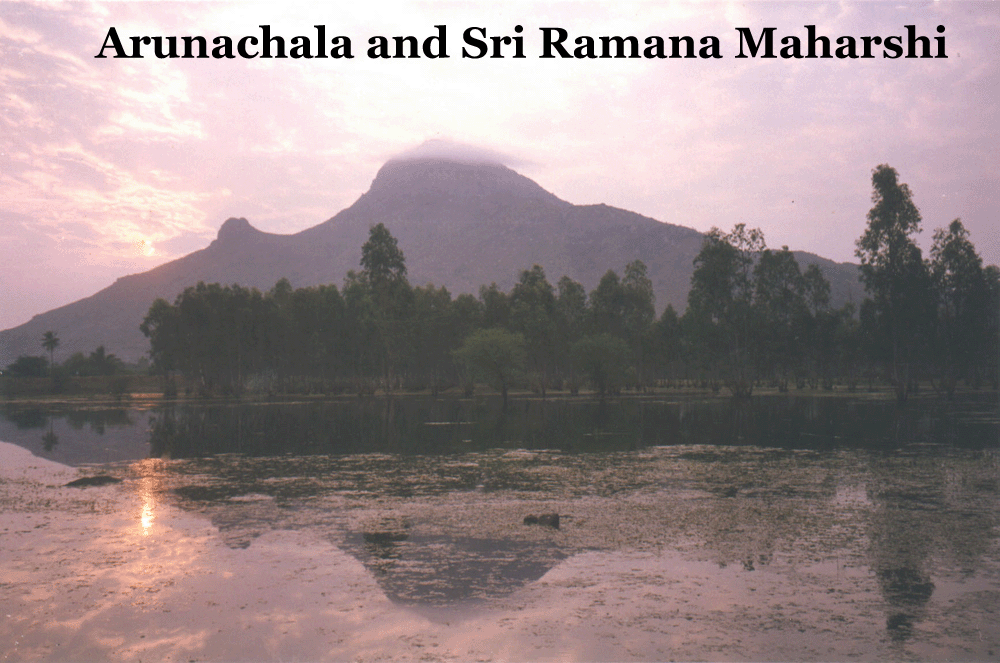
On May 7th I posted an account of Bhagavan’s ‘death-experience’ in Madurai that culminated in his Self-realisation. Today I am providing some additional material on this event. Some of it comes from Sri Ramana Leela, the Telugu biography that was written by Krishna Bhikshu. The first edition of Sri Ramana Leela was just a translation of Narasimha Swami’s Self Realization, but subsequent editions added new material. Bhagavan’s description of his Self-realisation experience is part of this new material.
This Telugu account is surprisingly short, but it does have interesting additions and variations from the English version that was recorded by Narasimha Swami. The translation I am giving here is by Mohan Rao. The original text is in bold, with supplementary words that are not in the original Telugu given in square brackets. Mohan Rao’s linguistic notes are in italics, while my comments and supplementary quotations are in roman.
In 1896, Nagaswami [Bhagavan’s older brother] married Janaki Ammal. The in-laws’ place was Madurai itself. At the post-wedding festivities, Venkataraman was the fellow-bridegroom to his brother. [It was his] seventeenth year. [He] was studying for the Matriculation examination. Though [he was] not that studious a person, there was no fear of failing in the examination. [He was] well-built, [having] good health; half of July had passed.
The Telugu term translated here as ‘post-wedding festivities’ is a phrase that describes the celebrations that go on for three days after traditional weddings.
‘Fellow-bridegroom’ is a term that denotes a young boy who is made to sit by the side of the bridegroom throughout the celebrations to give him some company and to prevent him from getting bored during the long hours of the rituals. The term is sometimes inaccurately translated as ‘best man’.
On the upper storey, Venkataraman was lying down. Nobody [else] was in there. Suddenly, it occurred to Venkataraman, ‘I shall be dead’. There was no reason. ‘Am dying!’
Narasimha Swami’s account has Bhagavan ‘sitting alone’ when the fear of death came. In that account Venkataraman ‘dramatised the scene of death’ by lying down and imitating a corpse. Krishna Bhikshu has him lying down when the fear of death first struck him. This means that he didn’t need to dramatise the scene of death by subsequently lying down and pretending he was dead.
‘There was no reason for feeling like that. It did not occur to me what that state was, and whether fear was proper or not. The thought of asking the elders or the doctors did not come. What is dying? How to escape it? This alone was the problem. There were no other thoughts. That very moment, [I] had to resolve it.’
The word translated as ‘reason’ in this and the previous Bhagavan paragraph can also be translated as ‘cause’.
‘Whether fear was proper or not’ is a literal translation. Idiomatically, it may mean ‘whether it was something to be feared or not’.
The word translated as ‘escape’ can also be translated as ‘avoid’.
The word translated as ‘problem’ may also mean ‘issue’.
Narasimha Swami filled his own account with the first-person pronoun ‘I’, but in a note that accompanies the text, he pointed out that this was not what Bhagavan himself said:
The exact words [of the death experience] have not been recorded. The Swami as a rule talks quite impersonally. There is seldom any clear or pronounced reference to ‘I’ and ‘you’ in what he says. The genius of Tamil is specially suited for such impersonal utterances, and he generally talks Tamil. However, one studying his words and ways discovers personal references, mostly veiled. His actual words may be found too colourless and hazy to suit or appeal to many readers, especially of the western type. Hence the use here of the customary phraseology with its distinct personal reference.
My own feeling is that in this particular description the insertion of the personal pronoun ‘I’ into Bhagavan’s description is misleading.
‘Dying means, the legs become stiff; lips become taut; eyes get closed. Breath stops. So it came into experience due to intensity of the strength of feeling. To me too, the legs became stiff, lips became taut, eyes got closed and breath stopped. But with consciousness not lost, everything was breaking forth clearly. (The activity of the outer sense-organs having gone, the in-turned perception became available.)’
‘Was breaking forth’: the original is actually in the active voice. An acceptable alternative translation would be 'everything was being cognised clearly'.
Again, it is the ‘intensity of the strength of feeling’ that drove the process, rather than a personal act of volition.
‘Even if this body dies, the I-consciousness will not go. The individuality- consciousness was clear. When the body is burnt and turned to ashes in the cremation ground, I will not become extinct. Because I am not the body.’
The word translated as ‘consciousness’ may also be translated as ‘awareness’ in both instances.
‘Individuality’ is a translation of vyaktitva. It may also be translated as personality, but 'individuality' is probably a better term here.
‘Now the body is inert. Insentient; I, on the other hand, am sentient. Therefore, death is to the inert body, ‘I’ am [the] indestructible conscious entity.
‘When the body gives up its activities, and the activities of the senses are not there, the knowledge that obtains is not senses-born. That ‘flashing forth of I’ is aparoksha. [It is] self-effulgent. Not a matter of imagination.
Aparoksha means 'not indirect', i.e., 'not obtained through the intervention of the senses and the mind'.
The ‘flashing forth of I’ is a reference to the aham-sphurana. Bhagavan elaborated on this part of the experience when he spoke to a visitor in 1945:
Yesterday a Bengali Swami in ochre robes by name Hrishikesanand came here. This morning from 8-30 to 11-00 Bhagavan continuously discussed spiritual matters with him…
… Bhagavan said, ‘In the vision of death, though all the senses were benumbed, the aham sphurana (Self-awareness) was clearly evident, and so I realised that it was that awareness that we call “I”, and not the body. This Self-awareness never decays. It is unrelated to anything. It is Self-luminous. Even if this body is burnt, it will not be affected. Hence, I realised on that very day so clearly that that was “I”.’ (Letters from Sri Ramanasramam, 22nd November, 1945)
Devaraja Mudaliar was also present during this retelling of Bhagavan’s death-experience, but he omitted the aham sphurana reference from his brief record of the dialogue:
Later in the morning, at Rishikesananda’s request, Bhagavan recounted his first experience of the Self in his upstairs room at Madura. ‘When I lay down with limbs outstretched and mentally enacted the death scene and realised that the body would be taken and cremated and yet I would live, some force, call it atmic power or anything else, rose within me and took possession of me. With that, I was reborn and I became a new man. I became indifferent to everything afterwards, having neither likes nor dislikes.’ (Day by Day with Bhagavan, 22nd November 1945)
In ‘“I” and “I-I”, a Reader’s Query’ (http://www.davidgodman.org/rteach/iandii1.shtml) I came to the conclusion that the following explanation from Vichara Sangraham (Self-Enquiry) is also a description by Bhagavan of what happened to him during his own death experience. My arguments in favour of this position can be found in the original article:
Therefore, leaving the corpse-like body as an actual corpse and remaining without even uttering the word ‘I’ by mouth, if one now keenly enquires, ‘What is it that rises as “I”?’ then in the Heart a certain soundless sphurana, ‘I-I’, will shine forth of its own accord. It is an awareness that is single and undivided, the thoughts which are many and divided having disappeared. If one remains still without leaving it, even the sphurana – having completely annihilated the sense of the individuality, the form of the ego, ‘I am the body’ – will itself in the end subside, just like the flame that catches the camphor. This alone is said to be liberation by great ones and scriptures. (The Mountain Path, 1982, p. 98)
‘The thing that is there after death is the eternal, real entity.’ In this way, in one moment, new knowledge accrued to Venkataraman.
'Accrued': The Telugu text uses a verse in the active voice, but there is no good equivalent in English. 'Accrued' is therefore adapted for the purpose, though it is slightly inaccurate. The alternative is to use the passive form 'is obtained'. But then it agrees neither with the voice of the verb, nor with the preposition 'to'.
Although these ideas were expressed sequentially, this experience was obtained by Venkataraman spontaneously only.
‘Expressed’: the literal rendering would be ‘spoken’, but ‘expressed’ is taken to be equally permissible.
‘Sequentially’: the dictionary equivalent is 'by degrees', but 'sequentially' is thought to be equally valid.
This is the end of the Telugu account. The translator noted in an email that the style and idiom of the original Telugu was very archaic. This might indicate that the words were not exactly the ones used by Bhagavan. However, my own conclusion is that this is a more reliable account of the death-experience than the one that appears in Self Realization since it has been shorn of both Narasimha Swami’s embellishments and his gratuitous insertions of the pronoun ‘I’.
I particularly like the final comment that realisation was obtained ‘spontaneously’, rather than as the result of a sequence of thoughts or actions.
How long did this ‘spontaneous’ process take? Most chroniclers have reported that it took a few minutes:
In answer to a question once put by D. S. Sarma, Bhagavan definitely said that in his case, there was no special sadhana, at any rate in this life, leading to Self-realisation, but that in his 17th year, while he was still a student at Madurai, enlightenment, jnana, came to him, suddenly, in the course of a few minutes, not as a result of laboured ratiocination but as a sudden flash of intuition, and that that jnana has remained with him ever since. (My Recollections, p. 135, by Devaraja Mudaliar)
Bhagavan, though, regarded it as an event that took place out of time. The following interesting exchange was recorded by Balaram Reddy in My Reminiscences. p. 75:
‘They say I gained realisation in twenty-eight minutes, or half an hour. How can they say that? It took just a moment. But why even a moment? Where is the question of time at all?’
I then asked Bhagavan if there was ever any change in his realisation after his experience in Madurai. He said ‘No. If there is a change, it is not realisation.’
Though Krishna Bhikshu’s account seems to me to be more reliable for the events it covers, there is a remarkable omission in his narrative: there is no reference to the spontaneous act of self-enquiry that occurred to Bhagavan while he was lying on the floor. This, more than anything else, was the immediate prior cause of the awakening. In the death-experience account that I posted on May 7th Bhagavan is recorded as saying: ‘So the question arose in me, “What was this ‘I’? Is it the body? Who called himself the ‘I’?”’
Here is Bhagavan’s brief account of how he resolved this question:
When I scrutinised within the mind ‘Who is the seer?’ the seer became non-existent and I saw that which remained. The mind does not [now] rise to say ‘I saw’; how [therefore] can the mind rise to say ‘I did not see’. (Arunachala Ashtakam, verse two, tr. Sadhu Om)
In the ‘“I” and “I-I”, a Reader’s Query’ article I referred to earlier, I equated the aham sphurana with the emanation of ‘I-I’ that Bhagavan often spoke about. If this is a justified correlation, then several of Bhagavan’s other verses can also be take to have autobiographical overtones:
Questioning ‘Who am I?’ within one’s mind, when one reaches the Heart the individual ‘I’ sinks crestfallen, and at once reality manifests itself as ‘I-I’. Though it reveals itself thus, it is not the ego ‘I’, but the perfect being, the Self Absolute. (Ulladu Narpadu, verse 30)
‘Whence does this ‘I’ arise? Seek this within. This ‘I’ then vanishes. This is the pursuit of wisdom. Where the ‘I’ vanished, there appears an ‘I-I’ by itself. This is the infinite [poornam]. (Upadesa Undiyar, verses 19 and 20).
Therefore on diving deep upon the quest ‘Who am ‘I’ and from whence?’, thoughts disappear and consciousness of Self then flashes forth as the ‘I-I’ within the cavity of every seeker’s Heart. (Atma Vidya Kirtanam, verse 4)
Bhagavan commented on the finality of his experience when he spoke to G. V. Subbaramayya:
Sri Bhagavan spoke to me and explained how his spontaneous Self-realisation had by-passed all the usual stages that seekers are enjoined to pass through.
‘Some people,’ he said, ‘start off by studying literature in their youth. Then they indulge in the pleasures of the world until they are fed up with them. Next, when they are at an advanced age, they turn to books on Vedanta. They go to a guru and get initiated by him and then start the process of sravana, manana and nididhyasana, which finally culminates in samadhi. This is the normal and standard way of approaching liberation. It is called krama mukti [gradual liberation]. But I was overtaken by akrama mukti [sudden liberation] before I passed through any of the above-mentioned stages.’
Sri Bhagavan laughed and added, ‘So now when thoughts of these things come to me, I don’t know what to do with them’. (The Power of the Presence, part three, p. 132)
Finally, some comments from Bhagavan on how the death experience affected him in the six weeks he stayed at home before he left for Arunachala:
Mr. T. V. Krishnaswami Aiyer asked, ‘Were Bhagavan’s brother and others aware of Bhagavan’s absorption in the Self and indifference to external things?’ Bhagavan said, ‘Yes. They could not but be aware. For though I tried my best to appear as if I was attending to external affairs, I could not succeed fully in the attempt. I would sit down to read like others, open a book, pretend to read it and after some time turn the page. Similarly, after some time I would take up another book. But all knew that my attitude had changed. They used to make fun of me for this abstraction of mine. I never took offence, as I was totally indifferent to their taunts. This encouraged them to go on with their mockery. If I was so minded, I could have silenced them all with one blow. But I did not care at all. After the “death” experience I was living in a different world. How could I turn my attention to books? Before that, I would at least attend to what the other boys repeated and repeat the same myself. But afterwards, I could not do even that. At school, my mind would not dwell on study at all. I would be imagining and expecting God would suddenly drop down from Heaven before me.’
Someone asked Bhagavan whether he deliberately went in for a study of Periya Puranam. Thereupon Bhagavan said, ‘No. No. It was a mere accident. A relation of mine, my uncle, was given the book by a Swami who was living near our house and was advised to read it. Thus the book happened to be in our house and, coming across it, I looked into it first out of curiosity and then, becoming interested, read the whole book. It made a great impression on me. Before that, the sixty-three images of the Nayanars in the temple were mere images and no more. But afterwards, they gained new significance for me. I used to go and weep before those images and before Nataraja that God should give me the same grace He gave to those saints. But this was after the “death” experience. Before that, the bhakti for the sixty-three saints lay dormant, as it were.’ Mr. Somasundaram Pillai asked Bhagavan, ‘With what bhava did Bhagavan cry before those images? Did Bhagavan pray he should have no further birth, or what?’ Bhagavan replied, ‘What bhava? I only wanted the same grace as was shown to those saints. I prayed I should have the same bhakti that they had. I knew nothing of freedom from births or bondage.’ (Day by Day with Bhagavan, 6th October, 1946)