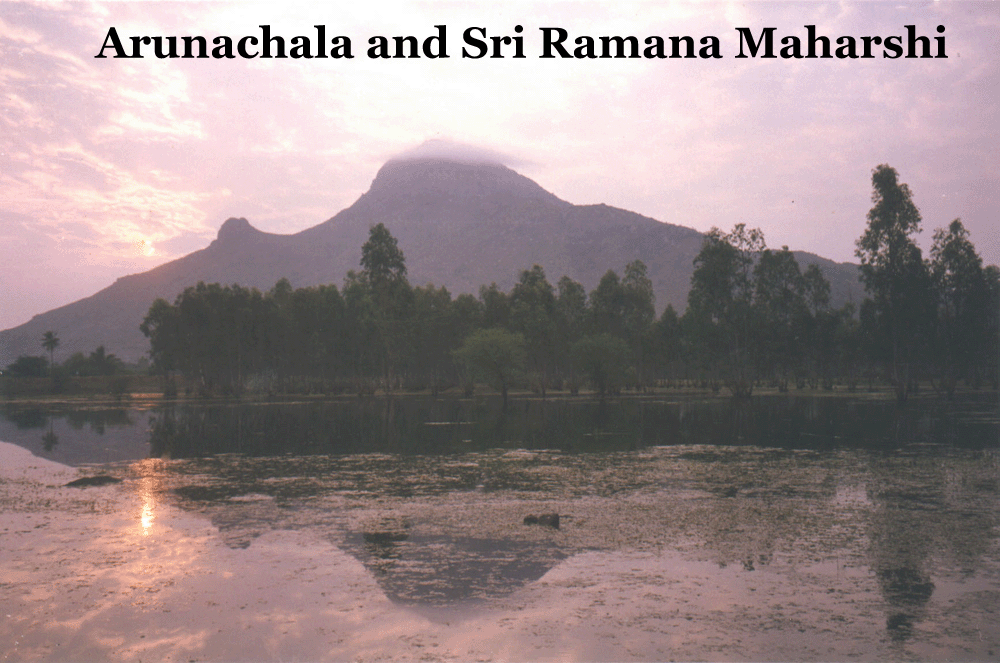
Sri Ramana Paravidyopanishad (The Supreme Science as Taught by Sri Ramana) is a Sanskrit work composed by Lakshmana Sarma in the 1950s. Over the course of several hundred verses he covers, in a systematic way, many aspects of Vedanta and Bhagavan’s teaching. The work was originally serialised in The Call Divine, a magazine that was devoted to Bhagavan, although many other topics were covered. Many of Bhagavan’s devotees wrote for this magazine in the 1950s, and some Ramanasramam publications (Talks with Sri Ramana Maharshi, for example) were serialised there before they appeared as books.
Until recently Sri Ramana Paravidyopanishad had never appeared in book form. About five or six years ago I decided to collect all the instalments, type them out, and put them on my site. A devotee who goes by the pen name ‘Samvid’ spotted the text there and decided to assist Ramanasramam in bringing out a proper edition of the book. This appeared in 2006.
When I was looking up a quotation in this work for my previous post on Swami Siddheswarananda’s views on Bhagavan’s teachings, I ended up reading a long series of verses about the relationship between the mind, the world and the Self. I found myself being impressed, as I had been years ago when I decided to resurrect the text, by the intelligent arrangement of the ideas and the way they move forward in a satisfyingly logical way. I decided to post a long sequence of verses here since I have a suspicion that there are many readers of this blog who are either unaware that the book exists or have simply not taken the trouble to go through it.
Lakshmana Sarma had personal lessons from Bhagavan on the meaning of Ulladu Narpadu, lessons that he encapsulated in books such as Revelation and Maha Yoga. His words and views therefore have substance and authority.
The verses appear in roman type. Lakshmana Sarma’s commentary is in italics. The translation from the original Sanskrit was done by Lakshmana Sarma himself. If there are any readers who would like to go through the original Sanskrit, it can be found in the Ramanasramam edition of the book.
Now we come to the question, ‘Is the world real?’ Bhagavan’s teaching on this point is given in the next seven verses.
84 The Guru, who is a sage, teaches the unreality of the world in accordance with his own experience, also giving reasons supporting it. The disciple who aspires to become free should accept this teaching with perfect faith and [with its help] strive for this goal.
85 The universe, comprising these three – the soul, God and the world of visible objects – is superimposed by the mind on the real Self, which is the sole reality of the supreme state. Hence all this [universe] is just an outcome of ignorance.
The mind is the creator of the universe. Ignorance is the primal cause of the mind. Hence it is said here that this ignorance is the cause of the universe.
86 That being so, when this ignorance is annihilated by the light of awareness of that Self, then, along with it, the consequence of it [the world] will, like the darkness that disappears before sunlight at dawn, cease to appear.
This will become more and more intelligible as we proceed. What is stated above are the actual facts of the Guru’s own experience. The conclusion that follows for the disciple is given next.
87 This universe [we see] shines in the dense darkness of ignorance, but does not shine in the great splendour of the light of Self-awareness. If this universe were real, why does it not shine in the supreme state, lit as it is by the conscious, effulgent light of the real Self?
An axiomatic distinction between the real and unreal, which is implicit in vedantic metaphysics, is next enunciated.
88 That which survives in the experience of the real Self is the supreme state. [That] alone is real. All else is only unreal. This is the distinction between the real and the unreal, revealed to us by the teachings of all the sages.
By this test the world is shown to be unreal. The next verse elaborates on this.
89 Since multiplicity is experienced only in the state of ignorance, it is declared to be unreal. On the other hand, because the unity of the Self is experienced on the liquidation of ignorance, that unity is real.
It may be questioned: ‘If ignorance is total darkness, how can anything be experienced in this state?’ The explanation is that this ignorance is not like perfect darkness, but like a greatly diminished light. In dim light a rope is not invisible; it is merely perceived wrongly as a snake. In the same way, in ignorance, what is real, the Self, is not invisible; it is mistakenly taken to be the world.
The reality is only that which survives in the supreme state.
90 ‘The sole reality is that peaceful Self which shines by the light of its own nature as pure consciousness in the supreme state wherein the world is lost.’ Such is the teaching of our holy Guru.
Here it is shown that the state is one of peace because there is no duality there. This is what we learn from all the Upanishads. This teaching is further confirmed by the analogy of the dream world.
91 As the dream world is known to be unreal for the reason that it vanishes upon waking, so this waking world is also proved to be unreal by its vanishing in the light of the real Self.
It is next pointed out that those who seek to discredit this teaching are those who do not ardently aspire to the supreme state.
92 But ignorant men, who are averse to winning the supreme state, put forth an endless series of arguments, [trying to refute this teaching]. The sages clear the doubts generated by these arguments so that earnest aspirants may not be deluded by them.
The teaching is addressed not to all men, but only to those who aspire to win the supreme state, because they alone are qualified to receive it.
93 This teaching of the unreality of the world is not addressed to those who look upon the body itself as the Self, or consider the Self to be the owner of the body. For these people the world is real, not unreal.
The teaching has to be adapted to the person being taught. The same teaching is not good for all. Here it is shown that he who believes that the Self is not the body, but the owner of it, or the dweller therein, is for this purpose in the same category as the one who believes the body itself to be the Self.
Why is it that the world is real to these people?
94 The teaching – that the trinity of the soul, God and the world is unreal – is indivisible. If one is convinced that one of these is real, the other two also will appear to be real. That is, the teaching must either be accepted as a whole or rejected wholly.
There is no option to split it up and accept it partially, rejecting some of it.
95 To those who seek deliverance, the teaching is that all these three are equally unreal. This teaching must [therefore] be accepted, exactly as it is taught, by those who are earnestly seeking to win deliverance by the extinction of ignorance.
For different aspirants there are different paths prescribed. This particular teaching is addressed only to those who believe that for them deliverance must come by right awareness.
An analogy is next given to explain the indivisibility of the teaching.
96 One who is wise will either accept the teaching as a whole, or reject the whole of it. Who can make use of half of a hen for cooking, reserving the other half for laying eggs?
A hen must be killed and cooked for food, or the whole hen must be allowed to live for laying eggs. The same indivisibility is characteristic of this teaching.
Now we come to a discussion of the objections of those who assert the perfect reality of the world.
On what evidence do they base their belief?
97 To begin with, it needs to be considered why the world is taken to be real. For the burden of proving the reality of the world lies on him that asserts it, [not on those who simply deny it].
98 Everyone who is ignorant [of the real Self] thinks the world is real because it is seen. This is no proof because it proves too much. The same reason would prove the reality of the mirage, the rope in the snake, etc.
Usually, the knowledge that arises from seeing is mixed up with imagination, or a false impression of what is seen. This reason is therefore inconclusive.
The question then arises: ‘What does the seeing of the world prove?’
99 The fact of being seen is not conclusive proof that the world exists exactly as imagined [by the seer]. From the seeing it is proper to infer only that there is a substratum in which the world appears.
In the first verse of Ulladu Narpadu Bhagavan says: ‘Because we see the world, it is indisputable that there exists a first cause [substratum or basic reality] which has the power to appear as many.’ In the same verse he proceeds to reveal, in the light of his own experience, that that substratum is only the real Self, on which are superimposed the four elements of the world appearance, the pictures of names and forms, the seeing individual soul, the screen and the light. The seeing subject and the spectacle seen form the appearance imposed on the substratum. The lighted screen is the substratum. Here the analogy of the cinema show is suggested. The pictures, in which the seer is included, come and go, but the lighted screen exists unaffected throughout. The power by which the appearance is superimposed on the substratum is known as maya. All that is meant by calling the world ‘an effect of maya’ is that things are not what they seem to those who have not known the real Self as it really is.
100 Even scientists have proved that things are not exactly as they appear [to the seer], for they say that the solid-seeming objects are really little more than empty space.
Atomic physics now tells us that the atom is not a solid particle, but a closed space in which electrons are rotating around a nucleus, composed of protons and neutrons, etc. The electrons rotate at different distances from the nucleus. The whole atom thus resembles a solar system. That things are not what they seem is thus indisputable. On the other hand, there is no proof that things are what they seem to be. There is, in fact, an antithesis between appearance and reality. It is this that is called maya, which is the illusion by which reality appears as the world, that spectacle which resembles a cinema-show. Due to this illusion there is ignorance (avidya) which works through the mind that wrongly identifies the body as the Self. For this reason the truth about the world is a profound mystery, one that transcends the human intellect, but it is no mystery to the sage, who alone is competent to tell us the truth as it really is. The next verse points this out.
101 Only the sage who knows the substratum of the world appearance, the reality, by being firmly established in the supreme state, is competent to reveal the truth of the world.
By his unawareness of that truth the common man, being a victim of his ignorance, cannot know the truth about the world.
102 When vision is focused on the outside, who can know the truth, whether of the real Self or of the world? But, with the mind turned inwards, the sage knows the truth of both by the eye of right awareness.
It is with the knowledge of this uniqueness of the sage that the disciple has to approach him and listen to his teaching.
103 Bhagavan, our Guru, has said: ‘The world laughs at the ignorant man, saying, “How can you know me properly unless you know yourself correctly?”’
By this it is meant that the disciple must be humble, knowing the limitations of his own intelligence. Without this humility he cannot be a true disciple.
The next verse is an introduction to the detailed exposition by Bhagavan of the truth concerning the world.
104 Bhagavan, our Guru, being a sage, expounds the unreality of the world by showing that the perception of the world takes place in ignorance. Therefore, the objector’s argument – that the world is real because he sees it – does not avail to prove his contention.
The ignorant man’s vision of the world is vitiated by the fact of his ignorance of his own real Self. This point has been repeatedly pointed out by Bhagavan. To know the world aright, one must first know oneself aright.
The verses that follow show how the seeing of the world is affected and falsified by the primary ignorance.
105 Every creature first identifies his own Self with the body, and thereby concludes that the body is real. Then it comes to believe that all forms that are seen are also real.
Whatever is seen is a form. The initial question therefore is whether forms are real. Everyone who sees comes to the conclusion that all forms are real. But the first step in the process of coming to this conclusion is the mistaken impression that the body is the Self.
True knowledge begins with the understanding that the body is not the Self. In truth, the Self is formless, so whatever is seen is for that very reason not the Self. Though the Self is indubitably real, that reality is instead ascribed to the body. So, a part of the world is mistakenly concluded to be real. This and the succeeding verses are a commentary on the fourth verse of Ulladu Narpadu.
106 Therefore all forms are unreal. To the sage they are not real. What really exists is formless. In right awareness nothing has form. This is further explained as follows:
107 By a single act of vision the ignorant man sees both himself and the world as forms. Since this seeing is illusory, there is no evidence to prove that the world is real.
108 One’s own body and the world are one [indivisible] spectacle; either they are both seen together, or they are both not seen. Does anyone see this world without at the same time seeing the body, which is the form ascribed to the Self?
This fact, that neither the body, nor the world, is seen apart from the other, is something we have never noticed before. We come to know of it for the first time only when the fact is pointed out by Bhagavan. Since the Self is really formless, the whole spectacle is suspect, since it is indivisible.
It may be objected that we see the dream world without a body. The answer to this follows.
109 If it is said that we see the dream world without bodies, [the response is] that there is a body [for the soul] in all the three states. The soul is never bodiless.
Here it is the soul that is spoken of, not the Self. The two are not the same in Bhagavan’s teachings, as will be seen in due course. This and the succeeding verses give the meaning of the fifth verse of Ulladu Narpadu.
110 Every creature has three bodies, a gross one, a subtle one and a causal one: the mind is the subtle body, and ignorance itself is called the causal body.
111 The three bodies mentioned here are also enumerated as the five sheaths. The middle three sheaths are the [same as the] subtle body, and the last sheath is stated to be the causal body.
The gross physical body is identical with the first of the five sheaths, called the food-sheath (annamaya kosa) because it is the product of food. This, being obvious, is not stated in the verse.
112 As long as the three bodies remain undissolved by the light of right awareness, the soul will be embodied. [Only] in the supreme state, wherein all the three are together lost, will there be bodilessness.
113 The mind, by its own force of ignorance, itself creates another body, and also another [dream] world. The sleeper who sees this dream world along with this dream body is not disembodied.
Thus the objection is overcome.
114 Everyone sees both his own body and the world through the eye, which is a part of that very body. How can this seeing be admissible as evidence in this enquiry about the reality of the world?
Since the body is a part of the world, its reality is also in question. It cannot be assumed without proof. But it is so assumed when the eye is appealed to as a witness to the truth of the world. The question of the reality of forms is now further pursued.
115 As is the eye, so is the spectacle, since the nature of the spectacle depends on that of the seeing eye. If that eye is a form, so will be the spectacle. But if the eye is the formless [Self], there will be no seeing of forms at all.
This is a law of nature that Bhagavan reveals for the first time. Seeing with the eye of flesh, which is a form, one sees forms. Seeing with the eye of right awareness as the Self, forms are not seen. So says Bhagavan. This proves that forms are unreal, at least for the purpose of this philosophy.
The subject is further elucidated.
116 In the state of ignorance both the world and the Self are seen as forms. [But] on the extinction of ignorance both are [found to be] formless, because in the supreme state the infinite Self is the eye.
In the true state, which is the supreme state, the Self alone is. It is described as infinite, and therefore formless. There are no objects to be seen, nor is there any real seeing. Hence, forms are unreal. If they were real, they would survive in that state.
117 By the vision of right awareness, the world, along with the soul, merges into the formless, real Self. The sages call that the vision of right awareness, wherein there is neither seer nor spectacle.
118 In that natural state [of the Self] there survives only the Self, which is consciousness, worldless, alone, and without the six modes of change, such as birth, and so on. Hence, it alone is real in its own right.
The world is not real in its own right; it has only a borrowed reality, as will become clear later on.
119 That Supreme Being, the Self, which is perfect as the sole reality, is styled the infinite eye. However, because for that Self in its true state there are no objects to be seen, it is not [really] an eye.
120 The term ‘eye’ has been used in this context by the most holy one [Bhagavan] only to ward off the misconception that it is non-consciousness, [inert]. Thus, the most holy one has conveyed the meaning that the Self is consciousness and the sole reality.
121 It is only by conceiving the formless Self as a form that one sees this world as consisting of forms. All this is really an ignorant superimposition on the formless, infinite reality, the Self.
122 It is only to him that sees himself as having a form that the names and forms appear as real. They have been fabricated by ignorance and superimposed on the nameless, formless Self, which is consciousness.
123 Thus it has been made plain by the Master that the seeing of the world is an effect of the primary ignorance. Thus, the claim that the world is real has been refuted by him. Also, it has been shown by him that the aloneness of the real Self in the true state is real.
124 Our Master confirms this teaching first by showing that the world is mental [inseparable from the mind], then by proving the unreality of the mind and the ego, and finally by teaching that even the primary ignorance is non-existent.
The next verse shows that the world does not exist apart from the mind, and is therefore mental.
125 The world is a totality of the five kinds of sensations, namely sounds and the rest, and nothing else. All these are only mental impressions. Hence, the world is nothing but the mind.
126 If the world were other than the mind, why does it not appear in deep sleep? Therein is the real Self, which is consciousness, and by whose consciousness-light the mind is mind!
The second half of the verse is an answer to the contention, which may be raised by the other side, that the non-seeing of the world in deep sleep is no argument, because it is due to the absence of the mind and the senses of perception in that state. The mind is not conscious by its own nature; its consciousness is derived from association with the real Self. Since that Self survives in deep sleep, the objection is invalid. This reason finds a place in Sri Sankaracharya’s Viveka Chudamani: ‘If the world is real, why then, let it be seen in deep sleep! Since it is not at all seen in it, it is therefore unreal, like a dream.’
127 Only when their minds are functioning does the world appear to men. Therefore, the world in the waking state is mental, as it is in dream.
This parallel between the waking and the dream states is elaborated in the next verse.
128 Just like the waking world, the dream world seems real during the dream. Also, just like the waking world, the dream world, in its own time, is serviceable [for the purposes of life].
The conclusion is stated in the following verse.
129 Just as the dream world is not other than the mind of the dreamer, so the world of things, seen in waking, is not other than the mind of the seer.
Objections to this conclusion are then noticed.
130 Fearing that if it is concluded that the world is mental, then its unreality will be an inescapable conclusion, ignorant [sectarians] seek to prove in a variety of ways that the world exists outside [as an independent reality].
That these disputants have no locus standi in this discussion is first shown.
131 The truth that the world is unreal is taught by the sages only to him who aspires to attain the highest state by the quest of the Self. It is not addressed to others, and hence the contentions of these objections are wholly in vain.
The uniqueness of Vedanta is that no one is coerced by threats of hell or otherwise to accept its highly elusive teachings. It is given out only to those whose minds are ripe and have become receptive to these metaphysical truths. Indeed, Vedanta advises ordinary people not to dabble in vedantic studies. Vedanta makes a distinction between those who are qualified to receive its advaitic teaching and those who are not qualified. This is called the adhikara vada.
The difficulty in accepting the vedantic standpoint is pointed out next.
132 No one is able to know the unreality of the dream world during the dream itself. In the same way, no one is able to know the unreality of the waking world while he is in the waking state.
The primary ignorance dominates the ego mind at all times, either while dreaming or in the waking state, and this is the cause of the inability of most men even to entertain the thought that the waking world may not be real. The disciple is in a better position because of his faith in the competence of his Guru. The Guru, who has the experience of the egoless state, can tell him the truth about the world and of the worldless, egoless state.
The flaw in the contentions of these disputants is next indicated.
133 There is no flawless evidence tending to prove that the world exists outside [apart from the mind of its seer]. But these partisans assume the truth of their contention, which is required to be proved, and then concoct arguments for their case.
The arguments put forward by these disputants, if carefully scrutinised, are found to be based on a subtle process of what logicians call ‘begging the question’.
One such argument is stated and discussed in the following verses.
134 If it is said that the sense impressions of sounds and the rest arise inside the mind, while their cause, the world, lies outside, how is this division of inside and outside to be accepted as unreal?
This argument is not a proof, but a mere assertion. Its inadequacy is seen in that it assumes the reality of the distinction between inside and outside, which is an outcome of the assumption that the body is the Self. In that assumption the body is assumed to be real, without offering any proof of its reality. We have seen that since the body is a part of the world, whose reality is in dispute, this assumption is improper.
135 All the divisions experienced in worldly life appear as real only in relation to the body. No separate proof is offered by them to prove the reality of the body!
Another argument is noticed next.
136 The argument, ‘The mind is small and the world is vast. How can it be within the mind?’ is also mistaken. It has been taught by the sage that it is the mind that is vast [not the world].
137 The mind is vaster than even the sky, and in it are the five elements of creation, the outer space [sky] and the rest. Consciousness in its motionless state is Brahman; the same when moving is mind. Thus it has been made clear [by Bhagavan] that the mind is of the nature of Brahman.
Bhagavan and Vedanta recognise three skies: the outer [physical] sky, the mind-sky and the sky of pure consciousness. This last is styled as a sky, because it contains the mind-sky, which in its turn contains the outer sky and all the worlds.
The fact that the world ceases to appear in deep sleep – wherein the exposition of the mental nature of the world is based – is sought to be countered by the following contention.
[Editor’s note: Lakshman Sarma sometimes uses the word ‘sky’ in this work to denote ‘akasa’, the fifth element that is the all-pervading space. As this verse explains, there are different levels of this ‘sky’.]
138 ‘If you doubt whether or not the world existed during your sleep, then ask those who did not sleep [during the time you slept], and know from their words that the world existed continuously [without a break].’
This is considered by the dvaitins to be an unanswerable argument. But Bhagavan himself, when this argument was stated as a difficulty to be overcome, showed that this also is a case of ‘begging the question’, as will be shown next.
139 This argument, put forward by the ignorant, takes as proved the truth of their main contention. The men who are not asleep are part and parcel of the world under enquiry.
What Bhagavan said on this point is given next.
140 We see these men who did not sleep only after we wake, not in our sleep! No separate proof is offered to prove the reality of these men who did not sleep.
The reason for not accepting the reality of the world was that it is not seen during deep sleep. That same objection holds good in respect of these men who did not sleep when we slept. Hence, this argument of the dualists fails utterly. It would be a valid argument, suggests Bhagavan, if we saw them during our dreamless sleep, which of course is impossible.
These men too have no valid argument for believing the world to be real, as is shown next.
141 Even those who remained awake [while we slept] know the world only by the mind and never otherwise. Hence, for all alike the world is only mental, both in waking and in dream.
Another argument is stated and refuted next.
142 The objectivity of the world is also asserted on the grounds that it appears the same to diverse seers. But the Master refutes the argument by asserting that the diversity of observers is unreal.
This diversity of souls is part of the world illusion. It is therefore no more real than the rest of it. The truth of this point is expounded by Bhagavan in the next verse.
143 Both in dream and in waking this diversity [of souls] is only a mental creation, since in deep sleep, which is mind-free, this diversity does not appear.
144 The mind itself creates the world in the waking state, as it does in dream. But the mind does not know, either in waking or in dream, that this is its own creation.
145 The mind creates the world subject to a superior power [avidya-maya] and therefore is unable to create it to its own liking. The mind, believing the world to be real, is deluded and suffers the woes of samsara.
That the mind has this anomalous power, which is also a weakness, is shown next.
146 This is the very nature of the mind, that it takes as real all that it creates. This is seen in day-dreaming, witnessing dramas, or listening to stories.
These instances are taken from our waking experience itself. They demonstrate this self-torturing quality of the mind, which is even worse in dreams.
The conclusion is then stated.
147 Creation is not other than seeing; seeing and creating are one and the same process. Annihilation is only the cessation of seeing and nothing else, for the world comes to an end by the right awareness of oneself.
The next step is the demonstration that the mind also is unreal. The next verse begins this exposition.
148 As it is settled that the world is mental, the world would be real if the mind were real. However, if the mind is unreal, then the world would also be unreal. Hence, it becomes necessary to enquire whether the mind is real.
But there is a preliminary question to be taken up and answered: the test or tests of reality to be applied.
149 First, it is necessary to enquire by what tests one can distinguish the real from the unreal, because, in [this] enquiry as to what is real, the test of reality approved of by the worldly ones is not valid.
150 The parrot who wishes to eat the fruit of the silk-cotton tree [at last] goes away disappointed. How can the beliefs of one, who thus deludes himself, be accepted as reasonable?
[Editor’s note: The fruits of the silk cotton tree are always green. After a long period of ripening on the tree, they break open, revealing an inner fibrous mass, not an edible fruit. There is a belief that parrots wait near these fruits, hoping that they will ripen into something tasty. The proverb that encapsulates this belief is a metaphor for pointless, ill-informed activity.]
This conduct of the parrot, whether true or not, is proverbial. Man is in the same situation. He expects to reap unalloyed happiness in worldly life and is always disappointed. This demonstrates his capacity for self-deception. Philosophers would not be philosophers if they accepted the credulous views of unthinking men.
Unless used under the guidance of a perfectly competent Guru, the worldly means of knowledge are certain to prove misleading. This truth is expressed in the next verse.
151 The intellect, the sense organs, and the mind are servants of the primary ignorance. Hence, the worldly methods of seeking knowledge do not at all favour success in this enquiry.
The worldly means of knowledge, called proofs, are direct perception, inference, analogy, tradition, and so on. These are understood and practised by logicians and philosophers. In vedantic reasoning these are not to be relied upon for the reason stated, namely that they are naturally the servants of ignorance, having been created in order to protect and confirm that ignorance.
152 The test of reality that is considered good by the worldly is unreliable because it is a child of ignorance. For the sadhakas the reliable test for distinguishing truth from falsehood is that which the sages have stated.
That test is next set forth.
153 That which shines by its own light [of consciousness], without change, and without setting and rising, is alone real. All that is not so is unreal. So say the sages.
This is the test approved of in vedantic metaphysics, and it is that which is used in the Upanishads.
The Bhagavad Gita is next referred to.
154 ‘There is never any [real] existence for the unreal, neither is there any non-existence for the real.’ Thus Bhagavan Sri Krishna himself stated the distinction between the real and the unreal.
Thus, things that appear at certain times and disappear at other times are excluded from the category of the real.
155 What had no existence in the beginning and will not exist after some time is non-existent even in the intervening period [during which it seems to exist]. The notion that anything which appears limited in space or time [is real] is ignorance.
156 The analogy for the real is gold and the analogy for the unreal is jewellery [made of gold]. Gold is real in comparison with jewellery; the latter is unreal because it is perishable.
157 The jewellery was gold before [being made] and it is gold even in the middle [when it appears as jewellery] and also at the end, [when it is melted down]. [Thus] the unrealities appear as real on a substratum of the real, just as unreal jewellery appears as real on a substratum of gold [which is comparatively real].
This is one of the analogies employed in the Chandogya Upanishad to illustrate the truth taught here, that the one supreme reality, which is the real Self, is the substratum of the world appearance.
158 If the two, the world and the mind, are scrutinised in this way, they are found to be unreal. The process of this demonstration, as taught by the most holy one [Bhagavan], is here set forth.
159 The world that is made to shine and the light, namely the mind, which caused the world to shine, arise and set together [as one]. Since this pair does not appear uninterruptedly, the pair should be known to be unreal.
160 Whatever shines intermittently is insentient and therefore shines by the light of another. That [reality], by which all things insentient shine, is self-shining, being consciousness by nature.
Here the light meant is not that of the sun, moon, or lamps, but the light of consciousness.
In the definition of reality two conditions were set out: continuous, uninterrupted shining and the capacity for being self-shining. The two are only one, being inseparable. The first was shown to be fulfilled by the supreme reality alone. The second condition also is here shown to be fulfilled by it alone. Therefore, it alone can be vedantically real. Nothing else, neither the mind, nor the world, meets this definition.
161 We know from the words of our divine Guru that that alone is real which survives in the state of peace, which is the highest, and that all else is unreal.
Thus, by the application of the vedantic test of reality, it has been shown that the inseparable pair, the mind and the world, is unreal, and that the real Self, which is Brahman, is alone real.
Now a doubt is raised and is set at rest in the following verses:
162 ‘If even the mind is unreal, then it will follow that what remains is only a void, since in deep sleep there is nothing at all.’ Those who raise this contention are committing the mistake of forgetting themselves!
163 How can this void be known at all if there is no one to witness it? This void is certainly not without a witness. Hence, this void is not the final reality.
164 This doctrine of the void has thus been clearly refuted by the most holy one. For us, there is not the least doubt on this point because [as demonstrated by Bhagavan], there is the real Self, the sole survivor, in the supreme state.
165 In the Heart of every living creature the self-shining real Self shines by its own light [of consciousness] as ‘I’. Hence, everyone knows himself to be real. Who is there in the world of men who says, ‘I do not exist!’
Thus it is made clear that the Self is self-revealed. This means that knowledge of the Self is by direct experience and not by inference. But many philosophers seem to be unaware of this.
166 The existence of their own Self is inferred by some from mental functioning, by the reasoning, ‘I think, therefore I am’. These men are like those dull-witted ones who ignore the elephant when it goes past, and become convinced afterwards by looking at the footprints!
167 Indeed, everyone experiences his own existence during deep sleep, where the mind is absent. Also, the sleeper manifests remembrance of the happiness [of sleep], saying, ‘I slept happily’.
168 How can anyone remember the happiness experienced by someone else? The happiness of sleep was surely enjoyed by oneself. Does anyone say, ‘He that existed prior to sleep is not the same person as I am now’?
As Bhagavan himself has pointed out, when Johnson goes to sleep, Benson does not awake, but only Johnson.
169 The mind, along with the universe, merges in it [the Self] in deep sleep, and from there it rises again [along with the universe] on waking. Hence the creed of the void is untrue.
170 Without a supporting substratum, how can the two, the universe and the mind, appear at all? Is there anyone who sees the serpent without its basis, the rope, or one who sees silver without its basis, the oyster shell?
171 Surely there does exist a reality-consciousness that lends [an appearance of] existence and shining to the universe [including the mind]. How else can worldly people have the notion that this unreality exists and shines?
172 Because these two shine only by the light [of the Self], therefore that one is self-shining consciousness. Apart from [that] Self there is nothing else, anywhere, which is self-shining.
173 When the real Self shines on the dawn of right awareness, neither the sun nor the moon nor the stars shine. By its light alone do these shine here for the ignorant one, whose mind is turned outwards.
174 There is not the least doubt about the existence of the real Self, because that same [pure] consciousness, by which the whole world shines, and by whose light the mind becomes mind, is the Self.
175 Ignorance does not obstruct the awareness of ‘I am’, but only the awareness of the fact ‘I am awareness’. Everyone – with the exception of those deluded by the scientific creed – knows of his own existence.
176 The eternal, unchanging ever-shining Self persists continuously as the real through all the varying states. Superimposed on it, the substratum, the whole world shines.
177 It is by borrowing the reality of this reality, which is perfect consciousness, that this world and the mind appear as real to all those whose minds are deluded on account of their ignorance of their own selves.
Bhagavan’s own pronouncement is next quoted.
178 Here is the utterance of the most holy one: ‘Brahman, which is only one, itself shines inside [in the Heart] of all creatures as the real Self, in the form of, “I”, “I”. There is no other Self.’
179 He also said: ‘This same [truth] is the meaning of the utterance of the famous, heavenly voice that told Moses, “My real nature is just the consciousness, ‘I am’”.’
180 The sages, becoming aware of that which is Brahman, shining in the supreme state as the real Self, are ever contented. It is as if they have had all their desires fulfilled simultaneously.
The perfect happiness in which the sages live is inexplicable in any other way.
181 This pure consciousness, which is the real Self, appears to the one who does not know himself as the world. This misunderstanding of the true nature of the real Self is rooted in the ignorance of one’s own Self.
182 This world, the outcome of ignorance, of course conceals the truth of that [Self]. The intellect, the senses and the mind are the servants of [that] ignorance.
183 Hence it is that the worldly means of proof, namely direct perception, tradition and inference, serve only to deceive the creature. They do not at all serve the attainment of right awareness.
184 Where is the wonder that the ignorant, thinking the world to be real in its own right, also become persuaded that the real Self – which is ever blissful, desireless, unrelated to anything and alone – is in bondage to worldliness?
185 The unreality of the world, which has thus been expounded, is not easy to understand by the aid of the one single simile. Hence, to make this intelligible to the sadhaka, the holy Guru gives three similes in succession.
186 When it is explained that the illusory appearance of the world is like that of the serpent in the rope, a doubt occurs to the disciple, because he thinks that the simile does not apply in all cases.
187 The illusory notion of the serpent ceases when the rope is known [to be the truth]. The world-illusion does not cease for the aspirant [when he understands that it is unreal]. Even after the truth [of the unreality of the world] is known by the help of revelation and by arguments, still the world continues to appear [as if real].
There is an explanation of this apparent anomaly, which is given next.
188 The world-illusion does not come to an end by theoretical knowledge, and hence there is no room for this doubt. Yet in order to remove this doubt the Guru gives a second simile.
189 Even after the truth of it becomes known, there persists the vision of water in the mirage. But even when this doubt is cleared, another doubt arises [in its place].
190 It is objected: ‘Worldly objects serve some useful purposes, but the water of the mirage does not.’ To this the reply is: ‘Things seen in a dream are useful [in the dream], but all the same they are unreal.’
191 In the same way, the objects of the world, though useful [while they appear to exist], are unreal. This state called waking is really a dream seen by the creature who is a victim of a sleep that consists of ignorance of the real Self.
Until recently Sri Ramana Paravidyopanishad had never appeared in book form. About five or six years ago I decided to collect all the instalments, type them out, and put them on my site. A devotee who goes by the pen name ‘Samvid’ spotted the text there and decided to assist Ramanasramam in bringing out a proper edition of the book. This appeared in 2006.
When I was looking up a quotation in this work for my previous post on Swami Siddheswarananda’s views on Bhagavan’s teachings, I ended up reading a long series of verses about the relationship between the mind, the world and the Self. I found myself being impressed, as I had been years ago when I decided to resurrect the text, by the intelligent arrangement of the ideas and the way they move forward in a satisfyingly logical way. I decided to post a long sequence of verses here since I have a suspicion that there are many readers of this blog who are either unaware that the book exists or have simply not taken the trouble to go through it.
Lakshmana Sarma had personal lessons from Bhagavan on the meaning of Ulladu Narpadu, lessons that he encapsulated in books such as Revelation and Maha Yoga. His words and views therefore have substance and authority.
The verses appear in roman type. Lakshmana Sarma’s commentary is in italics. The translation from the original Sanskrit was done by Lakshmana Sarma himself. If there are any readers who would like to go through the original Sanskrit, it can be found in the Ramanasramam edition of the book.
* * *
Now we come to the question, ‘Is the world real?’ Bhagavan’s teaching on this point is given in the next seven verses.
84 The Guru, who is a sage, teaches the unreality of the world in accordance with his own experience, also giving reasons supporting it. The disciple who aspires to become free should accept this teaching with perfect faith and [with its help] strive for this goal.
85 The universe, comprising these three – the soul, God and the world of visible objects – is superimposed by the mind on the real Self, which is the sole reality of the supreme state. Hence all this [universe] is just an outcome of ignorance.
The mind is the creator of the universe. Ignorance is the primal cause of the mind. Hence it is said here that this ignorance is the cause of the universe.
86 That being so, when this ignorance is annihilated by the light of awareness of that Self, then, along with it, the consequence of it [the world] will, like the darkness that disappears before sunlight at dawn, cease to appear.
This will become more and more intelligible as we proceed. What is stated above are the actual facts of the Guru’s own experience. The conclusion that follows for the disciple is given next.
87 This universe [we see] shines in the dense darkness of ignorance, but does not shine in the great splendour of the light of Self-awareness. If this universe were real, why does it not shine in the supreme state, lit as it is by the conscious, effulgent light of the real Self?
An axiomatic distinction between the real and unreal, which is implicit in vedantic metaphysics, is next enunciated.
88 That which survives in the experience of the real Self is the supreme state. [That] alone is real. All else is only unreal. This is the distinction between the real and the unreal, revealed to us by the teachings of all the sages.
By this test the world is shown to be unreal. The next verse elaborates on this.
89 Since multiplicity is experienced only in the state of ignorance, it is declared to be unreal. On the other hand, because the unity of the Self is experienced on the liquidation of ignorance, that unity is real.
It may be questioned: ‘If ignorance is total darkness, how can anything be experienced in this state?’ The explanation is that this ignorance is not like perfect darkness, but like a greatly diminished light. In dim light a rope is not invisible; it is merely perceived wrongly as a snake. In the same way, in ignorance, what is real, the Self, is not invisible; it is mistakenly taken to be the world.
The reality is only that which survives in the supreme state.
90 ‘The sole reality is that peaceful Self which shines by the light of its own nature as pure consciousness in the supreme state wherein the world is lost.’ Such is the teaching of our holy Guru.
Here it is shown that the state is one of peace because there is no duality there. This is what we learn from all the Upanishads. This teaching is further confirmed by the analogy of the dream world.
91 As the dream world is known to be unreal for the reason that it vanishes upon waking, so this waking world is also proved to be unreal by its vanishing in the light of the real Self.
It is next pointed out that those who seek to discredit this teaching are those who do not ardently aspire to the supreme state.
92 But ignorant men, who are averse to winning the supreme state, put forth an endless series of arguments, [trying to refute this teaching]. The sages clear the doubts generated by these arguments so that earnest aspirants may not be deluded by them.
The teaching is addressed not to all men, but only to those who aspire to win the supreme state, because they alone are qualified to receive it.
93 This teaching of the unreality of the world is not addressed to those who look upon the body itself as the Self, or consider the Self to be the owner of the body. For these people the world is real, not unreal.
The teaching has to be adapted to the person being taught. The same teaching is not good for all. Here it is shown that he who believes that the Self is not the body, but the owner of it, or the dweller therein, is for this purpose in the same category as the one who believes the body itself to be the Self.
Why is it that the world is real to these people?
94 The teaching – that the trinity of the soul, God and the world is unreal – is indivisible. If one is convinced that one of these is real, the other two also will appear to be real. That is, the teaching must either be accepted as a whole or rejected wholly.
There is no option to split it up and accept it partially, rejecting some of it.
95 To those who seek deliverance, the teaching is that all these three are equally unreal. This teaching must [therefore] be accepted, exactly as it is taught, by those who are earnestly seeking to win deliverance by the extinction of ignorance.
For different aspirants there are different paths prescribed. This particular teaching is addressed only to those who believe that for them deliverance must come by right awareness.
An analogy is next given to explain the indivisibility of the teaching.
96 One who is wise will either accept the teaching as a whole, or reject the whole of it. Who can make use of half of a hen for cooking, reserving the other half for laying eggs?
A hen must be killed and cooked for food, or the whole hen must be allowed to live for laying eggs. The same indivisibility is characteristic of this teaching.
Now we come to a discussion of the objections of those who assert the perfect reality of the world.
On what evidence do they base their belief?
97 To begin with, it needs to be considered why the world is taken to be real. For the burden of proving the reality of the world lies on him that asserts it, [not on those who simply deny it].
98 Everyone who is ignorant [of the real Self] thinks the world is real because it is seen. This is no proof because it proves too much. The same reason would prove the reality of the mirage, the rope in the snake, etc.
Usually, the knowledge that arises from seeing is mixed up with imagination, or a false impression of what is seen. This reason is therefore inconclusive.
The question then arises: ‘What does the seeing of the world prove?’
99 The fact of being seen is not conclusive proof that the world exists exactly as imagined [by the seer]. From the seeing it is proper to infer only that there is a substratum in which the world appears.
In the first verse of Ulladu Narpadu Bhagavan says: ‘Because we see the world, it is indisputable that there exists a first cause [substratum or basic reality] which has the power to appear as many.’ In the same verse he proceeds to reveal, in the light of his own experience, that that substratum is only the real Self, on which are superimposed the four elements of the world appearance, the pictures of names and forms, the seeing individual soul, the screen and the light. The seeing subject and the spectacle seen form the appearance imposed on the substratum. The lighted screen is the substratum. Here the analogy of the cinema show is suggested. The pictures, in which the seer is included, come and go, but the lighted screen exists unaffected throughout. The power by which the appearance is superimposed on the substratum is known as maya. All that is meant by calling the world ‘an effect of maya’ is that things are not what they seem to those who have not known the real Self as it really is.
100 Even scientists have proved that things are not exactly as they appear [to the seer], for they say that the solid-seeming objects are really little more than empty space.
Atomic physics now tells us that the atom is not a solid particle, but a closed space in which electrons are rotating around a nucleus, composed of protons and neutrons, etc. The electrons rotate at different distances from the nucleus. The whole atom thus resembles a solar system. That things are not what they seem is thus indisputable. On the other hand, there is no proof that things are what they seem to be. There is, in fact, an antithesis between appearance and reality. It is this that is called maya, which is the illusion by which reality appears as the world, that spectacle which resembles a cinema-show. Due to this illusion there is ignorance (avidya) which works through the mind that wrongly identifies the body as the Self. For this reason the truth about the world is a profound mystery, one that transcends the human intellect, but it is no mystery to the sage, who alone is competent to tell us the truth as it really is. The next verse points this out.
101 Only the sage who knows the substratum of the world appearance, the reality, by being firmly established in the supreme state, is competent to reveal the truth of the world.
By his unawareness of that truth the common man, being a victim of his ignorance, cannot know the truth about the world.
102 When vision is focused on the outside, who can know the truth, whether of the real Self or of the world? But, with the mind turned inwards, the sage knows the truth of both by the eye of right awareness.
It is with the knowledge of this uniqueness of the sage that the disciple has to approach him and listen to his teaching.
103 Bhagavan, our Guru, has said: ‘The world laughs at the ignorant man, saying, “How can you know me properly unless you know yourself correctly?”’
By this it is meant that the disciple must be humble, knowing the limitations of his own intelligence. Without this humility he cannot be a true disciple.
The next verse is an introduction to the detailed exposition by Bhagavan of the truth concerning the world.
104 Bhagavan, our Guru, being a sage, expounds the unreality of the world by showing that the perception of the world takes place in ignorance. Therefore, the objector’s argument – that the world is real because he sees it – does not avail to prove his contention.
The ignorant man’s vision of the world is vitiated by the fact of his ignorance of his own real Self. This point has been repeatedly pointed out by Bhagavan. To know the world aright, one must first know oneself aright.
The verses that follow show how the seeing of the world is affected and falsified by the primary ignorance.
105 Every creature first identifies his own Self with the body, and thereby concludes that the body is real. Then it comes to believe that all forms that are seen are also real.
Whatever is seen is a form. The initial question therefore is whether forms are real. Everyone who sees comes to the conclusion that all forms are real. But the first step in the process of coming to this conclusion is the mistaken impression that the body is the Self.
True knowledge begins with the understanding that the body is not the Self. In truth, the Self is formless, so whatever is seen is for that very reason not the Self. Though the Self is indubitably real, that reality is instead ascribed to the body. So, a part of the world is mistakenly concluded to be real. This and the succeeding verses are a commentary on the fourth verse of Ulladu Narpadu.
106 Therefore all forms are unreal. To the sage they are not real. What really exists is formless. In right awareness nothing has form. This is further explained as follows:
107 By a single act of vision the ignorant man sees both himself and the world as forms. Since this seeing is illusory, there is no evidence to prove that the world is real.
108 One’s own body and the world are one [indivisible] spectacle; either they are both seen together, or they are both not seen. Does anyone see this world without at the same time seeing the body, which is the form ascribed to the Self?
This fact, that neither the body, nor the world, is seen apart from the other, is something we have never noticed before. We come to know of it for the first time only when the fact is pointed out by Bhagavan. Since the Self is really formless, the whole spectacle is suspect, since it is indivisible.
It may be objected that we see the dream world without a body. The answer to this follows.
109 If it is said that we see the dream world without bodies, [the response is] that there is a body [for the soul] in all the three states. The soul is never bodiless.
Here it is the soul that is spoken of, not the Self. The two are not the same in Bhagavan’s teachings, as will be seen in due course. This and the succeeding verses give the meaning of the fifth verse of Ulladu Narpadu.
110 Every creature has three bodies, a gross one, a subtle one and a causal one: the mind is the subtle body, and ignorance itself is called the causal body.
111 The three bodies mentioned here are also enumerated as the five sheaths. The middle three sheaths are the [same as the] subtle body, and the last sheath is stated to be the causal body.
The gross physical body is identical with the first of the five sheaths, called the food-sheath (annamaya kosa) because it is the product of food. This, being obvious, is not stated in the verse.
112 As long as the three bodies remain undissolved by the light of right awareness, the soul will be embodied. [Only] in the supreme state, wherein all the three are together lost, will there be bodilessness.
113 The mind, by its own force of ignorance, itself creates another body, and also another [dream] world. The sleeper who sees this dream world along with this dream body is not disembodied.
Thus the objection is overcome.
114 Everyone sees both his own body and the world through the eye, which is a part of that very body. How can this seeing be admissible as evidence in this enquiry about the reality of the world?
Since the body is a part of the world, its reality is also in question. It cannot be assumed without proof. But it is so assumed when the eye is appealed to as a witness to the truth of the world. The question of the reality of forms is now further pursued.
115 As is the eye, so is the spectacle, since the nature of the spectacle depends on that of the seeing eye. If that eye is a form, so will be the spectacle. But if the eye is the formless [Self], there will be no seeing of forms at all.
This is a law of nature that Bhagavan reveals for the first time. Seeing with the eye of flesh, which is a form, one sees forms. Seeing with the eye of right awareness as the Self, forms are not seen. So says Bhagavan. This proves that forms are unreal, at least for the purpose of this philosophy.
The subject is further elucidated.
116 In the state of ignorance both the world and the Self are seen as forms. [But] on the extinction of ignorance both are [found to be] formless, because in the supreme state the infinite Self is the eye.
In the true state, which is the supreme state, the Self alone is. It is described as infinite, and therefore formless. There are no objects to be seen, nor is there any real seeing. Hence, forms are unreal. If they were real, they would survive in that state.
117 By the vision of right awareness, the world, along with the soul, merges into the formless, real Self. The sages call that the vision of right awareness, wherein there is neither seer nor spectacle.
118 In that natural state [of the Self] there survives only the Self, which is consciousness, worldless, alone, and without the six modes of change, such as birth, and so on. Hence, it alone is real in its own right.
The world is not real in its own right; it has only a borrowed reality, as will become clear later on.
119 That Supreme Being, the Self, which is perfect as the sole reality, is styled the infinite eye. However, because for that Self in its true state there are no objects to be seen, it is not [really] an eye.
120 The term ‘eye’ has been used in this context by the most holy one [Bhagavan] only to ward off the misconception that it is non-consciousness, [inert]. Thus, the most holy one has conveyed the meaning that the Self is consciousness and the sole reality.
121 It is only by conceiving the formless Self as a form that one sees this world as consisting of forms. All this is really an ignorant superimposition on the formless, infinite reality, the Self.
122 It is only to him that sees himself as having a form that the names and forms appear as real. They have been fabricated by ignorance and superimposed on the nameless, formless Self, which is consciousness.
123 Thus it has been made plain by the Master that the seeing of the world is an effect of the primary ignorance. Thus, the claim that the world is real has been refuted by him. Also, it has been shown by him that the aloneness of the real Self in the true state is real.
124 Our Master confirms this teaching first by showing that the world is mental [inseparable from the mind], then by proving the unreality of the mind and the ego, and finally by teaching that even the primary ignorance is non-existent.
The next verse shows that the world does not exist apart from the mind, and is therefore mental.
125 The world is a totality of the five kinds of sensations, namely sounds and the rest, and nothing else. All these are only mental impressions. Hence, the world is nothing but the mind.
126 If the world were other than the mind, why does it not appear in deep sleep? Therein is the real Self, which is consciousness, and by whose consciousness-light the mind is mind!
The second half of the verse is an answer to the contention, which may be raised by the other side, that the non-seeing of the world in deep sleep is no argument, because it is due to the absence of the mind and the senses of perception in that state. The mind is not conscious by its own nature; its consciousness is derived from association with the real Self. Since that Self survives in deep sleep, the objection is invalid. This reason finds a place in Sri Sankaracharya’s Viveka Chudamani: ‘If the world is real, why then, let it be seen in deep sleep! Since it is not at all seen in it, it is therefore unreal, like a dream.’
127 Only when their minds are functioning does the world appear to men. Therefore, the world in the waking state is mental, as it is in dream.
This parallel between the waking and the dream states is elaborated in the next verse.
128 Just like the waking world, the dream world seems real during the dream. Also, just like the waking world, the dream world, in its own time, is serviceable [for the purposes of life].
The conclusion is stated in the following verse.
129 Just as the dream world is not other than the mind of the dreamer, so the world of things, seen in waking, is not other than the mind of the seer.
Objections to this conclusion are then noticed.
130 Fearing that if it is concluded that the world is mental, then its unreality will be an inescapable conclusion, ignorant [sectarians] seek to prove in a variety of ways that the world exists outside [as an independent reality].
That these disputants have no locus standi in this discussion is first shown.
131 The truth that the world is unreal is taught by the sages only to him who aspires to attain the highest state by the quest of the Self. It is not addressed to others, and hence the contentions of these objections are wholly in vain.
The uniqueness of Vedanta is that no one is coerced by threats of hell or otherwise to accept its highly elusive teachings. It is given out only to those whose minds are ripe and have become receptive to these metaphysical truths. Indeed, Vedanta advises ordinary people not to dabble in vedantic studies. Vedanta makes a distinction between those who are qualified to receive its advaitic teaching and those who are not qualified. This is called the adhikara vada.
The difficulty in accepting the vedantic standpoint is pointed out next.
132 No one is able to know the unreality of the dream world during the dream itself. In the same way, no one is able to know the unreality of the waking world while he is in the waking state.
The primary ignorance dominates the ego mind at all times, either while dreaming or in the waking state, and this is the cause of the inability of most men even to entertain the thought that the waking world may not be real. The disciple is in a better position because of his faith in the competence of his Guru. The Guru, who has the experience of the egoless state, can tell him the truth about the world and of the worldless, egoless state.
The flaw in the contentions of these disputants is next indicated.
133 There is no flawless evidence tending to prove that the world exists outside [apart from the mind of its seer]. But these partisans assume the truth of their contention, which is required to be proved, and then concoct arguments for their case.
The arguments put forward by these disputants, if carefully scrutinised, are found to be based on a subtle process of what logicians call ‘begging the question’.
One such argument is stated and discussed in the following verses.
134 If it is said that the sense impressions of sounds and the rest arise inside the mind, while their cause, the world, lies outside, how is this division of inside and outside to be accepted as unreal?
This argument is not a proof, but a mere assertion. Its inadequacy is seen in that it assumes the reality of the distinction between inside and outside, which is an outcome of the assumption that the body is the Self. In that assumption the body is assumed to be real, without offering any proof of its reality. We have seen that since the body is a part of the world, whose reality is in dispute, this assumption is improper.
135 All the divisions experienced in worldly life appear as real only in relation to the body. No separate proof is offered by them to prove the reality of the body!
Another argument is noticed next.
136 The argument, ‘The mind is small and the world is vast. How can it be within the mind?’ is also mistaken. It has been taught by the sage that it is the mind that is vast [not the world].
137 The mind is vaster than even the sky, and in it are the five elements of creation, the outer space [sky] and the rest. Consciousness in its motionless state is Brahman; the same when moving is mind. Thus it has been made clear [by Bhagavan] that the mind is of the nature of Brahman.
Bhagavan and Vedanta recognise three skies: the outer [physical] sky, the mind-sky and the sky of pure consciousness. This last is styled as a sky, because it contains the mind-sky, which in its turn contains the outer sky and all the worlds.
The fact that the world ceases to appear in deep sleep – wherein the exposition of the mental nature of the world is based – is sought to be countered by the following contention.
[Editor’s note: Lakshman Sarma sometimes uses the word ‘sky’ in this work to denote ‘akasa’, the fifth element that is the all-pervading space. As this verse explains, there are different levels of this ‘sky’.]
138 ‘If you doubt whether or not the world existed during your sleep, then ask those who did not sleep [during the time you slept], and know from their words that the world existed continuously [without a break].’
This is considered by the dvaitins to be an unanswerable argument. But Bhagavan himself, when this argument was stated as a difficulty to be overcome, showed that this also is a case of ‘begging the question’, as will be shown next.
139 This argument, put forward by the ignorant, takes as proved the truth of their main contention. The men who are not asleep are part and parcel of the world under enquiry.
What Bhagavan said on this point is given next.
140 We see these men who did not sleep only after we wake, not in our sleep! No separate proof is offered to prove the reality of these men who did not sleep.
The reason for not accepting the reality of the world was that it is not seen during deep sleep. That same objection holds good in respect of these men who did not sleep when we slept. Hence, this argument of the dualists fails utterly. It would be a valid argument, suggests Bhagavan, if we saw them during our dreamless sleep, which of course is impossible.
These men too have no valid argument for believing the world to be real, as is shown next.
141 Even those who remained awake [while we slept] know the world only by the mind and never otherwise. Hence, for all alike the world is only mental, both in waking and in dream.
Another argument is stated and refuted next.
142 The objectivity of the world is also asserted on the grounds that it appears the same to diverse seers. But the Master refutes the argument by asserting that the diversity of observers is unreal.
This diversity of souls is part of the world illusion. It is therefore no more real than the rest of it. The truth of this point is expounded by Bhagavan in the next verse.
143 Both in dream and in waking this diversity [of souls] is only a mental creation, since in deep sleep, which is mind-free, this diversity does not appear.
144 The mind itself creates the world in the waking state, as it does in dream. But the mind does not know, either in waking or in dream, that this is its own creation.
145 The mind creates the world subject to a superior power [avidya-maya] and therefore is unable to create it to its own liking. The mind, believing the world to be real, is deluded and suffers the woes of samsara.
That the mind has this anomalous power, which is also a weakness, is shown next.
146 This is the very nature of the mind, that it takes as real all that it creates. This is seen in day-dreaming, witnessing dramas, or listening to stories.
These instances are taken from our waking experience itself. They demonstrate this self-torturing quality of the mind, which is even worse in dreams.
The conclusion is then stated.
147 Creation is not other than seeing; seeing and creating are one and the same process. Annihilation is only the cessation of seeing and nothing else, for the world comes to an end by the right awareness of oneself.
The next step is the demonstration that the mind also is unreal. The next verse begins this exposition.
148 As it is settled that the world is mental, the world would be real if the mind were real. However, if the mind is unreal, then the world would also be unreal. Hence, it becomes necessary to enquire whether the mind is real.
But there is a preliminary question to be taken up and answered: the test or tests of reality to be applied.
149 First, it is necessary to enquire by what tests one can distinguish the real from the unreal, because, in [this] enquiry as to what is real, the test of reality approved of by the worldly ones is not valid.
150 The parrot who wishes to eat the fruit of the silk-cotton tree [at last] goes away disappointed. How can the beliefs of one, who thus deludes himself, be accepted as reasonable?
[Editor’s note: The fruits of the silk cotton tree are always green. After a long period of ripening on the tree, they break open, revealing an inner fibrous mass, not an edible fruit. There is a belief that parrots wait near these fruits, hoping that they will ripen into something tasty. The proverb that encapsulates this belief is a metaphor for pointless, ill-informed activity.]
This conduct of the parrot, whether true or not, is proverbial. Man is in the same situation. He expects to reap unalloyed happiness in worldly life and is always disappointed. This demonstrates his capacity for self-deception. Philosophers would not be philosophers if they accepted the credulous views of unthinking men.
Unless used under the guidance of a perfectly competent Guru, the worldly means of knowledge are certain to prove misleading. This truth is expressed in the next verse.
151 The intellect, the sense organs, and the mind are servants of the primary ignorance. Hence, the worldly methods of seeking knowledge do not at all favour success in this enquiry.
The worldly means of knowledge, called proofs, are direct perception, inference, analogy, tradition, and so on. These are understood and practised by logicians and philosophers. In vedantic reasoning these are not to be relied upon for the reason stated, namely that they are naturally the servants of ignorance, having been created in order to protect and confirm that ignorance.
152 The test of reality that is considered good by the worldly is unreliable because it is a child of ignorance. For the sadhakas the reliable test for distinguishing truth from falsehood is that which the sages have stated.
That test is next set forth.
153 That which shines by its own light [of consciousness], without change, and without setting and rising, is alone real. All that is not so is unreal. So say the sages.
This is the test approved of in vedantic metaphysics, and it is that which is used in the Upanishads.
The Bhagavad Gita is next referred to.
154 ‘There is never any [real] existence for the unreal, neither is there any non-existence for the real.’ Thus Bhagavan Sri Krishna himself stated the distinction between the real and the unreal.
Thus, things that appear at certain times and disappear at other times are excluded from the category of the real.
155 What had no existence in the beginning and will not exist after some time is non-existent even in the intervening period [during which it seems to exist]. The notion that anything which appears limited in space or time [is real] is ignorance.
156 The analogy for the real is gold and the analogy for the unreal is jewellery [made of gold]. Gold is real in comparison with jewellery; the latter is unreal because it is perishable.
157 The jewellery was gold before [being made] and it is gold even in the middle [when it appears as jewellery] and also at the end, [when it is melted down]. [Thus] the unrealities appear as real on a substratum of the real, just as unreal jewellery appears as real on a substratum of gold [which is comparatively real].
This is one of the analogies employed in the Chandogya Upanishad to illustrate the truth taught here, that the one supreme reality, which is the real Self, is the substratum of the world appearance.
158 If the two, the world and the mind, are scrutinised in this way, they are found to be unreal. The process of this demonstration, as taught by the most holy one [Bhagavan], is here set forth.
159 The world that is made to shine and the light, namely the mind, which caused the world to shine, arise and set together [as one]. Since this pair does not appear uninterruptedly, the pair should be known to be unreal.
160 Whatever shines intermittently is insentient and therefore shines by the light of another. That [reality], by which all things insentient shine, is self-shining, being consciousness by nature.
Here the light meant is not that of the sun, moon, or lamps, but the light of consciousness.
In the definition of reality two conditions were set out: continuous, uninterrupted shining and the capacity for being self-shining. The two are only one, being inseparable. The first was shown to be fulfilled by the supreme reality alone. The second condition also is here shown to be fulfilled by it alone. Therefore, it alone can be vedantically real. Nothing else, neither the mind, nor the world, meets this definition.
161 We know from the words of our divine Guru that that alone is real which survives in the state of peace, which is the highest, and that all else is unreal.
Thus, by the application of the vedantic test of reality, it has been shown that the inseparable pair, the mind and the world, is unreal, and that the real Self, which is Brahman, is alone real.
Now a doubt is raised and is set at rest in the following verses:
162 ‘If even the mind is unreal, then it will follow that what remains is only a void, since in deep sleep there is nothing at all.’ Those who raise this contention are committing the mistake of forgetting themselves!
163 How can this void be known at all if there is no one to witness it? This void is certainly not without a witness. Hence, this void is not the final reality.
164 This doctrine of the void has thus been clearly refuted by the most holy one. For us, there is not the least doubt on this point because [as demonstrated by Bhagavan], there is the real Self, the sole survivor, in the supreme state.
165 In the Heart of every living creature the self-shining real Self shines by its own light [of consciousness] as ‘I’. Hence, everyone knows himself to be real. Who is there in the world of men who says, ‘I do not exist!’
Thus it is made clear that the Self is self-revealed. This means that knowledge of the Self is by direct experience and not by inference. But many philosophers seem to be unaware of this.
166 The existence of their own Self is inferred by some from mental functioning, by the reasoning, ‘I think, therefore I am’. These men are like those dull-witted ones who ignore the elephant when it goes past, and become convinced afterwards by looking at the footprints!
167 Indeed, everyone experiences his own existence during deep sleep, where the mind is absent. Also, the sleeper manifests remembrance of the happiness [of sleep], saying, ‘I slept happily’.
168 How can anyone remember the happiness experienced by someone else? The happiness of sleep was surely enjoyed by oneself. Does anyone say, ‘He that existed prior to sleep is not the same person as I am now’?
As Bhagavan himself has pointed out, when Johnson goes to sleep, Benson does not awake, but only Johnson.
169 The mind, along with the universe, merges in it [the Self] in deep sleep, and from there it rises again [along with the universe] on waking. Hence the creed of the void is untrue.
170 Without a supporting substratum, how can the two, the universe and the mind, appear at all? Is there anyone who sees the serpent without its basis, the rope, or one who sees silver without its basis, the oyster shell?
171 Surely there does exist a reality-consciousness that lends [an appearance of] existence and shining to the universe [including the mind]. How else can worldly people have the notion that this unreality exists and shines?
172 Because these two shine only by the light [of the Self], therefore that one is self-shining consciousness. Apart from [that] Self there is nothing else, anywhere, which is self-shining.
173 When the real Self shines on the dawn of right awareness, neither the sun nor the moon nor the stars shine. By its light alone do these shine here for the ignorant one, whose mind is turned outwards.
174 There is not the least doubt about the existence of the real Self, because that same [pure] consciousness, by which the whole world shines, and by whose light the mind becomes mind, is the Self.
175 Ignorance does not obstruct the awareness of ‘I am’, but only the awareness of the fact ‘I am awareness’. Everyone – with the exception of those deluded by the scientific creed – knows of his own existence.
176 The eternal, unchanging ever-shining Self persists continuously as the real through all the varying states. Superimposed on it, the substratum, the whole world shines.
177 It is by borrowing the reality of this reality, which is perfect consciousness, that this world and the mind appear as real to all those whose minds are deluded on account of their ignorance of their own selves.
Bhagavan’s own pronouncement is next quoted.
178 Here is the utterance of the most holy one: ‘Brahman, which is only one, itself shines inside [in the Heart] of all creatures as the real Self, in the form of, “I”, “I”. There is no other Self.’
179 He also said: ‘This same [truth] is the meaning of the utterance of the famous, heavenly voice that told Moses, “My real nature is just the consciousness, ‘I am’”.’
180 The sages, becoming aware of that which is Brahman, shining in the supreme state as the real Self, are ever contented. It is as if they have had all their desires fulfilled simultaneously.
The perfect happiness in which the sages live is inexplicable in any other way.
181 This pure consciousness, which is the real Self, appears to the one who does not know himself as the world. This misunderstanding of the true nature of the real Self is rooted in the ignorance of one’s own Self.
182 This world, the outcome of ignorance, of course conceals the truth of that [Self]. The intellect, the senses and the mind are the servants of [that] ignorance.
183 Hence it is that the worldly means of proof, namely direct perception, tradition and inference, serve only to deceive the creature. They do not at all serve the attainment of right awareness.
184 Where is the wonder that the ignorant, thinking the world to be real in its own right, also become persuaded that the real Self – which is ever blissful, desireless, unrelated to anything and alone – is in bondage to worldliness?
185 The unreality of the world, which has thus been expounded, is not easy to understand by the aid of the one single simile. Hence, to make this intelligible to the sadhaka, the holy Guru gives three similes in succession.
186 When it is explained that the illusory appearance of the world is like that of the serpent in the rope, a doubt occurs to the disciple, because he thinks that the simile does not apply in all cases.
187 The illusory notion of the serpent ceases when the rope is known [to be the truth]. The world-illusion does not cease for the aspirant [when he understands that it is unreal]. Even after the truth [of the unreality of the world] is known by the help of revelation and by arguments, still the world continues to appear [as if real].
There is an explanation of this apparent anomaly, which is given next.
188 The world-illusion does not come to an end by theoretical knowledge, and hence there is no room for this doubt. Yet in order to remove this doubt the Guru gives a second simile.
189 Even after the truth of it becomes known, there persists the vision of water in the mirage. But even when this doubt is cleared, another doubt arises [in its place].
190 It is objected: ‘Worldly objects serve some useful purposes, but the water of the mirage does not.’ To this the reply is: ‘Things seen in a dream are useful [in the dream], but all the same they are unreal.’
191 In the same way, the objects of the world, though useful [while they appear to exist], are unreal. This state called waking is really a dream seen by the creature who is a victim of a sleep that consists of ignorance of the real Self.
192 As long as this sleep of ignorance does not cease by direct experience [of the truth of the Self], this dream called waking, wherein the world appears as real, will continue.
The test of reality is again repeated in this context.
193 It must be understood that reality is freedom from being contradicted and unreality is being subject to extinction. The Self alone is real because it never ceases to be. The world is unreal because it ceases to appear when there is awareness of the Self.
The nature of the world’s unreality is next further clarified.
194 The whole universe appears as a superimposition on the real Self, the substratum, which is the reality, and hence it is not like a man’s horn. But it is taught that it is not real in its own right.
This distinction is important. There are two kinds of unreality. The utterly unreal, which is never conceivable as real, is one which has no substratum, like a man’s or hare’s horn. The other kind is that which can and does appear as real, like the rope-snake. The world’s unreality is of the latter kind. It is not real in its own right, since it owes its appearance of reality to its substratum. This point will be dealt with later.
So far the question of the reality of the world as a whole has been discussed and the conclusion has been reached as stated above. Bhagavan next deals with the same question in detail and thus confirms this conclusion.
195 This whole world appears divided up into an endless variety of parts. Our holy Guru makes it clear that all these parts also are unreal [when taken separately].
196 It is the mind that knows the difference between the individual soul and God and all other differences. It is the nature of the mind to perceive differences. In the mind-free state there are no differences.
Differences are perceived in waking and in dream, where the mind is present, not in deep sleep, nor in the supreme state, because there the mind is absent, as shown already.
This appearance of differences is next traced to its root, which is stated.
197 Hence the totality of all these differences, experienced by the unwise, exists only in the mind’s perception. All the mind’s perceptions have their root in the perception of the difference between the Self and the non-Self.
198 This is the persuasion ‘I am this body’, which is the root-cause of the tree of samsara. And since this persuasion is declared to be ignorance, all differences are the outcome of ignorance.
199 The mind, which is named ‘the soul’, itself creates and perceives these differences through ignorance. There are no differences in the state of deep sleep. And in the supreme state there are no differences, specifically the difference between God and the soul and all the rest.
200 For this reason all the pairs and the triads are unreal. They are non-existent in the natural state of the Self, and the one that dwells in that state, the supreme state, is unaffected by them.
The pairs are exemplified in the next two verses.
201-2 The Master declares that all these [listed items], and any similar entities, are [unreal] like dreams because their root-cause is the ego sense: the difference of inside and outside, birth and death, the totality and the units, the creation and the dissolution of the world, darkness and light, the Self and the not-Self, bondage and deliverance, knowledge and ignorance, the soul and God, free will and fate, pleasure and pain, bad and good qualities, and merit and sin.
These are pairs of opposites called dvandvas. The triads (triputis) are discussed next.
203 The knower, the objects of his knowledge, which are non-Self, and his knowledge of objects, and everything else that similarly comprises these three factors are said to be unreal, like dreams, because they are the outcome of ignorance.
The world is found on scrutiny to consist of these pairs and triads. The first pair to be dealt with is that of the soul and God.
204 The two, namely those named ‘the soul’ and ‘God’, which are created and projected on the real Self by ignorance, are not different from each other. This difference is perceived during the prevalence of ignorance, due to the identification with a form that is assumed to be real.
Apart from the limitation imposed by the form, the two are not the same. This is explained next.
205 Maya is the body [or attribute] of God. Ignorance is that of the soul. Maya is subject to that Supreme One. But the soul is subject to ignorance.
206 Maya and ignorance are mentioned in the sacred lore in order to account for the difference between the soul and God. This difference, being rooted in the ignorance, is unreal, but it is [regarded as] real from the standpoint of worldly activity.
This is the explanation of diversity, also called duality. This will appear as real as long as the cause, this ignorance, prevails.
207 Duality will continue to appear to be real, so long as this quality of being a ‘soul’ does not cease by right awareness [of the Self]. For this reason, this difference will appear as real, just like all other differences here.
The test of reality is again repeated in this context.
193 It must be understood that reality is freedom from being contradicted and unreality is being subject to extinction. The Self alone is real because it never ceases to be. The world is unreal because it ceases to appear when there is awareness of the Self.
The nature of the world’s unreality is next further clarified.
194 The whole universe appears as a superimposition on the real Self, the substratum, which is the reality, and hence it is not like a man’s horn. But it is taught that it is not real in its own right.
This distinction is important. There are two kinds of unreality. The utterly unreal, which is never conceivable as real, is one which has no substratum, like a man’s or hare’s horn. The other kind is that which can and does appear as real, like the rope-snake. The world’s unreality is of the latter kind. It is not real in its own right, since it owes its appearance of reality to its substratum. This point will be dealt with later.
So far the question of the reality of the world as a whole has been discussed and the conclusion has been reached as stated above. Bhagavan next deals with the same question in detail and thus confirms this conclusion.
195 This whole world appears divided up into an endless variety of parts. Our holy Guru makes it clear that all these parts also are unreal [when taken separately].
196 It is the mind that knows the difference between the individual soul and God and all other differences. It is the nature of the mind to perceive differences. In the mind-free state there are no differences.
Differences are perceived in waking and in dream, where the mind is present, not in deep sleep, nor in the supreme state, because there the mind is absent, as shown already.
This appearance of differences is next traced to its root, which is stated.
197 Hence the totality of all these differences, experienced by the unwise, exists only in the mind’s perception. All the mind’s perceptions have their root in the perception of the difference between the Self and the non-Self.
198 This is the persuasion ‘I am this body’, which is the root-cause of the tree of samsara. And since this persuasion is declared to be ignorance, all differences are the outcome of ignorance.
199 The mind, which is named ‘the soul’, itself creates and perceives these differences through ignorance. There are no differences in the state of deep sleep. And in the supreme state there are no differences, specifically the difference between God and the soul and all the rest.
200 For this reason all the pairs and the triads are unreal. They are non-existent in the natural state of the Self, and the one that dwells in that state, the supreme state, is unaffected by them.
The pairs are exemplified in the next two verses.
201-2 The Master declares that all these [listed items], and any similar entities, are [unreal] like dreams because their root-cause is the ego sense: the difference of inside and outside, birth and death, the totality and the units, the creation and the dissolution of the world, darkness and light, the Self and the not-Self, bondage and deliverance, knowledge and ignorance, the soul and God, free will and fate, pleasure and pain, bad and good qualities, and merit and sin.
These are pairs of opposites called dvandvas. The triads (triputis) are discussed next.
203 The knower, the objects of his knowledge, which are non-Self, and his knowledge of objects, and everything else that similarly comprises these three factors are said to be unreal, like dreams, because they are the outcome of ignorance.
The world is found on scrutiny to consist of these pairs and triads. The first pair to be dealt with is that of the soul and God.
204 The two, namely those named ‘the soul’ and ‘God’, which are created and projected on the real Self by ignorance, are not different from each other. This difference is perceived during the prevalence of ignorance, due to the identification with a form that is assumed to be real.
Apart from the limitation imposed by the form, the two are not the same. This is explained next.
205 Maya is the body [or attribute] of God. Ignorance is that of the soul. Maya is subject to that Supreme One. But the soul is subject to ignorance.
206 Maya and ignorance are mentioned in the sacred lore in order to account for the difference between the soul and God. This difference, being rooted in the ignorance, is unreal, but it is [regarded as] real from the standpoint of worldly activity.
This is the explanation of diversity, also called duality. This will appear as real as long as the cause, this ignorance, prevails.
207 Duality will continue to appear to be real, so long as this quality of being a ‘soul’ does not cease by right awareness [of the Self]. For this reason, this difference will appear as real, just like all other differences here.


