Showing posts with label Brahman. Show all posts

Tuesday, August 5, 2008

The jnana bhoomikas

I had planned to answer some pending queries from old threads today but I got sidetracked by my first reply, which was a response to Subramanian about the saptha bhoomikas. He mentioned these ‘seven stages of knowledge’ a few times in his replies to my post on how some jnanis seem to have more power than others. Since it is an interesting classification, I wanted to mention what Bhagavan himself had to say on this topic. When my reply moved into its third page, I decided to make a separate post out of it.

As Subramanian remarked, the saptha bhoomikas are mentioned in the Yoga Vasishta. They also appear in other texts. Some of the categories in these works vary from list to list. In Upadesa Manjari (Spiritual Instruction), chapter four, Bhagavan answers questions about these saptha bhoomikas, which are also known as the jnana bhoomikas. In a footnote to his reply the seven items are defined in the following way:

1 subheccha (the desire for enlightenment).
2 vicharana (enquiry)
3 tanumanasa (tenuous mind).
4 satwapatti (self-realisation).
5 asamsakti (non-attachment).
6 padarthabhavana (non-perception of objects).
7 turyaga (transcendence).

Those who have attained the last four bhoomikas are called brahmavit, brahmavidvara, brahmavidvariya and brahmavid varistha respectively.

A Brahmavit is one who has realised or known Brahman; a Brahmavidvara is one who is superior among the knowers of Brahman; a Brahmavidvarya is defined as ‘the best among the knowers of Brahman’ and Brahmavidvarishtha means ‘the very best among the knowers of Brahman’. These four terms in the final paragraph come from a similar explanation that can be found in the Varaha Upanishad.

The seven categories enumerated in Spiritual Instruction correspond exactly to a list in Kaivalya Navaneetam, a Tamil advaitic text. When Bhagavan was asked these questions in Upadesa Manjari, he was, in fact, being asked to comment on the version of the jnana bhoomikas that appears in Kaivalya Navaneetam. This is how that text defines and explains the various terms:

149 The elders have analysed them [the jnana bhoomikas] as:

1 Subheccha: desire for truth.
2 Vicharana: investigation into the truth
3 Tanumanasi: pure and attenuated mind
4 Sattvapatti: the realisation of the truth
5 Asamsakti: a detached outlook on the universe and its contents
6 Padarthabhavani: untainted awareness of Self
7 Turiya: the highest and indescribable state.

150 and 151

1 To wean from unedifying associations and desire, knowledge of the Supreme is the first plane called subheccha.
2 To associate with enlightened sages, learn from them and reflect on the truth, is called investigation.
3 To be free from desires by meditating on the truth with faith, is the attenuation of the mind.
4 The shining forth of the highest knowledge in the mind owing to the development of the foregoing conditions, is realisation.
5 To be free from illusion by firm realisation of truth is the detached outlook on the universe.
6 The bliss of the non-dual Self, devoid of triads [knower, knowing, known, and so on] is untainted awareness of Self.
7 Sublime silence of the very nature of Self is turiya.

(Kaivalya Navaneetam, part two, verses 149-51)

The four levels of knowing Brahman that correspond to categories four to seven are discussed in the first part of Kaivalya Navaneetham:

94 The wise, remaining like ether and liberated even here, are of four classes, namely Brahmavid (i.e. knower of Brahman), vara, varya, and varishta, in order of merit.

95 The Brahmavids who by steadfast practice have gained clear realisation of Brahman, continue to perform even the hard duties of their caste and stage in life, exactly as prescribed by the shastras, for the benefit of others, without themselves swerving from their supreme state.

96 Should passions rise up they disappear instantly and cannot taint the mind of the Brahmavids who live in society detached like water on a lotus leaf. They look ignorant, not showing forth their knowledge and remain mute owing to intensity of inward bliss.

97 Prarabdha, i.e. karma which is now bearing fruit, differs according to the actions of the persons in past incarnations. Therefore their present pursuits also differ among jnanis who are all, however, liberated even here. They may perform holy tapas; or engage in trade and commerce; or rule a kingdom; or wander about as mendicants.

98 They would not think of the past or future; would partake of what comes unsolicited; would not wonder if the sun turned into the moon or at any marvel, whether the sky were to spread its shoots down like a banyan tree or a corpse were to be revived; nor would they distinguish good and bad, for they always remain as the unchanging witness of all.

99 Among the other three classes, the vara and the varya remain settled in samadhi.

The vara feels concern for the maintenance of the body; the varya is reminded of it by others; the varishta never becomes aware of the body either by himself or through others.

100 Although there are distinguishing characteristics in the lives of the different sages, who are themselves very rare in the world, yet there is absolutely no difference in the experience of liberation.

What can be the use of the hard won samadhi?

The Brahmavid who is outwardly active, seems sometimes to feel the misery of calamities whereas the others remain in unbroken bliss.

101 Now if the Brahmavids live like the ignorant how are they free from the cycle of births, and how is their ignorance gone?

The all-pervading ether remains untainted by anything; the other four elements are tainted by contact with objects. So it is with the Brahmavid and the ignorant.

Now, having given the necessary background quotes, I can give Bhagavan’s views on this list, and by extension his opinions on whether some jnanis know Brahman better than others. The dialogue is from chapter four of Spiritual Instruction:

Question: To which of the seven stages of knowledge [jnana-bhoomikas] does the sage [jnani] belong?

Bhagavan: He belongs to the fourth stage.

Question: If that is so why have three more stages superior to it been distinguished?

Bhagavan: The marks of the stages four to seven are based upon the experiences of the realised person [jivanmukta]. They are not states of knowledge and release. So far as knowledge and release are concerned no distinction whatever is made in these four stages.

Question: As liberation is common to all, why is the varistha [literally, the most excellent] alone praised excessively?

Bhagavan: So far as the varistha’s common experience of bliss is concerned he is extolled only because of the special merit acquired by him in his previous births which is the cause of it.

Question: As there is no one who does not desire to experience constant bliss what is the reason why all sages [jnanis] do not attain the state of varistha?

Bhagavan: It is not to be attained by mere desire or effort. Karma [prarabdha] is its cause. As the ego dies along with its cause even in the fourth stage [bhoomika], what agent is there beyond that stage to desire anything or to make efforts? So long as they make efforts they will not be sages [jnanis]. Do the sacred texts [srutis] which specially mention the varistha say that the other three are unenlightened persons?

Question: As some sacred texts say that the supreme state is that in which the sense organs and the mind are completely destroyed, how can that state be compatible with the experience of the body and the senses?

Bhagavan: If that were so there would not be any difference between that state and the state of deep sleep. Further how can it be said to be the natural state when it exists at one time and not at another? This happens, as stated before, to some persons according to their karma [prarabdha] for some time or till death. It cannot properly be regarded as the final state. If it could it would mean that all great souls and the Lord, who were the authors of the Vedantic works [jnana granthas] and the Vedas, were unenlightened persons. If the supreme state is that in which neither the senses nor the mind exist and not the state in which they exist, how can it be the perfect state [paripurnam]? As karma alone is responsible for the activity or inactivity of the sages, great souls have declared the state of sahaja nirvikalpa [the natural state without concepts] alone to be the ultimate state.


* * *

My feeling from reading these answers is that Bhagavan thought that the distinction between level-four jnanis and level-seven jnanis was an artificial one. As he remarked in one of his replies: ‘So far as knowledge and release are concerned, no distinction whatever is made in these four [higher] stages’. It is also interesting to note that his own preferred term for the highest state was not Brahmavidvaristha but sahaja nirvikalpa samadhi.

My conclusion that Bhagavan was somewhat dismissive of the apparent distinctions between these states is reinforced by his concluding remarks in Vichara Sangraham [Self Enquiry]:

Because of the grades in misery and happiness, the released ones, the jivanmuktas and videhamuktas, may be spoken of as belonging to four categories – Brahmavid, Brahmavara, Brahmavariyan and Brahmavarishta. But these distinctions are from the standpoint of others who look at them; in reality, however, there are no distinctions in release gained through jnana. (The Collected Works of Sri Ramana Maharshi p. 35)

That is to say, the apparent distinctions between jnanis exist solely in the eyes of those ajnanis who want to categorise them.

The varishta state, the highest on the list, is traditionally regarded as one in which there is a lack of awareness of the body, combined with an experience of extreme bliss. Bhagavan himself experienced this state around the turn of the twentieth century when he was absorbed in the Self in the Arunachaleswara and Gurumurtham temples. He was not in a ‘higher’ state then; it was simply that his prarabdha had decreed that he should spend some time in a state of blissful Self-abidance in which he was completely unaware of either his body or the world. He himself has remarked that there was no change in his state or his experience from the moment when he realised the Self in Madurai in 1896.

I did not include this jnana bhoomika list in the ‘Power to Enlighten’ post because there is no indication in Bhagavan’s words that he felt that the distinctions between the top four stages of the bhoomikas were in any way connected with the ability to transmit grace and enlighten devotees. He says, quite clearly, that the bhoomika state one ends up in is a matter of prarabdha, but he does not say that those in the higher states have more power and more capacity to wake others up. The higher bhoomikas, if they are valid at all, are states of experience, rather than states that indicate how much transmitting power a jnani has.

I spoke to Papaji about brahmavit, brahmavidvara, brahmavidvariya and brahmavidvaristha soon after I went to Lucknow in 1993. I was curious to know what his take on this list would be.

His response was: ‘There are no knowers of Brahman. Brahman alone is. How can you have ‘better’ or ‘best’ knowers if the knower himself is not there? Brahman alone exists. No one knows it. Brahman is so alone, when Brahman speaks, there is not even anyone who knows or remembers what Brahman has said.’

This conclusion is supported by Bhagavan’s comment in Talks with Sri Ramana Maharshi, talk no 68: ‘How can one speak of him [the jivanmukta] as Brahmavid [a knower of Brahman]. Brahman can never be an object to be known.’


Thursday, May 8, 2008

Is the world real?

After a series of preliminary verses, the teaching portion of Guru Vachaka Kovai begins with a long series of verses about the nature and reality of the world. In the extract that follows, all the material in roman letters is either my explanation of key concepts or words in the text, or supplementary quotations from Bhagavan. The verses themselves are given in bold.

1 The Reality of the World

The question ‘Is the world real?’ is a recurring one in Indian philosophy, and Bhagavan was asked for his views on this topic on many occasions. To understand the context and background of his replies it will be helpful to have a proper understanding of what he meant by the words ‘real’ and ‘world’.

In everyday English the word ‘real’ generally denotes something that can be perceived by the senses. As such, it is a misleading translation of the Sanskrit word ‘sat’, which is often rendered in English as ‘being’ or ‘reality’. Bhagavan, along with many other Indian spiritual teachers, had a completely different definition of reality:

Bhagavan: What is the standard of reality? That alone is real which exists by itself, which reveals itself by itself and which is eternal and unchanging. (Maharshi’s Gospel, p. 61)

In Indian philosophy reality is not determined by perceptibility but by permanence, unchangeability and self-luminosity. This important definition is elaborated on in the dialogue from which the above quotation has been taken. It appears in full as a note to verse 64.

As for the word ‘world’, Muruganar points out in his comments to verses 63 and 64 that the Sanskrit word for world, ‘loka’, literally means ‘that which is seen’. The Tamil word for the world, ulagu, is derived from loka and has the same meaning. If one combines this definition of the word ‘world’ with the standard of reality set by Bhagavan, the question, ‘Is the world real?’ becomes an enquiry about the abiding reality of what is perceived: ‘Do things that are perceived have permanence, unchangeability and self-luminosity?’ The answer to that question is clearly ‘no’. The names and forms perceived by a seer do not meet the standard of reality defined by Bhagavan, and as such they are dismissed as ‘unreal’.

According to Bhagavan these names and forms appear in Brahman, the underlying substratum. Brahman does meet the stringent test for reality outlined above since it, and it alone, is permanent, unchanging and self-luminous. If one accepts these definitions, it follows that Brahman is real, whereas the world (the collection of perceived names and forms) is unreal. This formulation, ‘Brahman is real; the world is unreal’ is a standard and recurring statement in vedantic philosophy.

Vedanta is the philosophy that is derived from the Upanishads, the final portions of the Vedas, and the subdivision of it that tallies with Bhagavan’s teachings is known as ‘advaita’, which translates as ‘not two’. ‘Not two’ means, among other things, that there are not two separate entities, Brahman and the world; all is one indivisible whole. This point is important to remember since it is at the crux of the apparently paradoxical statements that Bhagavan made on the nature and reality of the world and its substratum. Since there is nothing that is separate from Brahman, it follows that the names and forms that appear and manifest within it partake of its reality. This means that when the world is known and directly experienced to be a mere appearance in the underlying Brahman, it can be accepted as real, since it is no longer perceived as a separate entity. If one knows oneself to be Brahman, one knows that the world is real because it is indistinguishable from one’s own Self. However, if one merely perceives external names and forms, without experiencing that substratum, those forms have to be dismissed as unreal since they do not meet the strict definition of reality.

Bhagavan summarised this position in the following reply:

Shankara [a ninth century sage and philosopher who was the principal populariser of advaita Vedanta] was criticised for his views on maya without understanding him. He said that (1) Brahman is real, (2) The universe is unreal, and (3) Brahman is the universe. He did not stop at the second, because the third explains the other two. It signifies that the universe is real if perceived as the Self, and unreal if perceived apart from the Self. Hence maya and reality are one and the same. (Guru Ramana, p. 65)

Bhagavan used many terms, apart from Brahman and the Self, to denote the underlying real substratum. Consciousness, the word used in the following verse, was one of his favourites.

19

Since the cause itself [reality] appears as the effect [the world], and because consciousness – the cause of this vast world described by the sastras [the scriptures] as being merely names and forms – is a truth as obvious as the nelli fruit on one’s palm, it is proper to term this great world ‘real’.

‘Nelli’ is the Tamil name for a small green fruit that physically resembles a gooseberry. It is known elsewhere in India as ‘amla’. In many parts of India people say, ‘It’s as obvious as the amla on one’s palm’ when they mean that something is clear, easily perceived and irrefutable. In Atma Vidya, one of Bhagavan’s poetical compositions, he wrote: ‘Even for the most infirm, so real is the Self that compared with it the amla [on the palm of] one’s hand appears a mere illusion.’ (The Collected Works of Sri Ramana Maharshi, p. 133)

20

The worlds that are described as being either three or fourteen are real when seen from the point of view of the primal cause [Brahman] because they have unceasing existence as their [real] nature. However, when attention is paid only to the names and forms, the effect, even the undecaying cause, the plenitude, will appear to be non-existent.

21

To the ignorant, who believe it to be real and revel in it, the world that appears before them is God’s creation, but to the steadfast jnanis, who have known the bondage-free Self by direct experience, it is merely a deluding and binding concept that is wholly mental.

Bhagavan generally taught that the appearance of an external world comes into existence as an act of projection by the individual ‘I’ that sees it. As such, it is very similar to the dream world, which is also a mental creation of the one who dreams. For those who were not able or willing to accept this explanation he would say that it was ‘God’s creation’. Irrespective of which theory one believes in, the external world is known to be a mere concept once the Self has been realised.

22

Understand [well] that the world-scene of empty names and forms, comprising the objects of the five senses perceived in the perfectly pure swarupa, the Supreme Self, is merely the divine sport of the mind-maya that arises as an imaginary idea in that swarupa, being-consciousness.

Question: Are names and forms real?

Bhagavan: You won’t find them separate from adhistana [the substratum]. When you try to get at name and form, you will find reality only. Therefore attain the knowledge of that which is real in all three states [waking, dreaming and sleeping]. (The Power of the Presence, part one, pp. 251-2)

23

Those in whose consciousness there is no awareness whatsoever of anything other than the Self, the absolute fullness of consciousness, will not declare this world, which from the perspective of God [Brahman] does not exist, to be that truth whose hallmark is never to deviate from absolute fullness [paripuranam].

In Bhagavan’s teachings there is usually a distinction made between God and Brahman. Iraivan, the Tamil word used here for God, corresponds approximately to Iswara, the generic Sanskrit term for the personal God who supervises the activities of the world. God, the world and the jivas (individual souls) arise and subsist together, but they are not, according to Bhagavan, fundamentally real entities since they are not permanent. Eventually, they all merge into Brahman, the impersonal absolute and unchanging reality, and disappear.

When the world is seen as a separate entity by the jiva, there is also a God who manages the affairs of that world. When the jiva no longer exists, the world and God also cease to exist. An objection could therefore be raised to this verse which says that the world does not exist in the perspective of God. Bhagavan would normally say that the world does not exist in Brahman, but it does exist in the perspective of God.

Sadhu Om has recorded an incident in which Bhagavan himself queried Muruganar about the vocabulary used in this verse:

The Tamil word Iraivan is usually understood as meaning God, the Lord of this world, and as Bhagavan has elsewhere explained, the trinity of soul, world and their Lord will always appear to co-exist in maya, and thus the apparent world does exist in the view of its apparent Lord, God.

Therefore, on seeing this verse, Bhagavan remarked, ‘Who said that there is no world in God’s view?’, but when the author, Sri Muruganar, explained that he had used the word in the sense of the Supreme Brahman, Sri Bhagavan accepted this meaning and approved the verse. (Guru Vachaka Kovai, tr. Sadhu Om, p. 8.)

24

You who believe that the world, which is experienced merely as an object of the senses, is real, and who cherish it as something worthwhile, come ultimately to grief, like the parrot that waits for the silk-cotton fruit to ripen! If this world is real merely because it is perceived, then water seen in a mirage is also real because it too is perceived.

The fruit of the silk-cotton tree is a large pod that always remains green. When it finally ripens, it bursts open, revealing its insides – an inedible, white, fluffy mass of fibre. Expecting the world to produce real benefits is compared to the fruitless vigil of the parrot that ignorantly expects something delicious to come out of the silk-cotton tree’s pod.

25

Do not get confused by abandoning the state of clarity, the swarupa perspective, and then pursue appearances, taking them to be real. That which appears will disappear, and hence it is not real, but the true nature of the one who sees never ceases to exist. Know that it alone is real.
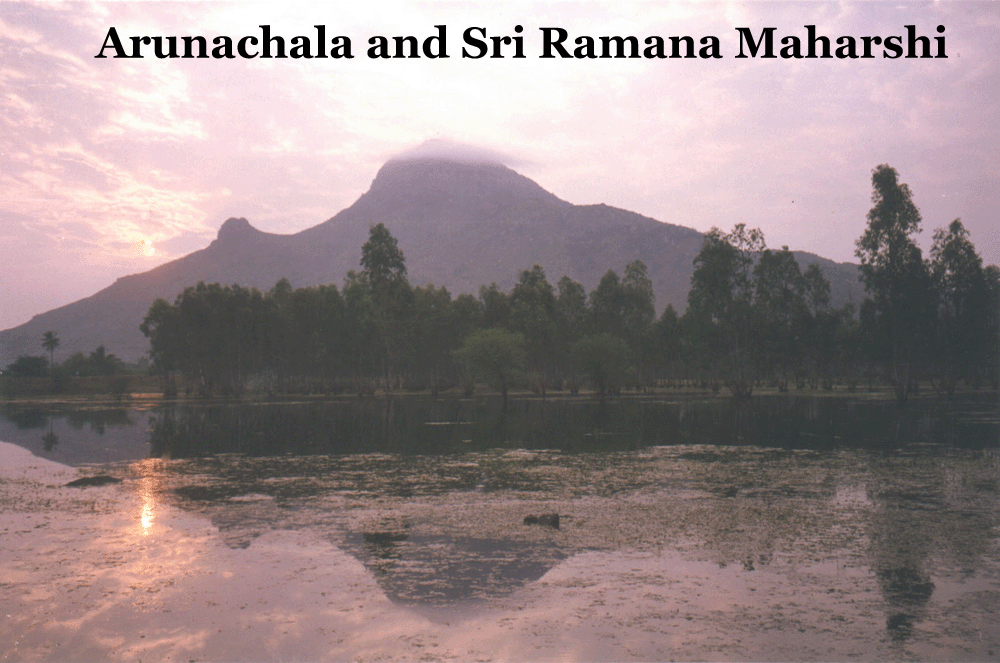
Saturday, April 26, 2008

God the scriptwriter

I signed up for Facebook a month or so ago and joined a 'Teachings of Ramana Maharshi' group that had just started there. One of the other members mentioned this statement that Bhagavan had made when his mother begged him to return home in 1898:
The Ordainer controls the fate of souls in accordance with their past deeds - their prarabdha karma. Whatever is destined not to happen will not happen, try hard how you may. Whatever is destined to happen will happen, do what you may to stop it. This is certain. The best course, therefore, is for one to be silent.
The person who posted the quote then asked about this 'Ordainer', and this is what I wrote in reply:

Before I write a response to this I should explain, for the benefit of those who do not know, the circumstances under which Bhagavan made this pronouncement. Bhagavan’s mother Azhagammal, came to see him in Tiruvannamalai in 1898 and begged him to return with her to the family home in Madurai. Bhagavan knew that such an option was not possible because he knew that it was his destiny (his prarabdha karma) to remain at Arunachala. This written statement was his response. The Tamil and English versions of it can be found on page 66 of Self-Realization, Narasimha Swami’s biography of Bhagavan.

This statement encapsulates several key elements of Bhagavan’s teachings that need to be explained before I can respond to the question that Cliff poses.

First, the term ‘ordainer’ refers to Iswara, the generic personal God of Hinduism, and not to the unmanifest Self. The relationship between the two was explained by Bhagavan in Guru Vachaka Kovai, verses 449 and 1218:
Other than as thoughts, jiva [the individual self], Iswara and the world do not exist.

The unmoving basis, the screen, is Brahman. The moving pictures that appear on that unmoving screen are jiva, Iswara and the world. You should know that everything which is perceived [on the screen] is maya.
The mind brings an illusory world into existence, dividing it into a seer and seen: a jiva who appears to inhabit the body, and an external world that is witnessed by it. When this projection takes place, Iswara, the God who supervises this creation, is also created. This God, the God who creates and sustains the world, is a mental creation, meaning that when the mind dies, the jiva, the world and God die with it, leaving Self alone. Iswara allocates karma to devotees and ensures that each devotee experiences the consequences of his and her actions. Here are some interesting answers that Paul Brunton elicited from Bhagavan on Iswara and his role in devotees’ lives:
Question: Is there a separate being Iswara who is the rewarder of virtue and punisher of sins? Is there a God?
Bhagavan: Yes.
Question: What is he like?
Bhagavan: Iswara has individuality in mind and body, which are perishable, but at the same time he also has the transcendental consciousness and liberation inwardly.

Iswara the personal God, the supreme creator of the universe really does exist. But this is only true from the relative standpoint of those who have not realised the truth, those people who believe in the reality of individual souls. From the absolute standpoint the sage cannot accept any other existence than the impersonal Self, one and formless.

Iswara, God, the creator, the personal God, is the last of the unreal forms to go. Only the absolute being is real. Hence, not only the world, not only the ego, but also the personal God are of unreality. We must find the absolute – nothing else.
(Conscious Immortality 1st ed, pp. 7, 8, 10, and 180-1)

That is to say, Iswara will exist and run the world while the individual projects creation, but he will cease to exist when the Self is realised and one knows oneself to be unmanifest Brahman. Since Bhagavan defines ‘reality’ as that which does not come and go, and as that which has its own inherent being, Iswara is not ultimately real since he comes and goes with the appearance and disappearance of the jiva. He is not permanent, unchanging being in the way that Brahman is.

How does Iswara, ‘the ordainer’, allocate destiny? Here is Bhagavan explaining the process, using an interesting and novel analogy:
A man might have performed many karmas in his previous births. A few of them alone will be chosen for this birth and he will have to enjoy the fruits in this birth. It is something like a slide show where the projectionist picks a few slides to be exhibited at a performance, the remaining slides being reserved for another performance.
(The Mountain Path 1982, p. 23)

And here is a second quote on how this process works:
Individuals have to suffer their karmas but Iswara manages to make the best of their karmas for his purpose. God manipulates the fruits of karma but he does not add or take away from it. The subconscious of man is a warehouse of good and bad karma. Iswara chooses from this warehouse what he sees will best suit the spiritual evolution … of each man, whether pleasant or painful. Thus, there is nothing arbitrary.
(Conscious Immortality, 1st ed. p. 376)

The point of the slide-show analogy is that the slides are arranged in a fixed sequence. The choice of slides and the order in which they display are determined in advance by Iswara. This is ‘God the ordainer’ determining which actions a jiva will perform, and in which order.

There is a traditional three-fold division of karma, of which prarabdha karma, mentioned in the original question, is one. Sanchita karma is the store of karma that has been brought forward from past lives. Prarabdha karma is the destiny that one has to undergo in this life, and agami karma is the new karma that is created in this life that is carried forward into future lives. One’s prarabdha karma is thus one’s destiny in this life, the God-ordained sequence of events that one has to experience.

Bhagavan did not seem to regard the laws of karma as being inherent in creation. They were, instead, a ‘divine ordinance’, a rule made by God, rather than a fundamental property of created matter. This was explained in the first verse of Upadesa Saram, which Bhagavan begins with the sentence ‘Action bears fruit by the ordinance of God’. This is Bhagavan’s reply to a question by Krishna Bhikshu, who asked who or what this ‘God’ was in this sentence:
Question: In ‘Karthuragnaya prapyathe phalam’ [‘actions bear fruit by the ordinance of God’] who is the karta [God, or the supreme doer]?
Bhagavan: Karta is Iswara. He is the one who distributes the fruits of actions to each person according to his karma. That means He is saguna Brahman [manifest Brahman]. The real Brahman is nirguna [attributeless] and without motion. It is only saguna Brahman that is named as Iswara. He gives the phala [fruits] to each person according to his karma [actions]. That means that Iswara is only an agent. He gives wages according to the labour done. That is all. Without that sakti [power] of Iswara, this karma [action] will not take place. That is why karma is said to be jadam [inert].
(Letters from Sri Ramanasramam, 11th August, 1946)

A natural consequence of all this is Bhagavan’s remark ‘Nothing happens except that which is divinely ordained’. (Padamalai, p. 295, v. 12.). While it is easy to see how this is so for embodied jivas who are under Iswara’s rule, it does not explain why Bhagavan, who had realised the Self and transcended the jurisdiction of ‘the Ordainer’, told his mother that he could not come back to Madurai because this event was not in his destiny.

To understand this some further philosophical digressions are necessary. Bhagavan taught that all the actions that a body performs are determined by its pre-destined prarabdha. This includes jnanis, the liberated ones. That destiny is God-given and immutable, but that does not mean that one has to identify with the body that is performing and undergoing its various destined actions. Enlightenment, or Self-realisation, is having the permanent knowledge and the experience that one is the underlying substratum, Brahman, not the temporary and ultimately unreal appearances (the world, the jiva and God) that appear and disappear within it. When one realises the Self, one knows that one is the Self and not the transient body that is going through its allotted activities. Destiny pertains to the body, not to the underlying Self. Bhagavan’s body had a destiny to fulfill, and that destiny did not include returning to Madurai, but the Self that he knew himself to be had no such destiny.

Traditional advaita, going back to Sankaracharya, teaches that jnanis, through their realisation, have transcended agami and sanchita karma, but continue to experience prarabdha karma until their body dies. That is to say, the karma that has accumulated in the past which produces rebirth and suffering has ended, meaning that there will be no more births, but the destiny of the body in this life (the prarabdha karma) has to continue until the body dies. Bhagavan objected to this argument, saying that if one knows oneself to be the Self, then all three of the karmas have ended. He summarised these views with an elegant analogy in Ulladu Narpadu Anubandham, verse 33:
The statement that the jnani retains prarabdha while free from sanchita and agami is only a formal answer to the questions of the ignorant. Of several wives none escapes widowhood when the husband dies; even so, when the doer goes, all three karmas vanish.
Bhagavan accepted that the body of a jnani had a predestined script of activities that it had to undergo, but he would not accept that he had prarabdha karma since he knew that he was not the body that was engaging in all these physical activities. As he remarked in Guru Vachaka Kovai, verse 1146:
Prarabdha will never fail [to take its course] in the case of a body that has been born to exhaust it. But the jivanmukta who has severed the chit-jada knot, and thereby become distinct from the body, has transcended prarabdha.
The jivanmukta is one who has become liberated while still alive in the body, while the chit-jada knot is the process by which pure consciousness attaches and identifies itself with the insentient body. The same idea was expressed more succinctly in Padamalai, p. 294, v 11 where Bhagavan said: ‘In the blissful experience of jnana, the Self, those prarabdha experiences will not cling to the “I”’.

There is one other consequence of realisation that I should mention since it impinges on another reason why Bhagavan could not accept his mother’s plea to return home. When one realises the Self, one no longer has any sankalpas. That is to say, one can no longer choose or decide what one should or should not do. People with minds who identify with bodies assume that they have ‘free-will’, that they can choose or decide what they do or don’t do. Jnanis who know that they are the Self and the Self alone have no such choices or options. When they speak, it is the Self that is speaking, and when they move, it is the Self that is animating them to perform a particular action. There is no intermediary mind that considers courses of action and then executes one of them. Bhagavan did not have a ‘choice’ to return home since the ‘chooser’ in him no longer existed. His body had a destiny to remain at Arunachala, a destiny that was scripted and ordained, but he himself had freed himself of its karmic destiny by abiding in the Self.

To give Bhagavan himself the last word, here are some more verses from Guru Vachaka Kovai (697, 698, 300, 1191, 151) on the topic of transcending prarabdha. They are probably more relevant and useful than my own discussion on what prarabdha is and who it affects:
The purport of the statement, ‘For those who dwell in the firmament [of consciousness] there is no prarabdha,’ is that not even an iota of prarabdha will exist for those who meditate unceasingly on the subtle space of consciousness that flourishes everywhere unobstructed, and which cannot be encompassed even by the vast physical space.

Prarabdha, like a whirlwind, relentlessly agitates and spins the mind that has shrunk through the ‘I am the body’ idea. However, it cannot stir, even slightly, the limitation-free mind that shines as the extremely clear space of being-consciousness when that ego-impurity [the ‘I am the body’ idea] is destroyed by self-enquiry.

It is impossible for the jiva who has become a victim of ego-delusion to overcome even slightly the force of prarabdha. Therefore, unless he subsides in the Heart by relying primarily on God’s grace, he can never, by mere effort, which is the activity of the rising ego, overcome the buffeting momentum of that prarabdha, subside by himself [in the Heart], attain Self-realisation and be freed from fear-causing delusion.

No one can do anything that is opposed to the ordinance of the Supreme Lord who possesses unlimited power and who can do anything. Therefore, to end the illusory anxieties of the mind, which engender an evil discontent, the proper course is to remain under the spell of supreme consciousness, which arises from meditating on the divine feet, with the mischief of the ego subdued.

Siva shines within each jiva as a witness, [enabling] him [the jiva] to experience his prarabdha through his [Siva’s] presence. Whoever knows his nature to be mere being-consciousness, without imagining through ignorance that he is the experiencer of prarabdha, shines as that supreme person, Siva.