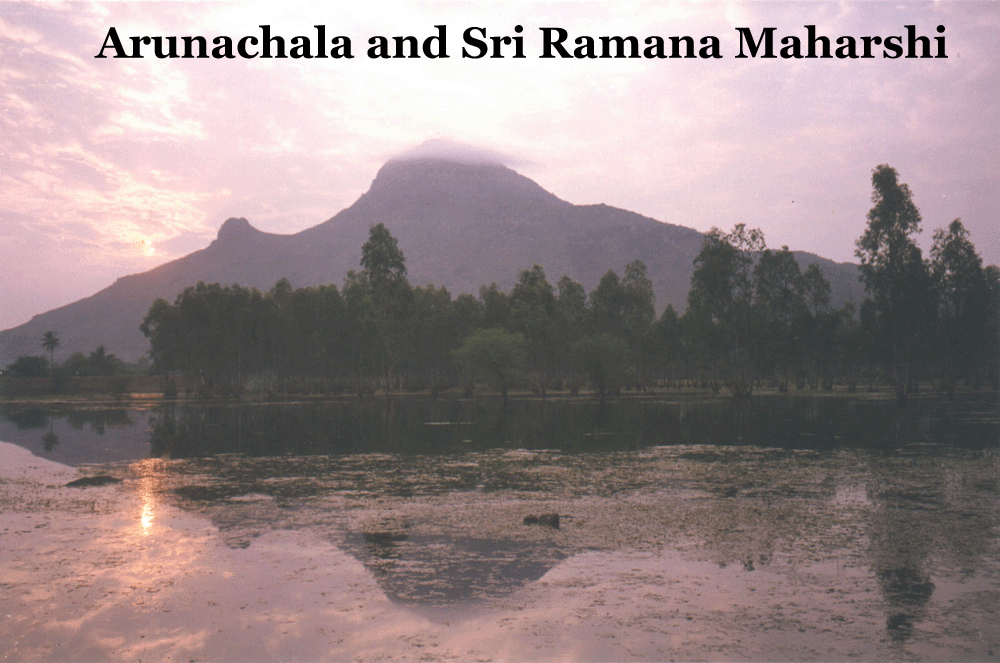
On February 7th Subramanian asked for a new post and an update on my Guhai Namasivaya project. I can say that it is going along quite nicely, and that I hope to have the whole thing in print later this year.
Today I can give a preview by posting one of the biographical chapters that will appear in the book. It comprises two narratives: the traditional one that has appeared in several published accounts, along with a second, copied and preserved by Ramana Maharshi, that has never, to my knowledge, appeared in print in either Tamil or English.
Both of these versions are hagiographic, the second markedly more so than the first. In a subsequent chapter I will attempt a more systematic analysis of Guhai Namasivaya’s life, opinions, spiritual practice, accomplishments and character by analysing the hundreds of verses to Arunachala that he composed during his long stay in Tiruvannamalai.
Like Padamalai and Guru Vachaka Kovai, the book is a collaborative effort between myself, Dr T. Venkatasubramanian and Robert Butler.
Guhai Namasivaya was a Saiva poet-saint who came to Tiruvannamalai in either the 15th or the early 16th century and then spent most of the remainder of his life living in a cave on Arunachala that still bears his name. His title ‘Guhai’ is the Tamil word for a cave.
The information about his life that has survived is highly hagiographical. The first attempt to chronicle his life was a Tamil biography, Guhai Namasivaya Leelai, composed about 1700 AD by Velaiyer Swami, one of the co-authors of the Kalatti Puranam. This work seems to have disappeared completely. Since none of the more recent accounts of his life refer to this biography, it is not possible to tell whether they derive their information from it, or whether they have tapped into other sources.
The oldest published account of his life appears in the Pulavar Puranam, a 19th century anthology of the lives of distinguished Tamil spiritual authors. Both Guhai Namasivaya and his most well-known disciple, Guru Namasivaya, had their lives chronicled in Tamil verse in this book.
Palm-leaf manuscripts of Guhai Namasivaya’s most well known poem, Arunagiri Antadi, can be found in the Tanjore Saraswati Mahal Library. In 1967 the library brought out an edition of this work that was preceded by a biography of the author which brought together all the incidents that comprise the traditional story of his life. No sources are cited, but the general outline of the narrative is very similar to the one that appears in Pulavar Puranam. The following subsection, a reconstruction of Guhai Namasivaya’s life, has been assembled from events narrated in these two sources.
Guhai Namasivaya: the traditional story
There is one agreed date in the life of Guhai Namasivaya: 1548 AD. Kamil Zvelebil in his Lexicon of Tamil Literature,[1] associates the date with the poem Arunagiri Antadi, which suggests that a colophon of one of the palm-leaf manuscripts contains this date.
[1] Lexicon of Tamil Literature, by Kamil Zvelebil, 1995 ed. p. 368. I will place all the footnotes in red at the end of the sentence in which they appear.
The poem itself comprises 100 verses in praise of Arunachala. It is generally accepted that Guhai Namasivaya came to Tiruvannamalai as a young man and began composing poetry about the mountain of Arunachala shortly afterwards. This would indicate a birth date in the 15th century or the early decades of the 16th century. This is consistent with the death dates of his two known disciples, Guru Namasivaya and Arumuga Swami, both of whom passed away in the mid-to-late 17th century.[2]
[2] An epitaph verse on the death of Guru Namasivaya gives a date of 1637 AD. A manuscript in Chennai University library (Sri Guhai Namasivaya Charittiram) states that Arumuga Swami passed away in 1673 AD. The three dates 1548, 1637 and 1673 are reasonable if one assumes that Arumuga Swami met Guhai Namasivaya when the latter was an old man.
Guhai Namasivaya was born in Karnataka to a pious Virasaiva couple.[3]
[3] Part of this narrative has been taken from an article that first appeared in The Mountain Path, 1990, pp. 115-23. It was co-authored by myself and Nadhia Sutara. The material first published there was primarily a translation of the introductory biography that appeared in 1967 Tamil Tanjore Saraswati Mahal Library edition of Arunagiri Antadi. This was supplemented by explanatory notes on the nature of Virasaivism and translations of some of Guhai Namasivaya’s verses. All the verses that appeared there have been retranslated for this chapter.
His spiritual nature became evident at an early age: he was virtuous in his conduct, adept at his studies and evinced no attachment to worldly matters. Feeling a great longing to receive the grace of the Lord, he embarked at an early age upon a search that led him to Sivananda Desikar, a famous Virasaiva Guru who lived at Sri Sailam, a major pilgrimage centre in southern Andhra Pradesh. He became a disciple of this Guru and began to serve him with fervent and selfless devotion.
The origin of Virasaivism, an offshoot of Saivism, can be traced back to the twelfth century. Its philosophy has grown out of the twenty-eight Saiva Agamas and the writings of its early exponents. Virasaivas are also known as Lingayats on account of the immense importance they attach to their conception of the term ‘lingam’. For them, lingam is not merely a physical object, it is synonymous with chaitanya, or consciousness, and can be taken to be Siva himself. In their philosophy, the term lingam can be equated with the parabrahman of the Upanishads, but it has other connotations as well. It is the cosmic principle that is the source of the universe and, in its physical form, it is the visible symbol of the consciousness that exists in all beings. In addition, and this is particularly interesting in view of the years Guhai Namasivaya spent at Arunachala, it is often conceived of as a mass of light or a column of blazing fire. Worship of the lingam in all its forms is central to Virasaivism.
The goal of Virasaivas is the attainment of oneness with Siva. To reach this exalted state, Virasaivas believe that one must submit to and serve a Guru who has already attained that oneness. Thus, in the Virasaiva tradition, the Guru is given immense importance, for it is he alone who can initiate the disciple, purify him, and lead him to unity with Siva.
For a devout Virasaiva, the spiritual path begins when he approaches a competent Guru and asks him for initiation. Usually, the Guru will first test him for a year to see how serious his spiritual inclinations are. When the Guru is satisfied that the disciple’s desire is genuine, he agrees to initiate him and accept him as a disciple. The initiation given by the Guru activates the power of lingam in the three bodies, the causal, the subtle and the gross, and removes some or all of the taints or imperfections that reside in each of the three bodies. Virasaivas believe that these taints, called mala, prevent the disciple from becoming established in lingam, the Supreme Siva-consciousness. In the prescribed initiation ceremony the Guru draws out the power of lingam from the heart of the devotee, establishes it in a physical lingam, which is called ishtalinga, presents it to the disciple and commands him to worship it as if were Siva himself. The handing over of the ishtalinga removes the taints (mala) that are attached to the physical body. The Guru then commands the devotee to wear the ishtalinga on his body at all times and to worship it three times a day. The Guru also tells him that the linga must on no account be separated from the body since such a separation is equivalent of spiritual death. In the Virasaiva tradition, it is not permitted to worship Siva in any other form except that of the ishtalinga or the lingam installed over one’s Guru’s samadhi. Virasaivas are therefore forbidden from worshipping forms of Siva that have been installed in temples.
We can assume that Guhai Namasivaya underwent this initiation ceremony since it is a compulsory rite of passage for all Virasaivas. He probably went through it quite early in his life, for it was not uncommon for eight-year-olds to be initiated in this way. Sivananda Desikar, Guhai Namasivaya’s Guru, was an adept in a Virasaiva yoga system known as Siva yoga. When Sivananada Desikar noticed what a mature disciple Guhai Namasivaya was, he initiated him into its practices. From then on, Guhai Namasivaya alternated his time between physical service to the Guru and the practice of Siva yoga. In the course of time he too became an accomplished Siva yogi.
The goal of Siva yoga is to find Siva in everything and to discover the fundamental root of that immanent Siva manifestation in one’s heart. Though Siva yoga has a strong bhakti component, it is primarily a variety of kundalini yoga. The Siva yogis aim to make contact with the power of the Lord. They believe that the contact finally takes place after the prana, rising through the sushumna, has passed through all the six chakras and moved on to the bramarandhra, located at the top of the head. Accomplished Siva yogis, at the time of their death, voluntarily send all their pranas out of their bodies through this brahmarandhra and merge into the all-pervading consciousness of Siva.
Guhai Namasivaya practised this system of yoga for many years. When he had thoroughly mastered it, Lord Mallikarjuna, the presiding deity of Sri Sailam, appeared to Guhai Namasivaya in a dream and commanded him to go to Arunachala and remain there as a Guru, giving teachings to mature disciples who approached him. When he related this dream to his Guru, Sivananada Desikar gave him his blessings and told him to carry out the order. Shortly afterwards, Guhai Namasivaya set out on horseback for Tiruvannamalai.
There is a tradition in Tiruvannamalai that Guhai Namasivaya was accompanied on his journey by Virupaksha Deva, the man who gave his name to Virupaksha Cave. Ramana Maharishi occasionally told his devotees that the two of them were Virasaivas who came from Karnataka to Tiruvannamalai at the same time. It is reported that both of them had served Sivananada Desikar for twelve years. Very little is known about the life of Virupaksha Deva except that he lived in Virupaksha Cave for a long time, and that when he died there his body transformed itself into vibhuti (sacred ash). That vibhuti is still kept in the cave and puja is done to it every day.
On his journey to Tiruvannamalai Guhai Namasivaya came one evening to a village where a wedding was in progress. The head of the house where the wedding was taking place greeted him respectfully, invited him into the house, gave him the place of honour and performed puja to him. At the conclusion of the puja everyone present received some vibhuti from the hand of Guhai Namasivaya. Shortly afterwards, the house was completely destroyed by a fire.
Some people, associating the fire with Guhai Namasivaya’s visit, poured scorn on him by saying, ‘The ash given by this yogi has turned the house itself into ash’.
Guhai Namasivaya was deeply hurt by this taunt, not personally, but because of the ridicule to which the Lord’s vibhuti had been subjected. He therefore meditated on Siva and through His grace was able to restore the house to its former unburnt state. Subsequently, those in the village who had formerly reviled him began to praise and worship him as if he were Siva himself. Guhai Namasivaya, perturbed by all the fuss his visit had caused, then took a vow that wherever he went in future, he would never again stay in any house.
On reaching Tiruvannamalai he stuck to his vow and lived in public halls, temple flower gardens and occasionally in the surrounding forest. He devoted himself to the practice of Siva yoga and became so accomplished in it that he was able to spend long periods in samadhi, immersed in his inner lingam. Each day he visited the entrance of the Arunachaleswara Temple but went no further because, as a Virasaiva, he was prohibited from worshipping there. It seems that Guhai Namasivaya either had a desire to worship in the temple, or felt that he would benefit by doing so, for each day he would gesture with his hands in the direction of the shrine and to say to himself, ‘Are you well without worshipping Him?’
There was a sadhu called Sivakkira Yogi who noticed that Guhai Namasivaya never went through the temple entrance, but merely made strange gestures there. He interpreted this strange behaviour as deliberate irreverence and decided to punish him by striking him on the back with his cane. Guhai Namasivaya made no attempt to retaliate, nor did he even reproach his attacker. He merely composed an extempore verse in Tamil to the effect that the Lord had struck him in order to drive out his evil propensities.
When Sivakkira Yogi saw Guhai Namasivaya responding in such a humble way, he immediately realised that he had failed to recognise the latter’s greatness. After this incident Guhai Namasivaya began to feel that it would be appropriate for him to enter the temple and worship there. While he was contemplating this breach with tradition, his Guru, Sivananda Desikar, unexpectedly appeared, surrounded by a retinue of his devotees. Guhai Namasivaya greeted him with great love and devotion. In return, Sivananda Desikar spoke to him in a friendly and intimate way. Then to Guhai Namsivaya’s surprise, his Guru entered the temple with his disciples, walked straight to the inner sanctum and began to worship Siva there. Guhai Namasivaya, who had accompanied his Guru into the temple, followed his Guru’s example. He threw himself full-length on the ground and, filled with ecstasy, mentally worshipped the image of Siva that was enshrined there. When he stood up he could see no sign either of his Guru or his fellow disciples, but when he looked at the lingam he had been worshipping, he saw only the form of his Guru. Two of his verses (282 and 127)[4] refer to this epiphany:
[4] All verse numbers refer to the numbering scheme we have adopted for the published version of the book. These numbers correspond to those that appear in the Sri Ramanasramam edition of the Tamil verses of Guhai Namasivaya.
Arunesan is the Lord of Arunai, an old name of both Tiruvannamalai and the mountain of Arunachala. Brahma is the god of creation, while Yama is the god of death. In saying that he will ‘No more … approach Brahma and Yama’ Guhai Namasivaya is indicating that the experience liberated him from birth and death.
Guhai Namasivaya, realising that the appearance of his Guru had been the play of the Lord, interpreted his vision to mean that he now had permission to enter the temple and worship there. In Virasaivism, the authority of the Guru is paramount. If the Guru sanctions a practice, it immediately becomes acceptable even if it contravenes traditional rules and regulations. After this incident Guhai Namasivaya decided to take up residence in the entrance to the temple. Each day he was there, he composed a verse in praise of Arunachala-Siva and put together a flower garland. He would then offer both of them to the lingam of Lord Siva in the inner shrine. In verse 456 he described the joy he took in these activities:
Sonachala, meaning ‘Red Mountain’, is another ancient name for Arunachala.
During this period of his life Guhai Namasivaya supported himself by begging for his food. He seemed quite content with his spartan existence. The following verse (459) appears in his writings:
To go for bhiksha is to beg for one’s food. This verse is not one of Guhai Namasivaya’s; it was composed by the Tamil saint Pattinathar. It probably ended up in a collection of Guhai Namasivaya’s verses because it resonated so well with his own outlook.[6]
[6] The dates of Pattinathar, a distinguished siddha-poet, seem to be in dispute, but all except one of the experts I have come across place him well before Guhai Namasivaya.
After he had lived like this for some time, Lord Siva appeared in one of his dreams and commanded him: ‘Remain in a cave on the slopes of our mountain and carry on your yoga practice there.’
Guhai Namasivaya accepted the order and moved into a cave on the lower slopes of the eastern side of the hill. This cave was his base for the rest of his life. The mountain soon became the main focus of his spiritual activities. To understand how this came about, it will be instructive to compare certain aspects of Virasaivism, particularly the teachings on the nature of lingam, with the spiritual traditions that are associated with Arunachala. The Virasaivas conceive of lingam, in its unmanifest form, as a blazing mass or column of light in the heart of each devotee. At the time of initiation, the Guru draws out this power, installs it in a physical form, the ishtalinga, and instructs the disciple to worship it as if it were Siva himself. In the case of Arunachala, Siva initially appeared as a dazzling, limitless column of light and then later transformed himself into the physical lingam of Arunachala. As Ramana Maharishi remarked on several occasions, the hill is not the abode of Siva or a symbolic representation of him; it is, like the ishtalinga of Virasaivas, Siva manifesting in a lingam-shaped form. This is what he had to say to someone who enquired which portion of the hill was the holiest and most sacred:
[7] Ramana Pictorial Souvenir, p. 7.
There is a tradition in Tiruvannamalai that the lingam in the Arunachaleswara Temple and the mountain lingam of Arunachala are one and the same. Thus, when Sivananda Desikar manifested and superimposed his image on the temple lingam, Guhai Namasivaya, who had been worshipping that image, received the message that his Guru and Arunachala were identical. This understanding is mentioned in the verse he immediately composed. Furthermore, realising that the vision had authorised him to regard Arunachala as his Guru, he began to worship the mountain as a Guru lingam. He described this new relationship and the effect it had on him in the following verse (546):
In Virasaivism it is the Guru’s job to cleanse the devotee of the ‘soul’s threefold impurity’ (the ego, karma and maya) and the ‘two-fold karma’, which are good and bad deeds and their consequences. This process would have been initiated by Guhai Namasivaya’s human Guru, Sivananda Desikar, but as the above verse clearly states, it was Arunachala-Siva who completed the job.
By channelling his devotional fervour towards the mountain, he was able to generate a level of love that he had never experienced from worshipping his ishtalinga and practising Siva yoga. In verse 548 he sang:
Unnamulai is the consort of Siva (Lord Annamalai) in Tiruvannamalai. They are deemed to be a joint entity with a shared body. Unnamulai is the left side of the body; Siva the right. When Guhai Namasivaya was living in the temple gopuram in town, he had begun the practice of composing a verse to Arunachala each day. To show his love and gratitude to his Guru Arunachala for the grace he had bestowed on him, he continued this practice for the rest of his life. This devotional habit was mentioned by his disciple, Guru Namasivaya, in several of his verses:
[8] Extracts from verses 7, 14 and 16 of Annamalai Venba. The practice of composing daily verses to Arunachala is reported in several other verses of this poem.
The venba was the format of the Tamil verses he composed: three lines, followed by a slightly shorter fourth. Guhai Namasivaya utilised this metrical form in all his verses that praised Arunachala. Annamalai, meaning ‘unreachable or unapproachable mountain,’ is a common Tamil name for the mountain. The town of Tiruvannamalai combines the word ‘Annamalai’ with an honorific prefix.
Guhai Namasivaya developed the siddhi of being able to witness events that were taking place in far-off places. His disciple Guru Namasivaya not only mastered the same skill, he was also able to change events that were occurring in the visions he was having. The one incident of this kind that is reported in the life of Guhai Namasivaya occurred when he witnessed in Tiruvannamalai the strange behaviour of a Vaishnava guru from Kanchipuram who was travelling to Tirupati on a pilgrimage. Both places are about a hundred miles from Tiruvannamalai. The guru was being carried in a palanquin by his disciples. As they approached Kalatti (modern-day Kalahasti) the guru asked his disciples about the hill he could see through his window. When he was told that it was the famous Siva shrine of Kalatti, he immediately asked his disciples to hold a cloth across the window so that he could avoid seeing the hill. Observing this irreverent conduct from afar, Guhai Namasivaya composed the following verse (289):
Sonagiri, meaning ‘Red Mountain’, is one of the many names of Arunachala. ‘The Guru at Sonagiri’ is Siva in the form of Arunachala. It was Siva who destroyed, in separate incidents, the tripuras (the flying cities of the asuras), Narasimha, Kama and Yama. As a divine punishment for his narrow-mindedness the Vaishnava guru became completely blind. However, when he arrived at Tirupati and worshipped there, Lord Venkateswara asked him to go back to Kalatti and sing praises to Siva. After he had sung Siva’s praises there, his sight was restored.
The rishis and yogis of the Puranas would often do tapas for years to accumulate great powers. Then, if they were roused to anger, they would often curse people who had offended them. This would inevitably result in dire consequences for the victims of the curses. At least one incident of this kind occurred in the life of Guhai Namasivaya. One day, while he was living on the hill, he took pity on a poor man whose only goat had been killed by a snake just before it was about to give birth. Guhai Namasivaya asked the man to leave the goat’s body with him and to collect it the next day. When the goatherd returned to pick up the corpse, he found that not only had the goat been restored to life, it had also given birth to two kids. As news of this miracle spread around the town, some boys from the local weaving community decided to play a joke on Guhai Namasivaya.
One boy, pretending to be dead, was carried into the presence of Guhai Namasivaya by his friends. The boys claimed that their friend had died of a snake bite and asked the saint to restore him to life. Guhai Namasivaya, who could see that they were merely making fun of him, cursed them with such vehemence, the boy who was pretending to be dead actually did die. Then, still angry, Guhai Namasivaya composed the following verse (455):
‘Kolar’ is a contraction of the Tamil word ‘kaikolar’, a common term for weavers. Guhai Namasivaya lumped them together with all the other unsavory characters listed in the following lines, and then cursed the whole Tiruvannamalai weaving community, saying that it would never prosper or flourish in Tiruvannamalai again. The curse took effect: all the weavers were forced to leave town or take up other occupations because none of them could make a living by weaving in Tiruvannamalai. In the years that followed, all attempts to re-establish weaving businesses in the town failed.
There is a local tradition that Guhai Namasivaya was about to curse the mountain itself in the last line, but just before he uttered it, Siva appeared and said ‘I am here’. Guhai Namasivaya then changed the ending of the verse to ‘which itself never suffers destruction’.
The ancient rishis who had the power to curse, as a result of their tapas, often also had the ability to approach the gods and demand, successfully, that they intervene in worldly matters. Guhai Namasivaya was credited with this power as well. A barbarian chieftain, Agittu, once invaded and looted the town of Tiruvannamalai. He murdered many of the inhabitants, abducted a large number of the town’s young women and, in an act of deliberate desecration, set up camp in one of the temple courtyards and roasted an ox there. When news of this reached Guhai Namasivaya, he became angry and rebuked Lord Arunachaleswara (the presiding deity of Arunachala) in the following manner (452):
Arunachaleswara accepted the justness of the complaint and, for the sake of Guhai Namasivaya, decided to intervene in the matter. That night the Lord appeared to Agittu in a dream in the form of a sadhu and struck him on the back with his stick. Agittu woke up immediately and noticed that on the spot where he had been beaten there was a rash that soon grew and developed into a large, swollen abscess. He consulted some of the elders of the town, recounting his dream to them. They all advised him that he could only save his life by leaving the temple. Agittu, not wanting any further punishment, abandoned the temple to the pujaris and the town’s devotees who cleared up his mess and reconsecrated the holy shrine. However, Agittu could not escape the wrath of Guhai Namasivaya and Lord Arunachaleswara. His abscess grew and worms appeared in it, which gnawed away at his healthy flesh. All remedies failed, including one horrific experiment in which he applied foetuses, taken from pregnant women he had slaughtered for the purpose, to the wound. When he eventually died in great agony, his death was celebrated throughout Tiruvannamalai.
There is another similar miraculous intervention attributed to Guhai Namasivaya. The story has many parallels with the one just narrated, but it purports to chronicle an entirely different incident. A Muslim ruler invaded Tiruvannamalai. After he had overrun the town, he began to harass and injure many of its inhabitants. Some devotees went to Guhai Namasivaya and appealed to him to help. In response, Guhai Namasivaya sang a verse (450) to Arunachala, asking for His intervention:
This story has a less gory ending than the previous one. That night Vinayaka (Ganesh) appeared in the Muslim king’s dream in the form of an elephant and frightened him. When he woke up, he came to the conclusion that Vinayaka was criticising his behaviour in the town and decided to make amends. As a token of his repentance he organised a big puja at the Vinayaka shrine that is located just to the left of the entrance to Kili Gopuram in the Arunachaleswara Temple. During the ceremony the king offered a large number of elephants to Vinayaka. The shrine is now known as ‘Yanai Tiraikonda Vinayaka Shrine,’ ‘The-elephants-accepted-as-tribute Vinayaka Shrine.’
Guhai Namasivaya mentioned this miracle in the first verse of Arunagiri Malai:
While this incident has traditionally been accepted as being a part of Guhai Namasivaya’s life story, its authenticity is problematic since it is referred to in one of the poems of Arunagirinatha, a saint who lived in Tiruvannamalai for about eighty years, probably between 1370 and 1450 AD.[9]
[9] Zvelebil summarises the pros and cons of dating Arunagirinatha on page 71 of Lexicon of Tamil Literature, and comes up with this 1370-1450 span. His dates can be fixed with some degree of accuracy since he was a court poet who worked for rulers of Tiruvannamalai whose dates are fairly well established.
Sivaprakasa Swamigal, a 17th century Tamil poet who composed verses on Arunachala, and who lived for a time in Tiruvannamalai, mentioned this incident in the invocatory verse of Sonasaila Malai, a hundred-verse poem in praise of Arunachala:
The two commentaries on this work that I have come across both state that the ‘elephant herd’ incident is the Guhai Namasivaya version I have just outlined. It seems that the incident is widely believed to belong to the life story of Guhai Namasivaya.
The traditional account of Guhai Namasivaya’s life states that he lived to be 200 years old. If one accepts this improbable age, one could possibly locate him in the span of 1420 to 1620 and have this Vinayaka story happen while Arunagirinatha was still alive. This would mean that Arunagiri Antadi, known to have been composed in 1548, would have been written when Guhai Namasivaya was about 130 years old. A possible death date of 1620 would just about make it possible to have a disciple (Arumuga Swami) who is known to have passed away in 1673. Alternatively, one could come to the conclusion that the whole narrative is merely a somewhat garbled variant of the story of the barbarian chief.
Guhai Namasivaya’s immense age is referred to in the final incidents that are narrated in the traditional story of his life. When he reached 100 years of age, the thought occurred to Guhai Namasivaya: ‘The span allotted to man by Brahma is 100 years. That is enough for this worldly life.’
He had his disciples prepare a samadhi pit for him, intending to enter it and give up his life there. He composed what he thought would be his final verse to Arunachala (241):
However, just as he was lowering himself into the tomb, Lord Siva spoke to him, ordering him to stay a further 100 years on earth. His resigned response to the Lord’s intervention is recorded in one of his verses (441):
In saying ‘bestow Your feet’ Guhai Namasivaya is asking Siva to guarantee union with Him at the moment of his death. One hundred years later, a similar tomb-side scene was enacted. In the traditional story of his life Guhai Namasivaya voluntarily gave up his body by sending the prana (life force) out through the brahmarandhra on the top of his head. This was a practice he probably mastered during his early years as a Siva yogi. Just before he entered his samadhi pit he composed his final two verses in which he expressed how happy he was to abandon his sick and old body. He also declared that had crossed the ocean of birth and death and no longer needed to incarnate again (451 and 97):
Siva granted his request. An anonymous verse, presumably composed posthumously by one of his disciples, narrated that Siva (Arunesar) had enabled Guhai Namasivaya to move on from being a divine ‘walking lingam,’ in human form to a samadhi shrine on the slopes of Arunachala (437):
The phrase ‘walking lingam’ could also be translated as ‘dancing lingam’. The phrase translated as ‘attain the divine state’ is also used to denote physical death.
An alternative biography of Guhai Namasivaya
Most of the verses by Guhai Namasivaya that are featured in this book were originally found in a notebook in Ramana Maharshi’s handwriting that was discovered in the Ramanasramam archives in the 1980s. Since most of these verses do not appear anywhere else, we have surmised that Ramana Maharshi copied them from palm-leaf manuscripts that were stored in the Guhai Namasivaya Temple. Ramana Maharshi lived there briefly around 1900, and then occupied the nearby Virupaksha Cave for a further fifteen years. The Guhai Namasivaya Temple did have a collection of palm-leaf manuscripts, but they disappeared without trace several decades ago. I spoke to the owner of the Guhai Namasivaya Temple in the 1980s about these manuscripts. He informed me that they had been given to someone who had promised to publish them in Tamil, but both the man and the manuscripts disappeared and have never been traced. This notebook, now the only surviving record of much of Guhai Namasivaya’s output, contains an introductory prose biography of Guhai Namasivaya that differs substantially from the account given in the previous section. The primary topic is an extensive pilgrimage that Guhai Namasivaya took from Sri Sailam to Tiruvannamalai. The narrative also takes great pains to stress how committed he was to the Virasaiva faith. The source of this alternative version is unknown since it was written anonymously and has no title. However, the prose format gives a clue to its age. Tamil biographies of saints were almost invariably written in verse until the beginning of the 19th century. Though this would indicate a composition date several centuries after Guhai Namasivaya passed away, it does not rule out the possibility that the information it contains is derived from an earlier poetic source. I am giving a translation of this previously unpublished biography here. Some portions that elaborate on Virasaiva philosophy have been omitted since they are overly technical and not germane to the narrative. The original text is in roman. My own explanatory notes are interpolated in italics.
Chenna Mallikarjuna Devachariyar was the occupant [athibathi] of the Srisaila Simhasana [Peetam]. He had obtained the anugraha [grace] of Allama Prabhu.
Sri Sailam is the pilgrimage centre in Andhra Pradesh where Guhai Namasivaya went from Karnataka to meet his Guru in the traditional account of his life. In this version, though, the Guru is not Sivananda Desikar but someone else. The presiding deity of Sri Sailam is Chenna Mallikarjuna. Chenna Mallikarjuna Devachariyar was the head of a math (monastic institution) there. We can assume that it was a Virasaiva institution of some sort. Allama Prabhu, the other person mentioned, was one of the founding saints of Vairasaivism.
At that time there lived a devotee called Nanjaiyar. He was a sangama.
Sangamas are Virasaiva devotees. The term also denotes the community of devotees.
Nanjaiyar had a desire for a son. After prostrating in the prescribed way to Chenna Mallikarjuna Devachariyar, he informed him about this desire. The Guru asked him to return the following day.
After Nanjaiyar had left, the Guru prayed to his ishtalinga and in response received the following divine command: ‘Nanjaiyar does not have the good fortune of a child in his own line. However, as he is a crest-jewel of Guru-linga-sangama, through the upadesa of sthula panchakshara [the five-syllabled mantra ‘Om Namasivaya’], beginning with pranava, I, who am the import of this will myself be born to him.’
There are eight shields (ashtavarana) that protect the Virasaiva. The first three on the list are the Guru, the lingam and the sangama. Virasaivas believe that these are the three forms of Siva. Calling Nanjaiyar ‘a crest-jewel of Guru-linga-sangama’ denotes that he embodies the highest aspirations of the Virasaiva faith. Sthula means ‘physical’ or ‘material’. The panchakshara is the sacred five-lettered mantra ‘Namasivaya’, meaning ‘Obeisance to Siva’. Pranava is the sound of Om. The five-lettered mantra that begins with pranava is ‘Om Namasivaya’.
I think the text is suggesting that the holy mantra ‘Om Namasivaya’ is going to take physical form in the incarnation of the Guru who would become known as ‘Om Namasivaya’. Throughout this account Guhai Namasivaya is referred to as ‘Om Namasivaya’ rather than ‘Guhai Namasivaya’. His own disciple Guru Namasivaya also called him ‘Om Namasivaya’ in his verses. This would indicate the title of ‘Guhai’ was either given much later in his life, or possibly even after his death.
Ten months later Nanjaiyar’s son was born. He was taken to Sri Marula Siddheswarasiriyar, who was also known as Avadhuta Asiriyar. This Guru was shining as the head of the Ujjain Simhasana.
Marula Siddheswarar was one of the semi-mythical founders of Virasaivism who, if he lived at all, lived many centuries before these events took place. He is associated with Ujjain, a noted pilgrimage city in modern-day Madhya Pradesh. The Marula Siddheswarar of this story is not the original Guru but the head of the Ujjain Simhasana Math.
From him [Marula Siddheswarar] the child received lingadharana initiation and the name ‘Om Namasivaya’. In his fifth year Om Namasivaya started his studies under Chenna Mallikarjuna Devar [the Guru mentioned in the first paragraph].
Lingadharana is the initiation ceremony in which the Guru sanctifies a lingam and gives it to a disciple. In Virasaiva families this is often done very early in life, and is often combined with the ceremony in which a name is given to the child.
At the age of eleven Marula Siddheswarar Deva initiated him into various Virasaiva traditions, after which he shone with the eight ornaments, beginning with vibhuti [sacred ash].
Om Namasivaya then appealed to his Guru, ‘Swami, the Arunachala paramjyoti lingam [the transcendent lingam of light], which confers liberation on thinking, which was beyond the comprehension of Brahma and Vishnu, which is the central lordly lingam among the panchabhuta lingams, which shines in the south in this universe, as in this body, is attracting my heart [ullam]. Therefore, my Lord, you should give your consent [for me to go there].’
The panchabhuta lingams are the five Siva temples in South India whose lingams are associated with one of the five elements. The Tiruvannamalai lingam is the fire lingam.
The Guru replied, ‘The divine grace gives its consent’. Tents, palanquins and other items were collected. Three hundred and sixty sangamas set off on the trip, which began with many musical accompaniments. The idea was to perform a pradakshina of Indian sacred places that went first towards the sacred places of the West, and then towards those of the north. Later on, it would turn south.
On his journey Om Namasivaya went to a village full of Siva bhaktas. One Siva bhakta, in whose house a wedding was taking place, humbly invited him in. Om Namasivaya accepted the invitation, went inside and blessed the newly married couple. That night a fire broke out and the house and its occupants, including the bride and bridegroom, were burnt to death. The next day Om Namasivaya stood before the house with his paduka and asked for bhiksha. Both the house and its occupants were miraculously restored to their former state. The bride and bridegroom came out, prostrated to him and offered bhiksha. The onlookers thought that Om Namsivaya was Parasivam itself. They all prostrated to him and praised him.
Paduka are the sandals of the Guru. The term also denotes one of the eight Virasaiva aids (ashtavarana) to faith: the practice of drinking water that has bathed the lingam or washed the Guru’s feet.
This story is one of the few that is common to both versions of Guhai Namasivaya’s life. In the earlier version Guhai Namasivaya offered vibhuti (sacred ash) to the householder before his house was reduced to ashes in a fire. In both cases the house and its occupants were restored to their former state.
From there he travelled to the following holy places and had darshan of the deity in each one: Siva Gangai, Sambulingamalai, Ummattur, Nanjunda Koodal, Subramaniam, Tiruvanjaikkalam, Mookambikai, Gokarnam, Tareswaram, Seccheswaram, Koluveswaram, Mrideswaram, Kalyana Pattanam, Kottur, Kolipakam, Ambai, Virupakshi, Hemakootam, Vanavaasa Maanagaram, Uluva Maamalai, and Koodal Sangameswaram. In each place he accepted offerings and help from local devotees.
These are mostly old names for towns. The ones that are recognisable are in western India.
Om Namasivaya’s group eventually reached Delhi and camped there. When the Muslim fakirs of the place heard that Om Namasivaya was camping near Delhi, many of them came to see him. Om Namasivaya heard from his devotees that they had arrived. He went out to meet them and gestured to them that they should sit down. Om Namasivaya did not speak, but remained instead absorbed in meditation [Siva-dhyana]. All the fakirs who had come became motionless and mentally silent. Before they left they reverentially offered varieties of fruit and prostrated to him, as they would have done to their own Guru. The silence they experienced with Om Namsasivaya did not last, and they soon reverted to their usual mental state. The fakirs went and informed the Badushah about Om Namasivaya. After he had heard the fakirs’ positive report, he invited, with many ritual courtesies, the whole group to stay in a math that he controlled. He attended to all their needs with reverential devotion.
‘Badushah’ is a generic name for a Muslim ruler. It does not denote any specific known historical figure.
Some of the fakirs wanted to test Om Namasivaya. They showed the Badushah an iron pillar and suggested that this iron pillar should be heated to a red-hot temperature. They then declared that if Om Namasivaya could embrace this pillar without harming himself, they would accept him as being superior to all of them, and they would prostrate to him. The Badhushah was initially frightened when he heard about this challenge. However, he decided to go ahead with it and promised that if Om Namasivaya could accomplish this feat, he would offer one half of his kingdom to him, and the other half to Om Namasivaya’s entourage. Om Namasivaya was informed of the challenge and accepted it.
As it was being heated, Om Namasivaya asked the head of his sangamas to check if the pillar, which was being heated by a bellows, had become sufficiently hot. The man checked and reported that it was not yet hot enough. When the fat iron pillar was glowing red and emitting sparks, Om Namaisvaya took hold of it and embraced it, remaining all the time in his natural [sahaja] state. All those who witnessed this fell at his feet and praised him as ‘Om Namasivaya with the Pillar’. One of the followers of Om Namasivaya later cut up the pillar into many pieces, made them into ornaments, and wore them on his person.
The main elements of this story reappear in yet another account of Guhai Namasivaya’s life. In this variant version the story of hugging the pillar took place in Poonamalee, a town near Chennai. I will give this alternative version in the notes that follow the description of Guhai Namasivaya’s visit to that town.
The Badushah informed Om Namasivaya about the vow he had made. Om Namasivaya told him, ‘Since I am a sannyasin, I don’t need a kingdom. I am going on a pilgrimage to Kedaram [Kedarnath]. Afterwards, I will go to Kasi and spend some time there. If you want to help me, you can arrange for a math and other facilities to be available for me when I finally reach Kasi.’
A few days later he started for Kedaram, worshipped for six months by devas and for six months by Virasaivas.
The Kedarnath Temple is located at an altitude of 3,584 metres. It is snowbound and inaccessible for six months of the year.
After staying there for some time, Om Namasivaya went on to North Vaidhyanatham and had darshan there. From there he went to Kasi and stayed for five years in the math that the Badushah had arranged for him. At the end of that period Marula Siddheswara, the chief of the Ujjain Simhasana, came to see Om Namasivaya in Kasi and requested him to visit Ujjain. Om Namasivaya accepted the invitation and started for Ujjain. The officers of the Badushah, who were looking after Om Namasivaya on the Badushah’s behalf, informed him of the departure. The Badushah came to Kasi in an attempt to persuade him to stay. Om Namasivaya was determined to make the journey to Ujjain. However, he asked the sangamas who had accompanied him on his travels to remain in the Kasi Math. The math there was renamed ‘Sangamapuram’. Om Namasivaya asked the Badushah to return to Delhi, which he agreed to do. However, the Badushah felt that something that had been gifted to a great being [his kingdom] should not be taken back. He gave it up and from then on earned his living through tailoring.
Om Namasivaya went to Ujjain with Avadhuta Asiriyar [Marula Siddheswara] and stayed with him for a few days. While he was there, he began to get ready for his journey to Arunachala. Marula Siddheswara asked Om Namasivaya to accept as an offering income to which he, Marula Siddheswara, was entitled to in several places, including Kalatti. Om Namasivaya accepted the offer.
On his journey south a sangama came up to him and said, ‘I live in Raacchudi. My name is Vireswaran. You should spend some time with me.’
He took Om Namasivaya to a nearby temple and looked after him with great love. Vireswaran then allowed him to continue his journey. Om Namasivaya promised him, ‘I will come when I want to’.
Later, he fulfilled his promise and went to Raacchudi. From there he went to Kalatti [Kalahasti] and had darshan of the holy feet of Guru Swarupa in the vayu lingam [wind lingam]. He stayed there for a few days. Then he went to Poovirundavalli [Poondamalli, near Chennai] and placed the lotus flower offered first to the ishtalinga on his hand on the head of the Siva lingam in the temple. The archaka [temple priest] went and told the king that a kumbhabhishekam should be performed.
Flowers can only be offered to a deity that have not been smelled or previously offered to anyone else. If such offerings are made, the lingam becomes ritually impure and an elaborate cleansing ceremony (the kumbhabhishekam) has to be performed.
The king asked Om Namasivaya to explain his behaviour. Om Namasivaya replied that the flower offered to the conscious earth temple lingam [chit prithvi alaya lingam] can be offered to the insentient earth temple lingam [jada prithvi alaya lingam].
Virasaivas believe that the body is a conscious temple, and that in offering a flower to an ishtalinga one is making an offering to a living lingam. The ‘insentient earth temple lingam’ is the stone lingam in the temple.
This explanation was not acceptable to the archaka.
He replied with a challenge: ‘If the garland on the temple lingam flies through the air and falls around Om Namasivaya’s neck, I will accept that Om Namasivaya is correct on this point. It will then be a victory for Om Namasivaya. If he accepts this challenge, he must also accept that the loser should offer as a fine twelve human heads and 12,000 gold coins.’
Om Namasivaya accepted the challenge and agreed to the terms. The priest secretly arranged for a young brahmin boy to be hidden behind the lingam. The boy was given a rope and a stick, which were attached to the garland to ensure that it did not fly off. The priest also declared that only officials of the temple would be allowed to stand in front of the lingam while the test took place.
The boy who was hidden behind the lingam unexpectedly died while he was there. This in itself necessitated a kumbhabhishekam since the death of the boy while he was attached to the garland ritually contaminated the lingam. The boy was taken away to the cremation ground while the brahmins of the temple began to make preparations for the kumbhabhishekam. Meanwhile, the garland itself had manifested, through Siva’s grace, around Om Namasivaya’s neck, and the cap which had adorned the head of the lingam appeared on the top of his head. The king and the others present prostrated to Om Namasivaya with reverential devotion. Om Namasivaya had won the challenge.
The priest accepted defeat and offered his property in lieu of the gold fine. The king reminded him about the requirement of offering twelve heads. Om Namasivaya intervened and said that the king could return the property to the priest, adding that the heads were not required by him either. The king returned the property to the priest. Then, miraculously, the dead boy, who had already been cremated, came back to life from the ashes. The priest and all the others who were present offered loving prostrations to Om Namasivaya.
I mentioned in the traditional account of Guhai Namasivaya’s life that he was accompanied on his journey from Sri Sailam to Tiruvannamalai by Virupaksha Devar. Virupaksha Devar is involved in an alternative version of this Poonamalee story, one that conflates the miracle of the iron pillar in Delhi with the incidents just described.
Once the contest had been decided in favour of Guru Namasivaya, the king announced that he would become his devotee and prostrate to him if he could pass a further test. The king announced that he would heat an iron bar until it became red hot. Then Guhai Namasivaya would have to hold the bar aloft and proclaim that Saivism was the one true religion. Guhai Namasivaya nodded in the direction of Virupaksha Devar, indicating that he should take up the challenge on his behalf. Virupaksha Devar agreed. The iron bar was heated and pronounced ready. Virupaksha Devar, though, felt that it was not glowing red enough to convince bystanders that the rod was definitely too hot to hold. Twice the king’s servants declared that the bar was ready, and twice Virupaksha Devar asked them to make it hotter. When it finally became hot enough for him, he picked up the bar, gripped it tightly, held it aloft, and made the required declaration of faith. His hand remained unburnt. Then, in an unscripted encore, he put the red-hot rod in his mouth and swallowed it, without suffering any ill effects. The satisfied king prostrated to Guhai Namasivaya and announced that he was ready to follow the tenets of the Saiva faith.
The origin of this particular variant of the hot-iron story is not known, but it must have had some currency in Tiruvannamalai at some point since Virupaksha Devar is still known to some people there as ‘Hot-iron-bar Virupaksha’ in honour of his victory in this trial by ordeal.[10]
[10] This version of the red-hot pillar story was recorded in Arunachala Puranam, a Tamil collection of Arunachala texts and stories that was edited and compiled by Panduranganar. As with all stories about Guhai Namasivaya, no sources are cited.
The next place on Om Namasivaya’s journey was Tiruttani. Lord Kumara, the presiding deity, came in the form of a sangama and accompanied Om Namasivaya to the temple, chatting with him the whole way. When he reached the sanctum sanctorum, the deity appeared in his real form to Om Namasivaya. Om Namasivaya spent a few days there.
He then travelled to Kanchipuram, where he asked Kamakshi, the presiding goddess, ‘How did you embrace Siva in the past?’
She gave him a demonstration of how it had been done. Om Namasivaya, delighted in his eyes, his mind and his consciousness, spent a few days there.
Kamakshi was doing penance under a mango tree on the banks of a river near Kanchipuram. She was worshipping a lingam made of sand. When a flood came, she hugged the lingam to protect it from the flood.
Kamakshi is the consort of Siva in Kanchipuram. In that particular temple he is known as ‘Ekambaranathan’. Guhai Namasivaya later composed a verse that described the experience he had when Ekambaranathan manifested in front of him (71):
From there Om Namasivaya went to some of the towns that hosted the ‘element’ lingams. He had darshan of the akasha [space] lingam in Chidambaram, the prithvi [earth] lingam in Tiruvarur, and the appu [water] lingam in Jambukeswaram. After that he came to Tirtha Malai [close to Tiruvannamalai] and had darshan of the Lord there.
Tirthagiriswami, the presiding deity, came in the form of a Virasaiva brahmin, brought food and drink on a plate, fed everybody and entertained them. Om Namasivaya pointed to a nearby place and asked what it was.
The local people told him, ‘That is the Paramanandaiya Math. It has four gopurams and sixty-four entrances.’
This math is located between Chengam and Tirthamalai.
‘If that is so, let us go and have a look,’ said Om Namasivaya.
Paramanandaiya [the head of the math] learned about the proposed visit and said, ‘Those who have taken food from Virasaiva brahmins should not come here.’
Om Namasivaya responding by saying, ‘Then, let no one come here’.
The place was soon abandoned, becoming a forest.
Om Namasivaya’s party had a scout who went ahead to look for suitable places to stay. This person, who had gone to look for a campsite, reported back to Om Namasivaya: ‘Chengandaiamman Temple [in or near Chengam] has all the facilities, and it lies on the border of Chengammavur. However, only those whose ordained life has come to an end will go there on non-festival days.’
Om Namasivaya was undaunted. He asked that his tent be pitched there. When he went stay in it, Kali came up to him and saluted him.
Om Namasivaya asked her, ‘Who are you?’
‘The title given to me is “Chengandai Amman who takes humans as a sacrifice,” ' she replied.
Om Namasivaya asked, ‘How and why did you get this name?’
She said, ‘I remain meditating on the divine feet in solitude. However, if people come here at any time other than the scheduled festival times, not knowing the consequences of their acts, they all die through the agency of the saktis that surround me. This is how I acquired the name.’
Om Namasivaya asked, ‘Can you assume many forms?’
‘Yes,’ she replied, and showed him many forms. When Om Namasivaya asked if she could take viswarupa [the cosmic form, or the form of the whole universe], she assumed it.
After this demonstration she became a thirteen-year-old beautifully bedecked girl and said to Om Namasivaya, ‘We shall now be husband and wife’.
Om Namasivaya replied, ‘I am a sannyasin, so this should not happen.’
He refused the invitation.
Then she said, ‘Even if devotees offer poison, it is your duty to accept it. You should spend at least six months here and let me entertain you.’
Om Namasivaya said, ‘This is acceptable’. But then he added, ‘It will be good for your tapas if you can persuade the saktis surrounding you to remain peaceful, without getting angry’.
She agreed to try, received tirtha prasad from Om Namasivaya, and lovingly entertained him and all his party.
That same day Lord Annamalai came in the form of a sangama and said, ‘I live in Tiruvannamalai. My name is Arunachalesan [Lord of Arunachala]. Knowing that you come from Sri Sailam, I have come here to escort you.’
Om Namasivaya told him, ‘I have given my word to Mother here that I will spend six months in her place. I can come at the end of that period. Until then, you should give me darshan every day.’
Arunachalesan agreed and gave him darshan every day. After six months Om Namasivaya started for Tiruvannamalai. While he was journeying there, Lord Annamalalai appeared simultaneously in the dreams of Tiruvannamalai devotees, asking them to decorate the town and welcome Om Namasivaya with many gifts.
On his arrival Om Namasivaya alighted from his palanquin near the flagpole in the temple. Accompanied by the welcoming devotees, he went to the temple, embraced the Siva lingam and feasted on it fully with his eye of jnana.
Then he blessed it by saying, ‘Annamalai Father, live happily!’
He also went to the Mother’s shrine and blessed Mother Unnamulai. Afterwards, he went and stayed with the sangamas in a place near the temple. One devotee who came to have Om Namasivaya’s darshan was an eighty-five-year-old leper who was full of devotion to the Guru-linga-sangama. He prayed to Om Namasivaya for relief from his disease. Om Namasivaya looked at him with his eye of grace and gave him vibhuti. Once he had smeared it upon his body, he became free from both his disease and his old age. He turned into a young and healthy youth. All who saw this, including the leper’s wife, were wonderstruck. His wife wanted to look young so that she could remain attuned to her husband. When she mentioned this to him, he took her to Om Namasivaya and informed him of her desire. She saluted Om Namasivaya reverentially and applied the vibhuti that he had given her as an act of grace. She was immediately transformed into a thirteen-year-old girl. Both she and her husband subsequently spent their time in service to the Guru-linga-sangama.
The manuscript ends abruptly at this point, so none of the subsequent events of Guhai Namasivaya’s life in Tiruvannamalai are recorded. Ramana Maharshi was generally a patient and industrious copier of texts. If further instalments had been available, I feel sure that he would have copied them. The most reasonable conclusion for this abrupt ending is that the palm-leaf manuscript of the biography he was copying from was incomplete.
Today I can give a preview by posting one of the biographical chapters that will appear in the book. It comprises two narratives: the traditional one that has appeared in several published accounts, along with a second, copied and preserved by Ramana Maharshi, that has never, to my knowledge, appeared in print in either Tamil or English.
Both of these versions are hagiographic, the second markedly more so than the first. In a subsequent chapter I will attempt a more systematic analysis of Guhai Namasivaya’s life, opinions, spiritual practice, accomplishments and character by analysing the hundreds of verses to Arunachala that he composed during his long stay in Tiruvannamalai.
Like Padamalai and Guru Vachaka Kovai, the book is a collaborative effort between myself, Dr T. Venkatasubramanian and Robert Butler.
* * *
Guhai Namasivaya was a Saiva poet-saint who came to Tiruvannamalai in either the 15th or the early 16th century and then spent most of the remainder of his life living in a cave on Arunachala that still bears his name. His title ‘Guhai’ is the Tamil word for a cave.
The information about his life that has survived is highly hagiographical. The first attempt to chronicle his life was a Tamil biography, Guhai Namasivaya Leelai, composed about 1700 AD by Velaiyer Swami, one of the co-authors of the Kalatti Puranam. This work seems to have disappeared completely. Since none of the more recent accounts of his life refer to this biography, it is not possible to tell whether they derive their information from it, or whether they have tapped into other sources.
The oldest published account of his life appears in the Pulavar Puranam, a 19th century anthology of the lives of distinguished Tamil spiritual authors. Both Guhai Namasivaya and his most well-known disciple, Guru Namasivaya, had their lives chronicled in Tamil verse in this book.
Palm-leaf manuscripts of Guhai Namasivaya’s most well known poem, Arunagiri Antadi, can be found in the Tanjore Saraswati Mahal Library. In 1967 the library brought out an edition of this work that was preceded by a biography of the author which brought together all the incidents that comprise the traditional story of his life. No sources are cited, but the general outline of the narrative is very similar to the one that appears in Pulavar Puranam. The following subsection, a reconstruction of Guhai Namasivaya’s life, has been assembled from events narrated in these two sources.
Guhai Namasivaya: the traditional story
There is one agreed date in the life of Guhai Namasivaya: 1548 AD. Kamil Zvelebil in his Lexicon of Tamil Literature,[1] associates the date with the poem Arunagiri Antadi, which suggests that a colophon of one of the palm-leaf manuscripts contains this date.
[1] Lexicon of Tamil Literature, by Kamil Zvelebil, 1995 ed. p. 368. I will place all the footnotes in red at the end of the sentence in which they appear.
The poem itself comprises 100 verses in praise of Arunachala. It is generally accepted that Guhai Namasivaya came to Tiruvannamalai as a young man and began composing poetry about the mountain of Arunachala shortly afterwards. This would indicate a birth date in the 15th century or the early decades of the 16th century. This is consistent with the death dates of his two known disciples, Guru Namasivaya and Arumuga Swami, both of whom passed away in the mid-to-late 17th century.[2]
[2] An epitaph verse on the death of Guru Namasivaya gives a date of 1637 AD. A manuscript in Chennai University library (Sri Guhai Namasivaya Charittiram) states that Arumuga Swami passed away in 1673 AD. The three dates 1548, 1637 and 1673 are reasonable if one assumes that Arumuga Swami met Guhai Namasivaya when the latter was an old man.
Guhai Namasivaya was born in Karnataka to a pious Virasaiva couple.[3]
[3] Part of this narrative has been taken from an article that first appeared in The Mountain Path, 1990, pp. 115-23. It was co-authored by myself and Nadhia Sutara. The material first published there was primarily a translation of the introductory biography that appeared in 1967 Tamil Tanjore Saraswati Mahal Library edition of Arunagiri Antadi. This was supplemented by explanatory notes on the nature of Virasaivism and translations of some of Guhai Namasivaya’s verses. All the verses that appeared there have been retranslated for this chapter.
His spiritual nature became evident at an early age: he was virtuous in his conduct, adept at his studies and evinced no attachment to worldly matters. Feeling a great longing to receive the grace of the Lord, he embarked at an early age upon a search that led him to Sivananda Desikar, a famous Virasaiva Guru who lived at Sri Sailam, a major pilgrimage centre in southern Andhra Pradesh. He became a disciple of this Guru and began to serve him with fervent and selfless devotion.
The origin of Virasaivism, an offshoot of Saivism, can be traced back to the twelfth century. Its philosophy has grown out of the twenty-eight Saiva Agamas and the writings of its early exponents. Virasaivas are also known as Lingayats on account of the immense importance they attach to their conception of the term ‘lingam’. For them, lingam is not merely a physical object, it is synonymous with chaitanya, or consciousness, and can be taken to be Siva himself. In their philosophy, the term lingam can be equated with the parabrahman of the Upanishads, but it has other connotations as well. It is the cosmic principle that is the source of the universe and, in its physical form, it is the visible symbol of the consciousness that exists in all beings. In addition, and this is particularly interesting in view of the years Guhai Namasivaya spent at Arunachala, it is often conceived of as a mass of light or a column of blazing fire. Worship of the lingam in all its forms is central to Virasaivism.
The goal of Virasaivas is the attainment of oneness with Siva. To reach this exalted state, Virasaivas believe that one must submit to and serve a Guru who has already attained that oneness. Thus, in the Virasaiva tradition, the Guru is given immense importance, for it is he alone who can initiate the disciple, purify him, and lead him to unity with Siva.
For a devout Virasaiva, the spiritual path begins when he approaches a competent Guru and asks him for initiation. Usually, the Guru will first test him for a year to see how serious his spiritual inclinations are. When the Guru is satisfied that the disciple’s desire is genuine, he agrees to initiate him and accept him as a disciple. The initiation given by the Guru activates the power of lingam in the three bodies, the causal, the subtle and the gross, and removes some or all of the taints or imperfections that reside in each of the three bodies. Virasaivas believe that these taints, called mala, prevent the disciple from becoming established in lingam, the Supreme Siva-consciousness. In the prescribed initiation ceremony the Guru draws out the power of lingam from the heart of the devotee, establishes it in a physical lingam, which is called ishtalinga, presents it to the disciple and commands him to worship it as if were Siva himself. The handing over of the ishtalinga removes the taints (mala) that are attached to the physical body. The Guru then commands the devotee to wear the ishtalinga on his body at all times and to worship it three times a day. The Guru also tells him that the linga must on no account be separated from the body since such a separation is equivalent of spiritual death. In the Virasaiva tradition, it is not permitted to worship Siva in any other form except that of the ishtalinga or the lingam installed over one’s Guru’s samadhi. Virasaivas are therefore forbidden from worshipping forms of Siva that have been installed in temples.
We can assume that Guhai Namasivaya underwent this initiation ceremony since it is a compulsory rite of passage for all Virasaivas. He probably went through it quite early in his life, for it was not uncommon for eight-year-olds to be initiated in this way. Sivananda Desikar, Guhai Namasivaya’s Guru, was an adept in a Virasaiva yoga system known as Siva yoga. When Sivananada Desikar noticed what a mature disciple Guhai Namasivaya was, he initiated him into its practices. From then on, Guhai Namasivaya alternated his time between physical service to the Guru and the practice of Siva yoga. In the course of time he too became an accomplished Siva yogi.
The goal of Siva yoga is to find Siva in everything and to discover the fundamental root of that immanent Siva manifestation in one’s heart. Though Siva yoga has a strong bhakti component, it is primarily a variety of kundalini yoga. The Siva yogis aim to make contact with the power of the Lord. They believe that the contact finally takes place after the prana, rising through the sushumna, has passed through all the six chakras and moved on to the bramarandhra, located at the top of the head. Accomplished Siva yogis, at the time of their death, voluntarily send all their pranas out of their bodies through this brahmarandhra and merge into the all-pervading consciousness of Siva.
Guhai Namasivaya practised this system of yoga for many years. When he had thoroughly mastered it, Lord Mallikarjuna, the presiding deity of Sri Sailam, appeared to Guhai Namasivaya in a dream and commanded him to go to Arunachala and remain there as a Guru, giving teachings to mature disciples who approached him. When he related this dream to his Guru, Sivananada Desikar gave him his blessings and told him to carry out the order. Shortly afterwards, Guhai Namasivaya set out on horseback for Tiruvannamalai.
There is a tradition in Tiruvannamalai that Guhai Namasivaya was accompanied on his journey by Virupaksha Deva, the man who gave his name to Virupaksha Cave. Ramana Maharishi occasionally told his devotees that the two of them were Virasaivas who came from Karnataka to Tiruvannamalai at the same time. It is reported that both of them had served Sivananada Desikar for twelve years. Very little is known about the life of Virupaksha Deva except that he lived in Virupaksha Cave for a long time, and that when he died there his body transformed itself into vibhuti (sacred ash). That vibhuti is still kept in the cave and puja is done to it every day.
On his journey to Tiruvannamalai Guhai Namasivaya came one evening to a village where a wedding was in progress. The head of the house where the wedding was taking place greeted him respectfully, invited him into the house, gave him the place of honour and performed puja to him. At the conclusion of the puja everyone present received some vibhuti from the hand of Guhai Namasivaya. Shortly afterwards, the house was completely destroyed by a fire.
Some people, associating the fire with Guhai Namasivaya’s visit, poured scorn on him by saying, ‘The ash given by this yogi has turned the house itself into ash’.
Guhai Namasivaya was deeply hurt by this taunt, not personally, but because of the ridicule to which the Lord’s vibhuti had been subjected. He therefore meditated on Siva and through His grace was able to restore the house to its former unburnt state. Subsequently, those in the village who had formerly reviled him began to praise and worship him as if he were Siva himself. Guhai Namasivaya, perturbed by all the fuss his visit had caused, then took a vow that wherever he went in future, he would never again stay in any house.
On reaching Tiruvannamalai he stuck to his vow and lived in public halls, temple flower gardens and occasionally in the surrounding forest. He devoted himself to the practice of Siva yoga and became so accomplished in it that he was able to spend long periods in samadhi, immersed in his inner lingam. Each day he visited the entrance of the Arunachaleswara Temple but went no further because, as a Virasaiva, he was prohibited from worshipping there. It seems that Guhai Namasivaya either had a desire to worship in the temple, or felt that he would benefit by doing so, for each day he would gesture with his hands in the direction of the shrine and to say to himself, ‘Are you well without worshipping Him?’
There was a sadhu called Sivakkira Yogi who noticed that Guhai Namasivaya never went through the temple entrance, but merely made strange gestures there. He interpreted this strange behaviour as deliberate irreverence and decided to punish him by striking him on the back with his cane. Guhai Namasivaya made no attempt to retaliate, nor did he even reproach his attacker. He merely composed an extempore verse in Tamil to the effect that the Lord had struck him in order to drive out his evil propensities.
When Sivakkira Yogi saw Guhai Namasivaya responding in such a humble way, he immediately realised that he had failed to recognise the latter’s greatness. After this incident Guhai Namasivaya began to feel that it would be appropriate for him to enter the temple and worship there. While he was contemplating this breach with tradition, his Guru, Sivananda Desikar, unexpectedly appeared, surrounded by a retinue of his devotees. Guhai Namasivaya greeted him with great love and devotion. In return, Sivananda Desikar spoke to him in a friendly and intimate way. Then to Guhai Namsivaya’s surprise, his Guru entered the temple with his disciples, walked straight to the inner sanctum and began to worship Siva there. Guhai Namasivaya, who had accompanied his Guru into the temple, followed his Guru’s example. He threw himself full-length on the ground and, filled with ecstasy, mentally worshipped the image of Siva that was enshrined there. When he stood up he could see no sign either of his Guru or his fellow disciples, but when he looked at the lingam he had been worshipping, he saw only the form of his Guru. Two of his verses (282 and 127)[4] refer to this epiphany:
[4] All verse numbers refer to the numbering scheme we have adopted for the published version of the book. These numbers correspond to those that appear in the Sri Ramanasramam edition of the Tamil verses of Guhai Namasivaya.
In the lingam of the sanctum sanctorum at Arunai,[5] I have capitalized the initial letters of pronouns that refer to Siva and His consort Parvati since this reflects Guhai Namasivaya’s conviction that They, and none other, are the supreme beings. Since, in his scheme of things, other deities are inferior beings, I have not accorded them the same status. On a more practical level this system occasionally helps to sort out who is who in some of the more complex verses.
which is the lingam for all directions,
the One whose feet devotees bow to and praise
stands perpetually revealed to my eyes as the Sadguru.
Arunesan!
When You revealed to me Your compassion-filled holy form
in the lingam within Arunai’s holy of holies,
I grasped and held the feet of the Guru as the true reality.
No more will I approach Brahma and Yama.[5]
Arunesan is the Lord of Arunai, an old name of both Tiruvannamalai and the mountain of Arunachala. Brahma is the god of creation, while Yama is the god of death. In saying that he will ‘No more … approach Brahma and Yama’ Guhai Namasivaya is indicating that the experience liberated him from birth and death.
Guhai Namasivaya, realising that the appearance of his Guru had been the play of the Lord, interpreted his vision to mean that he now had permission to enter the temple and worship there. In Virasaivism, the authority of the Guru is paramount. If the Guru sanctions a practice, it immediately becomes acceptable even if it contravenes traditional rules and regulations. After this incident Guhai Namasivaya decided to take up residence in the entrance to the temple. Each day he was there, he composed a verse in praise of Arunachala-Siva and put together a flower garland. He would then offer both of them to the lingam of Lord Siva in the inner shrine. In verse 456 he described the joy he took in these activities:
The world praises Lord Sonachala.
The desire of this dog is a thousand eyes
to keep Him ever in my sight,
adorning Him with flower garlands,
garlanding Him with verses, many times over,
and singing His holy name to a thousand tunes.
Sonachala, meaning ‘Red Mountain’, is another ancient name for Arunachala.
During this period of his life Guhai Namasivaya supported himself by begging for his food. He seemed quite content with his spartan existence. The following verse (459) appears in his writings:
To worship continuously the One [Siva]
who wears the poisonous serpent as his ornament,
to live in harmony with His wishes,
to go for bhiksha, eat it,
and come to the temple entrance to sleep,
this is happiness indeed!
To go for bhiksha is to beg for one’s food. This verse is not one of Guhai Namasivaya’s; it was composed by the Tamil saint Pattinathar. It probably ended up in a collection of Guhai Namasivaya’s verses because it resonated so well with his own outlook.[6]
[6] The dates of Pattinathar, a distinguished siddha-poet, seem to be in dispute, but all except one of the experts I have come across place him well before Guhai Namasivaya.
After he had lived like this for some time, Lord Siva appeared in one of his dreams and commanded him: ‘Remain in a cave on the slopes of our mountain and carry on your yoga practice there.’
Guhai Namasivaya accepted the order and moved into a cave on the lower slopes of the eastern side of the hill. This cave was his base for the rest of his life. The mountain soon became the main focus of his spiritual activities. To understand how this came about, it will be instructive to compare certain aspects of Virasaivism, particularly the teachings on the nature of lingam, with the spiritual traditions that are associated with Arunachala. The Virasaivas conceive of lingam, in its unmanifest form, as a blazing mass or column of light in the heart of each devotee. At the time of initiation, the Guru draws out this power, installs it in a physical form, the ishtalinga, and instructs the disciple to worship it as if it were Siva himself. In the case of Arunachala, Siva initially appeared as a dazzling, limitless column of light and then later transformed himself into the physical lingam of Arunachala. As Ramana Maharishi remarked on several occasions, the hill is not the abode of Siva or a symbolic representation of him; it is, like the ishtalinga of Virasaivas, Siva manifesting in a lingam-shaped form. This is what he had to say to someone who enquired which portion of the hill was the holiest and most sacred:
The whole hill is sacred. It is Siva Himself. Just as we identify ourselves with a body, so Siva has chosen to identify Himself with the hill. Arunachala is pure wisdom in the form of a hill. It is out of compassion for those who seek Him that He has chosen to reveal Himself in the form of a hill visible to the eye.[7]
[7] Ramana Pictorial Souvenir, p. 7.
There is a tradition in Tiruvannamalai that the lingam in the Arunachaleswara Temple and the mountain lingam of Arunachala are one and the same. Thus, when Sivananda Desikar manifested and superimposed his image on the temple lingam, Guhai Namasivaya, who had been worshipping that image, received the message that his Guru and Arunachala were identical. This understanding is mentioned in the verse he immediately composed. Furthermore, realising that the vision had authorised him to regard Arunachala as his Guru, he began to worship the mountain as a Guru lingam. He described this new relationship and the effect it had on him in the following verse (546):
Taking into my heart as my Guru Lord Arunagiri,
who now stands formless before me,
I have put to flight two-fold karma,
impossible to describe,
my soul’s threefold impurity,
so difficult to destroy,
and my unparalleled suffering.
In Virasaivism it is the Guru’s job to cleanse the devotee of the ‘soul’s threefold impurity’ (the ego, karma and maya) and the ‘two-fold karma’, which are good and bad deeds and their consequences. This process would have been initiated by Guhai Namasivaya’s human Guru, Sivananda Desikar, but as the above verse clearly states, it was Arunachala-Siva who completed the job.
By channelling his devotional fervour towards the mountain, he was able to generate a level of love that he had never experienced from worshipping his ishtalinga and practising Siva yoga. In verse 548 he sang:
Except for the ineffable Lord Annamalai
and His consort Unnamulai, His left side,
I have known no other gods,
or even if I have known them,
I have never sought them in my heart of hearts,
believing them to be beneficial.
Unnamulai is the consort of Siva (Lord Annamalai) in Tiruvannamalai. They are deemed to be a joint entity with a shared body. Unnamulai is the left side of the body; Siva the right. When Guhai Namasivaya was living in the temple gopuram in town, he had begun the practice of composing a verse to Arunachala each day. To show his love and gratitude to his Guru Arunachala for the grace he had bestowed on him, he continued this practice for the rest of his life. This devotional habit was mentioned by his disciple, Guru Namasivaya, in several of his verses:
Mountain to whom [Guhai] Namasivayan,
performer of great and severe tapas, makes obeisance,
daily adorning Him with a garland of one venba verse.
Mountain who ripens as a harvest of venba verse
in the affectionate thoughts of His devotee Guhai Namasivayan.
Mountain where dwells my Guru, Om Namasivayan,
he who is like garnered treasure,
daily praising [Annamalai] in chaste Tamil.[8]
[8] Extracts from verses 7, 14 and 16 of Annamalai Venba. The practice of composing daily verses to Arunachala is reported in several other verses of this poem.
The venba was the format of the Tamil verses he composed: three lines, followed by a slightly shorter fourth. Guhai Namasivaya utilised this metrical form in all his verses that praised Arunachala. Annamalai, meaning ‘unreachable or unapproachable mountain,’ is a common Tamil name for the mountain. The town of Tiruvannamalai combines the word ‘Annamalai’ with an honorific prefix.
Guhai Namasivaya developed the siddhi of being able to witness events that were taking place in far-off places. His disciple Guru Namasivaya not only mastered the same skill, he was also able to change events that were occurring in the visions he was having. The one incident of this kind that is reported in the life of Guhai Namasivaya occurred when he witnessed in Tiruvannamalai the strange behaviour of a Vaishnava guru from Kanchipuram who was travelling to Tirupati on a pilgrimage. Both places are about a hundred miles from Tiruvannamalai. The guru was being carried in a palanquin by his disciples. As they approached Kalatti (modern-day Kalahasti) the guru asked his disciples about the hill he could see through his window. When he was told that it was the famous Siva shrine of Kalatti, he immediately asked his disciples to hold a cloth across the window so that he could avoid seeing the hill. Observing this irreverent conduct from afar, Guhai Namasivaya composed the following verse (289):
Is the Vishnu devotee the equal of Him
who destroyed the tripuras,
Narasimha, warring Kama and Yama?
Answer me!
Why is he ruining himself by failing to praise and worship
the Guru at Sonagiri, where bees build their hives?
Sonagiri, meaning ‘Red Mountain’, is one of the many names of Arunachala. ‘The Guru at Sonagiri’ is Siva in the form of Arunachala. It was Siva who destroyed, in separate incidents, the tripuras (the flying cities of the asuras), Narasimha, Kama and Yama. As a divine punishment for his narrow-mindedness the Vaishnava guru became completely blind. However, when he arrived at Tirupati and worshipped there, Lord Venkateswara asked him to go back to Kalatti and sing praises to Siva. After he had sung Siva’s praises there, his sight was restored.
The rishis and yogis of the Puranas would often do tapas for years to accumulate great powers. Then, if they were roused to anger, they would often curse people who had offended them. This would inevitably result in dire consequences for the victims of the curses. At least one incident of this kind occurred in the life of Guhai Namasivaya. One day, while he was living on the hill, he took pity on a poor man whose only goat had been killed by a snake just before it was about to give birth. Guhai Namasivaya asked the man to leave the goat’s body with him and to collect it the next day. When the goatherd returned to pick up the corpse, he found that not only had the goat been restored to life, it had also given birth to two kids. As news of this miracle spread around the town, some boys from the local weaving community decided to play a joke on Guhai Namasivaya.
One boy, pretending to be dead, was carried into the presence of Guhai Namasivaya by his friends. The boys claimed that their friend had died of a snake bite and asked the saint to restore him to life. Guhai Namasivaya, who could see that they were merely making fun of him, cursed them with such vehemence, the boy who was pretending to be dead actually did die. Then, still angry, Guhai Namasivaya composed the following verse (455):
This is a town in which kolar live.
This is a town where no one asks questions
when murders are committed.
This is a town in which young men stand alone
and cry out in pain.
This is a town that daily bears a burden of opprobrium.
This is a town where people
who have committed heinous crimes live.
This is Annamalai, which itself never suffers destruction.
‘Kolar’ is a contraction of the Tamil word ‘kaikolar’, a common term for weavers. Guhai Namasivaya lumped them together with all the other unsavory characters listed in the following lines, and then cursed the whole Tiruvannamalai weaving community, saying that it would never prosper or flourish in Tiruvannamalai again. The curse took effect: all the weavers were forced to leave town or take up other occupations because none of them could make a living by weaving in Tiruvannamalai. In the years that followed, all attempts to re-establish weaving businesses in the town failed.
There is a local tradition that Guhai Namasivaya was about to curse the mountain itself in the last line, but just before he uttered it, Siva appeared and said ‘I am here’. Guhai Namasivaya then changed the ending of the verse to ‘which itself never suffers destruction’.
The ancient rishis who had the power to curse, as a result of their tapas, often also had the ability to approach the gods and demand, successfully, that they intervene in worldly matters. Guhai Namasivaya was credited with this power as well. A barbarian chieftain, Agittu, once invaded and looted the town of Tiruvannamalai. He murdered many of the inhabitants, abducted a large number of the town’s young women and, in an act of deliberate desecration, set up camp in one of the temple courtyards and roasted an ox there. When news of this reached Guhai Namasivaya, he became angry and rebuked Lord Arunachaleswara (the presiding deity of Arunachala) in the following manner (452):
Sonesa!
Have all the three eyes,
including the one on Your forehead, fallen asleep?
Have the battle axe and the trident
that You hold in Your hands been plundered?
Do You not have the least regard for Your devotees?
Should they all die an accursed death?
Arunachaleswara accepted the justness of the complaint and, for the sake of Guhai Namasivaya, decided to intervene in the matter. That night the Lord appeared to Agittu in a dream in the form of a sadhu and struck him on the back with his stick. Agittu woke up immediately and noticed that on the spot where he had been beaten there was a rash that soon grew and developed into a large, swollen abscess. He consulted some of the elders of the town, recounting his dream to them. They all advised him that he could only save his life by leaving the temple. Agittu, not wanting any further punishment, abandoned the temple to the pujaris and the town’s devotees who cleared up his mess and reconsecrated the holy shrine. However, Agittu could not escape the wrath of Guhai Namasivaya and Lord Arunachaleswara. His abscess grew and worms appeared in it, which gnawed away at his healthy flesh. All remedies failed, including one horrific experiment in which he applied foetuses, taken from pregnant women he had slaughtered for the purpose, to the wound. When he eventually died in great agony, his death was celebrated throughout Tiruvannamalai.
There is another similar miraculous intervention attributed to Guhai Namasivaya. The story has many parallels with the one just narrated, but it purports to chronicle an entirely different incident. A Muslim ruler invaded Tiruvannamalai. After he had overrun the town, he began to harass and injure many of its inhabitants. Some devotees went to Guhai Namasivaya and appealed to him to help. In response, Guhai Namasivaya sang a verse (450) to Arunachala, asking for His intervention:
Sonesar has in His hands the trident and the shining battle axe.
He has the saving grace that was revealed
when He consumed the poison.
The eye that burned Kama is there on His forehead.
Why then, today, does He dally and remain still?
This story has a less gory ending than the previous one. That night Vinayaka (Ganesh) appeared in the Muslim king’s dream in the form of an elephant and frightened him. When he woke up, he came to the conclusion that Vinayaka was criticising his behaviour in the town and decided to make amends. As a token of his repentance he organised a big puja at the Vinayaka shrine that is located just to the left of the entrance to Kili Gopuram in the Arunachaleswara Temple. During the ceremony the king offered a large number of elephants to Vinayaka. The shrine is now known as ‘Yanai Tiraikonda Vinayaka Shrine,’ ‘The-elephants-accepted-as-tribute Vinayaka Shrine.’
Guhai Namasivaya mentioned this miracle in the first verse of Arunagiri Malai:
Ganapati, you who are the child [Pillaiyar]
who accepted a herd of elephants as tribute!
You who possess all the extolled virtues!
You it is whose aid and blessing we invoke
for this garland in praise of Him
who became a column of fire,
sought by the swan and the boar,
and who now abides in the world as Arunagiri.
While this incident has traditionally been accepted as being a part of Guhai Namasivaya’s life story, its authenticity is problematic since it is referred to in one of the poems of Arunagirinatha, a saint who lived in Tiruvannamalai for about eighty years, probably between 1370 and 1450 AD.[9]
[9] Zvelebil summarises the pros and cons of dating Arunagirinatha on page 71 of Lexicon of Tamil Literature, and comes up with this 1370-1450 span. His dates can be fixed with some degree of accuracy since he was a court poet who worked for rulers of Tiruvannamalai whose dates are fairly well established.
Sivaprakasa Swamigal, a 17th century Tamil poet who composed verses on Arunachala, and who lived for a time in Tiruvannamalai, mentioned this incident in the invocatory verse of Sonasaila Malai, a hundred-verse poem in praise of Arunachala:
Holding in my heart the One
whose feet ringing anklets adorn,
who as tribute received an elephant herd,
and who is praised as He who receives the tribute of steeds
that are the minds of devotees whose words are sweet,
I shall praise Sonasailan [Arunachala], wise and fair!
The two commentaries on this work that I have come across both state that the ‘elephant herd’ incident is the Guhai Namasivaya version I have just outlined. It seems that the incident is widely believed to belong to the life story of Guhai Namasivaya.
The traditional account of Guhai Namasivaya’s life states that he lived to be 200 years old. If one accepts this improbable age, one could possibly locate him in the span of 1420 to 1620 and have this Vinayaka story happen while Arunagirinatha was still alive. This would mean that Arunagiri Antadi, known to have been composed in 1548, would have been written when Guhai Namasivaya was about 130 years old. A possible death date of 1620 would just about make it possible to have a disciple (Arumuga Swami) who is known to have passed away in 1673. Alternatively, one could come to the conclusion that the whole narrative is merely a somewhat garbled variant of the story of the barbarian chief.
Guhai Namasivaya’s immense age is referred to in the final incidents that are narrated in the traditional story of his life. When he reached 100 years of age, the thought occurred to Guhai Namasivaya: ‘The span allotted to man by Brahma is 100 years. That is enough for this worldly life.’
He had his disciples prepare a samadhi pit for him, intending to enter it and give up his life there. He composed what he thought would be his final verse to Arunachala (241):
If one enquires into the matter
it will be found that Arunesan is even more compassionate
than either a mother or a loving father.
Now tell me, will He allow the illusory body of this devotee
to go on suffering, even though it has lived for a hundred years,
or will He allow it to die?
However, just as he was lowering himself into the tomb, Lord Siva spoke to him, ordering him to stay a further 100 years on earth. His resigned response to the Lord’s intervention is recorded in one of his verses (441):
Sonesa!
You who come and bestow Your grace on those who say:
‘Guru who, out of grace, dispenses samba rice,
sugar, honey, ghee, milk to nourish me!’
After allotting me one hundred [more] years of age,
bestow Your feet.
In saying ‘bestow Your feet’ Guhai Namasivaya is asking Siva to guarantee union with Him at the moment of his death. One hundred years later, a similar tomb-side scene was enacted. In the traditional story of his life Guhai Namasivaya voluntarily gave up his body by sending the prana (life force) out through the brahmarandhra on the top of his head. This was a practice he probably mastered during his early years as a Siva yogi. Just before he entered his samadhi pit he composed his final two verses in which he expressed how happy he was to abandon his sick and old body. He also declared that had crossed the ocean of birth and death and no longer needed to incarnate again (451 and 97):
We have reached as our refuge
the feet of our Sonagiri Father.
We have crossed the ocean of demeaning births.
We will have no regard for that lotus-seated creator [Brahma],
nor will we pay any attention to Yama [the god of death],
that cruel one who rides a powerful buffalo.
No more shall I endure this body
that is the dwelling place of three hundred and sixty maladies,
and which dies.
Arunesar, You whose matted locks
are adorned with the crescent moon and the River Ganga!
Henceforth, abolish births for myself, Your devotee.
Siva granted his request. An anonymous verse, presumably composed posthumously by one of his disciples, narrated that Siva (Arunesar) had enabled Guhai Namasivaya to move on from being a divine ‘walking lingam,’ in human form to a samadhi shrine on the slopes of Arunachala (437):
On that day Arunesar enabled Namasivaya,
he who is the form of the walking lingam,
through grace, to attain the divine state
as a samadhi shrine on the tall divine form
which, in ancient times,
was impossible for Brahma and Vishnu to know.
The phrase ‘walking lingam’ could also be translated as ‘dancing lingam’. The phrase translated as ‘attain the divine state’ is also used to denote physical death.
An alternative biography of Guhai Namasivaya
Most of the verses by Guhai Namasivaya that are featured in this book were originally found in a notebook in Ramana Maharshi’s handwriting that was discovered in the Ramanasramam archives in the 1980s. Since most of these verses do not appear anywhere else, we have surmised that Ramana Maharshi copied them from palm-leaf manuscripts that were stored in the Guhai Namasivaya Temple. Ramana Maharshi lived there briefly around 1900, and then occupied the nearby Virupaksha Cave for a further fifteen years. The Guhai Namasivaya Temple did have a collection of palm-leaf manuscripts, but they disappeared without trace several decades ago. I spoke to the owner of the Guhai Namasivaya Temple in the 1980s about these manuscripts. He informed me that they had been given to someone who had promised to publish them in Tamil, but both the man and the manuscripts disappeared and have never been traced. This notebook, now the only surviving record of much of Guhai Namasivaya’s output, contains an introductory prose biography of Guhai Namasivaya that differs substantially from the account given in the previous section. The primary topic is an extensive pilgrimage that Guhai Namasivaya took from Sri Sailam to Tiruvannamalai. The narrative also takes great pains to stress how committed he was to the Virasaiva faith. The source of this alternative version is unknown since it was written anonymously and has no title. However, the prose format gives a clue to its age. Tamil biographies of saints were almost invariably written in verse until the beginning of the 19th century. Though this would indicate a composition date several centuries after Guhai Namasivaya passed away, it does not rule out the possibility that the information it contains is derived from an earlier poetic source. I am giving a translation of this previously unpublished biography here. Some portions that elaborate on Virasaiva philosophy have been omitted since they are overly technical and not germane to the narrative. The original text is in roman. My own explanatory notes are interpolated in italics.
* * *
Chenna Mallikarjuna Devachariyar was the occupant [athibathi] of the Srisaila Simhasana [Peetam]. He had obtained the anugraha [grace] of Allama Prabhu.
Sri Sailam is the pilgrimage centre in Andhra Pradesh where Guhai Namasivaya went from Karnataka to meet his Guru in the traditional account of his life. In this version, though, the Guru is not Sivananda Desikar but someone else. The presiding deity of Sri Sailam is Chenna Mallikarjuna. Chenna Mallikarjuna Devachariyar was the head of a math (monastic institution) there. We can assume that it was a Virasaiva institution of some sort. Allama Prabhu, the other person mentioned, was one of the founding saints of Vairasaivism.
At that time there lived a devotee called Nanjaiyar. He was a sangama.
Sangamas are Virasaiva devotees. The term also denotes the community of devotees.
Nanjaiyar had a desire for a son. After prostrating in the prescribed way to Chenna Mallikarjuna Devachariyar, he informed him about this desire. The Guru asked him to return the following day.
After Nanjaiyar had left, the Guru prayed to his ishtalinga and in response received the following divine command: ‘Nanjaiyar does not have the good fortune of a child in his own line. However, as he is a crest-jewel of Guru-linga-sangama, through the upadesa of sthula panchakshara [the five-syllabled mantra ‘Om Namasivaya’], beginning with pranava, I, who am the import of this will myself be born to him.’
There are eight shields (ashtavarana) that protect the Virasaiva. The first three on the list are the Guru, the lingam and the sangama. Virasaivas believe that these are the three forms of Siva. Calling Nanjaiyar ‘a crest-jewel of Guru-linga-sangama’ denotes that he embodies the highest aspirations of the Virasaiva faith. Sthula means ‘physical’ or ‘material’. The panchakshara is the sacred five-lettered mantra ‘Namasivaya’, meaning ‘Obeisance to Siva’. Pranava is the sound of Om. The five-lettered mantra that begins with pranava is ‘Om Namasivaya’.
I think the text is suggesting that the holy mantra ‘Om Namasivaya’ is going to take physical form in the incarnation of the Guru who would become known as ‘Om Namasivaya’. Throughout this account Guhai Namasivaya is referred to as ‘Om Namasivaya’ rather than ‘Guhai Namasivaya’. His own disciple Guru Namasivaya also called him ‘Om Namasivaya’ in his verses. This would indicate the title of ‘Guhai’ was either given much later in his life, or possibly even after his death.
Ten months later Nanjaiyar’s son was born. He was taken to Sri Marula Siddheswarasiriyar, who was also known as Avadhuta Asiriyar. This Guru was shining as the head of the Ujjain Simhasana.
Marula Siddheswarar was one of the semi-mythical founders of Virasaivism who, if he lived at all, lived many centuries before these events took place. He is associated with Ujjain, a noted pilgrimage city in modern-day Madhya Pradesh. The Marula Siddheswarar of this story is not the original Guru but the head of the Ujjain Simhasana Math.
From him [Marula Siddheswarar] the child received lingadharana initiation and the name ‘Om Namasivaya’. In his fifth year Om Namasivaya started his studies under Chenna Mallikarjuna Devar [the Guru mentioned in the first paragraph].
Lingadharana is the initiation ceremony in which the Guru sanctifies a lingam and gives it to a disciple. In Virasaiva families this is often done very early in life, and is often combined with the ceremony in which a name is given to the child.
At the age of eleven Marula Siddheswarar Deva initiated him into various Virasaiva traditions, after which he shone with the eight ornaments, beginning with vibhuti [sacred ash].
Om Namasivaya then appealed to his Guru, ‘Swami, the Arunachala paramjyoti lingam [the transcendent lingam of light], which confers liberation on thinking, which was beyond the comprehension of Brahma and Vishnu, which is the central lordly lingam among the panchabhuta lingams, which shines in the south in this universe, as in this body, is attracting my heart [ullam]. Therefore, my Lord, you should give your consent [for me to go there].’
The panchabhuta lingams are the five Siva temples in South India whose lingams are associated with one of the five elements. The Tiruvannamalai lingam is the fire lingam.
The Guru replied, ‘The divine grace gives its consent’. Tents, palanquins and other items were collected. Three hundred and sixty sangamas set off on the trip, which began with many musical accompaniments. The idea was to perform a pradakshina of Indian sacred places that went first towards the sacred places of the West, and then towards those of the north. Later on, it would turn south.
On his journey Om Namasivaya went to a village full of Siva bhaktas. One Siva bhakta, in whose house a wedding was taking place, humbly invited him in. Om Namasivaya accepted the invitation, went inside and blessed the newly married couple. That night a fire broke out and the house and its occupants, including the bride and bridegroom, were burnt to death. The next day Om Namasivaya stood before the house with his paduka and asked for bhiksha. Both the house and its occupants were miraculously restored to their former state. The bride and bridegroom came out, prostrated to him and offered bhiksha. The onlookers thought that Om Namsivaya was Parasivam itself. They all prostrated to him and praised him.
Paduka are the sandals of the Guru. The term also denotes one of the eight Virasaiva aids (ashtavarana) to faith: the practice of drinking water that has bathed the lingam or washed the Guru’s feet.
This story is one of the few that is common to both versions of Guhai Namasivaya’s life. In the earlier version Guhai Namasivaya offered vibhuti (sacred ash) to the householder before his house was reduced to ashes in a fire. In both cases the house and its occupants were restored to their former state.
From there he travelled to the following holy places and had darshan of the deity in each one: Siva Gangai, Sambulingamalai, Ummattur, Nanjunda Koodal, Subramaniam, Tiruvanjaikkalam, Mookambikai, Gokarnam, Tareswaram, Seccheswaram, Koluveswaram, Mrideswaram, Kalyana Pattanam, Kottur, Kolipakam, Ambai, Virupakshi, Hemakootam, Vanavaasa Maanagaram, Uluva Maamalai, and Koodal Sangameswaram. In each place he accepted offerings and help from local devotees.
These are mostly old names for towns. The ones that are recognisable are in western India.
Om Namasivaya’s group eventually reached Delhi and camped there. When the Muslim fakirs of the place heard that Om Namasivaya was camping near Delhi, many of them came to see him. Om Namasivaya heard from his devotees that they had arrived. He went out to meet them and gestured to them that they should sit down. Om Namasivaya did not speak, but remained instead absorbed in meditation [Siva-dhyana]. All the fakirs who had come became motionless and mentally silent. Before they left they reverentially offered varieties of fruit and prostrated to him, as they would have done to their own Guru. The silence they experienced with Om Namsasivaya did not last, and they soon reverted to their usual mental state. The fakirs went and informed the Badushah about Om Namasivaya. After he had heard the fakirs’ positive report, he invited, with many ritual courtesies, the whole group to stay in a math that he controlled. He attended to all their needs with reverential devotion.
‘Badushah’ is a generic name for a Muslim ruler. It does not denote any specific known historical figure.
Some of the fakirs wanted to test Om Namasivaya. They showed the Badushah an iron pillar and suggested that this iron pillar should be heated to a red-hot temperature. They then declared that if Om Namasivaya could embrace this pillar without harming himself, they would accept him as being superior to all of them, and they would prostrate to him. The Badhushah was initially frightened when he heard about this challenge. However, he decided to go ahead with it and promised that if Om Namasivaya could accomplish this feat, he would offer one half of his kingdom to him, and the other half to Om Namasivaya’s entourage. Om Namasivaya was informed of the challenge and accepted it.
As it was being heated, Om Namasivaya asked the head of his sangamas to check if the pillar, which was being heated by a bellows, had become sufficiently hot. The man checked and reported that it was not yet hot enough. When the fat iron pillar was glowing red and emitting sparks, Om Namaisvaya took hold of it and embraced it, remaining all the time in his natural [sahaja] state. All those who witnessed this fell at his feet and praised him as ‘Om Namasivaya with the Pillar’. One of the followers of Om Namasivaya later cut up the pillar into many pieces, made them into ornaments, and wore them on his person.
The main elements of this story reappear in yet another account of Guhai Namasivaya’s life. In this variant version the story of hugging the pillar took place in Poonamalee, a town near Chennai. I will give this alternative version in the notes that follow the description of Guhai Namasivaya’s visit to that town.
The Badushah informed Om Namasivaya about the vow he had made. Om Namasivaya told him, ‘Since I am a sannyasin, I don’t need a kingdom. I am going on a pilgrimage to Kedaram [Kedarnath]. Afterwards, I will go to Kasi and spend some time there. If you want to help me, you can arrange for a math and other facilities to be available for me when I finally reach Kasi.’
A few days later he started for Kedaram, worshipped for six months by devas and for six months by Virasaivas.
The Kedarnath Temple is located at an altitude of 3,584 metres. It is snowbound and inaccessible for six months of the year.
After staying there for some time, Om Namasivaya went on to North Vaidhyanatham and had darshan there. From there he went to Kasi and stayed for five years in the math that the Badushah had arranged for him. At the end of that period Marula Siddheswara, the chief of the Ujjain Simhasana, came to see Om Namasivaya in Kasi and requested him to visit Ujjain. Om Namasivaya accepted the invitation and started for Ujjain. The officers of the Badushah, who were looking after Om Namasivaya on the Badushah’s behalf, informed him of the departure. The Badushah came to Kasi in an attempt to persuade him to stay. Om Namasivaya was determined to make the journey to Ujjain. However, he asked the sangamas who had accompanied him on his travels to remain in the Kasi Math. The math there was renamed ‘Sangamapuram’. Om Namasivaya asked the Badushah to return to Delhi, which he agreed to do. However, the Badushah felt that something that had been gifted to a great being [his kingdom] should not be taken back. He gave it up and from then on earned his living through tailoring.
Om Namasivaya went to Ujjain with Avadhuta Asiriyar [Marula Siddheswara] and stayed with him for a few days. While he was there, he began to get ready for his journey to Arunachala. Marula Siddheswara asked Om Namasivaya to accept as an offering income to which he, Marula Siddheswara, was entitled to in several places, including Kalatti. Om Namasivaya accepted the offer.
On his journey south a sangama came up to him and said, ‘I live in Raacchudi. My name is Vireswaran. You should spend some time with me.’
He took Om Namasivaya to a nearby temple and looked after him with great love. Vireswaran then allowed him to continue his journey. Om Namasivaya promised him, ‘I will come when I want to’.
Later, he fulfilled his promise and went to Raacchudi. From there he went to Kalatti [Kalahasti] and had darshan of the holy feet of Guru Swarupa in the vayu lingam [wind lingam]. He stayed there for a few days. Then he went to Poovirundavalli [Poondamalli, near Chennai] and placed the lotus flower offered first to the ishtalinga on his hand on the head of the Siva lingam in the temple. The archaka [temple priest] went and told the king that a kumbhabhishekam should be performed.
Flowers can only be offered to a deity that have not been smelled or previously offered to anyone else. If such offerings are made, the lingam becomes ritually impure and an elaborate cleansing ceremony (the kumbhabhishekam) has to be performed.
The king asked Om Namasivaya to explain his behaviour. Om Namasivaya replied that the flower offered to the conscious earth temple lingam [chit prithvi alaya lingam] can be offered to the insentient earth temple lingam [jada prithvi alaya lingam].
Virasaivas believe that the body is a conscious temple, and that in offering a flower to an ishtalinga one is making an offering to a living lingam. The ‘insentient earth temple lingam’ is the stone lingam in the temple.
This explanation was not acceptable to the archaka.
He replied with a challenge: ‘If the garland on the temple lingam flies through the air and falls around Om Namasivaya’s neck, I will accept that Om Namasivaya is correct on this point. It will then be a victory for Om Namasivaya. If he accepts this challenge, he must also accept that the loser should offer as a fine twelve human heads and 12,000 gold coins.’
Om Namasivaya accepted the challenge and agreed to the terms. The priest secretly arranged for a young brahmin boy to be hidden behind the lingam. The boy was given a rope and a stick, which were attached to the garland to ensure that it did not fly off. The priest also declared that only officials of the temple would be allowed to stand in front of the lingam while the test took place.
The boy who was hidden behind the lingam unexpectedly died while he was there. This in itself necessitated a kumbhabhishekam since the death of the boy while he was attached to the garland ritually contaminated the lingam. The boy was taken away to the cremation ground while the brahmins of the temple began to make preparations for the kumbhabhishekam. Meanwhile, the garland itself had manifested, through Siva’s grace, around Om Namasivaya’s neck, and the cap which had adorned the head of the lingam appeared on the top of his head. The king and the others present prostrated to Om Namasivaya with reverential devotion. Om Namasivaya had won the challenge.
The priest accepted defeat and offered his property in lieu of the gold fine. The king reminded him about the requirement of offering twelve heads. Om Namasivaya intervened and said that the king could return the property to the priest, adding that the heads were not required by him either. The king returned the property to the priest. Then, miraculously, the dead boy, who had already been cremated, came back to life from the ashes. The priest and all the others who were present offered loving prostrations to Om Namasivaya.
I mentioned in the traditional account of Guhai Namasivaya’s life that he was accompanied on his journey from Sri Sailam to Tiruvannamalai by Virupaksha Devar. Virupaksha Devar is involved in an alternative version of this Poonamalee story, one that conflates the miracle of the iron pillar in Delhi with the incidents just described.
Once the contest had been decided in favour of Guru Namasivaya, the king announced that he would become his devotee and prostrate to him if he could pass a further test. The king announced that he would heat an iron bar until it became red hot. Then Guhai Namasivaya would have to hold the bar aloft and proclaim that Saivism was the one true religion. Guhai Namasivaya nodded in the direction of Virupaksha Devar, indicating that he should take up the challenge on his behalf. Virupaksha Devar agreed. The iron bar was heated and pronounced ready. Virupaksha Devar, though, felt that it was not glowing red enough to convince bystanders that the rod was definitely too hot to hold. Twice the king’s servants declared that the bar was ready, and twice Virupaksha Devar asked them to make it hotter. When it finally became hot enough for him, he picked up the bar, gripped it tightly, held it aloft, and made the required declaration of faith. His hand remained unburnt. Then, in an unscripted encore, he put the red-hot rod in his mouth and swallowed it, without suffering any ill effects. The satisfied king prostrated to Guhai Namasivaya and announced that he was ready to follow the tenets of the Saiva faith.
The origin of this particular variant of the hot-iron story is not known, but it must have had some currency in Tiruvannamalai at some point since Virupaksha Devar is still known to some people there as ‘Hot-iron-bar Virupaksha’ in honour of his victory in this trial by ordeal.[10]
[10] This version of the red-hot pillar story was recorded in Arunachala Puranam, a Tamil collection of Arunachala texts and stories that was edited and compiled by Panduranganar. As with all stories about Guhai Namasivaya, no sources are cited.
The next place on Om Namasivaya’s journey was Tiruttani. Lord Kumara, the presiding deity, came in the form of a sangama and accompanied Om Namasivaya to the temple, chatting with him the whole way. When he reached the sanctum sanctorum, the deity appeared in his real form to Om Namasivaya. Om Namasivaya spent a few days there.
He then travelled to Kanchipuram, where he asked Kamakshi, the presiding goddess, ‘How did you embrace Siva in the past?’
She gave him a demonstration of how it had been done. Om Namasivaya, delighted in his eyes, his mind and his consciousness, spent a few days there.
Kamakshi was doing penance under a mango tree on the banks of a river near Kanchipuram. She was worshipping a lingam made of sand. When a flood came, she hugged the lingam to protect it from the flood.
Kamakshi is the consort of Siva in Kanchipuram. In that particular temple he is known as ‘Ekambaranathan’. Guhai Namasivaya later composed a verse that described the experience he had when Ekambaranathan manifested in front of him (71):
Arunesar, He who shares His form with Mother,
[appearing] once as Ekambaranathan
declared me to be His slave
and placed His feet upon my head before my very eyes –
yet still I cannot believe how this could have been.
From there Om Namasivaya went to some of the towns that hosted the ‘element’ lingams. He had darshan of the akasha [space] lingam in Chidambaram, the prithvi [earth] lingam in Tiruvarur, and the appu [water] lingam in Jambukeswaram. After that he came to Tirtha Malai [close to Tiruvannamalai] and had darshan of the Lord there.
Tirthagiriswami, the presiding deity, came in the form of a Virasaiva brahmin, brought food and drink on a plate, fed everybody and entertained them. Om Namasivaya pointed to a nearby place and asked what it was.
The local people told him, ‘That is the Paramanandaiya Math. It has four gopurams and sixty-four entrances.’
This math is located between Chengam and Tirthamalai.
‘If that is so, let us go and have a look,’ said Om Namasivaya.
Paramanandaiya [the head of the math] learned about the proposed visit and said, ‘Those who have taken food from Virasaiva brahmins should not come here.’
Om Namasivaya responding by saying, ‘Then, let no one come here’.
The place was soon abandoned, becoming a forest.
Om Namasivaya’s party had a scout who went ahead to look for suitable places to stay. This person, who had gone to look for a campsite, reported back to Om Namasivaya: ‘Chengandaiamman Temple [in or near Chengam] has all the facilities, and it lies on the border of Chengammavur. However, only those whose ordained life has come to an end will go there on non-festival days.’
Om Namasivaya was undaunted. He asked that his tent be pitched there. When he went stay in it, Kali came up to him and saluted him.
Om Namasivaya asked her, ‘Who are you?’
‘The title given to me is “Chengandai Amman who takes humans as a sacrifice,” ' she replied.
Om Namasivaya asked, ‘How and why did you get this name?’
She said, ‘I remain meditating on the divine feet in solitude. However, if people come here at any time other than the scheduled festival times, not knowing the consequences of their acts, they all die through the agency of the saktis that surround me. This is how I acquired the name.’
Om Namasivaya asked, ‘Can you assume many forms?’
‘Yes,’ she replied, and showed him many forms. When Om Namasivaya asked if she could take viswarupa [the cosmic form, or the form of the whole universe], she assumed it.
After this demonstration she became a thirteen-year-old beautifully bedecked girl and said to Om Namasivaya, ‘We shall now be husband and wife’.
Om Namasivaya replied, ‘I am a sannyasin, so this should not happen.’
He refused the invitation.
Then she said, ‘Even if devotees offer poison, it is your duty to accept it. You should spend at least six months here and let me entertain you.’
Om Namasivaya said, ‘This is acceptable’. But then he added, ‘It will be good for your tapas if you can persuade the saktis surrounding you to remain peaceful, without getting angry’.
She agreed to try, received tirtha prasad from Om Namasivaya, and lovingly entertained him and all his party.
That same day Lord Annamalai came in the form of a sangama and said, ‘I live in Tiruvannamalai. My name is Arunachalesan [Lord of Arunachala]. Knowing that you come from Sri Sailam, I have come here to escort you.’
Om Namasivaya told him, ‘I have given my word to Mother here that I will spend six months in her place. I can come at the end of that period. Until then, you should give me darshan every day.’
Arunachalesan agreed and gave him darshan every day. After six months Om Namasivaya started for Tiruvannamalai. While he was journeying there, Lord Annamalalai appeared simultaneously in the dreams of Tiruvannamalai devotees, asking them to decorate the town and welcome Om Namasivaya with many gifts.
On his arrival Om Namasivaya alighted from his palanquin near the flagpole in the temple. Accompanied by the welcoming devotees, he went to the temple, embraced the Siva lingam and feasted on it fully with his eye of jnana.
Then he blessed it by saying, ‘Annamalai Father, live happily!’
He also went to the Mother’s shrine and blessed Mother Unnamulai. Afterwards, he went and stayed with the sangamas in a place near the temple. One devotee who came to have Om Namasivaya’s darshan was an eighty-five-year-old leper who was full of devotion to the Guru-linga-sangama. He prayed to Om Namasivaya for relief from his disease. Om Namasivaya looked at him with his eye of grace and gave him vibhuti. Once he had smeared it upon his body, he became free from both his disease and his old age. He turned into a young and healthy youth. All who saw this, including the leper’s wife, were wonderstruck. His wife wanted to look young so that she could remain attuned to her husband. When she mentioned this to him, he took her to Om Namasivaya and informed him of her desire. She saluted Om Namasivaya reverentially and applied the vibhuti that he had given her as an act of grace. She was immediately transformed into a thirteen-year-old girl. Both she and her husband subsequently spent their time in service to the Guru-linga-sangama.
The manuscript ends abruptly at this point, so none of the subsequent events of Guhai Namasivaya’s life in Tiruvannamalai are recorded. Ramana Maharshi was generally a patient and industrious copier of texts. If further instalments had been available, I feel sure that he would have copied them. The most reasonable conclusion for this abrupt ending is that the palm-leaf manuscript of the biography he was copying from was incomplete.


