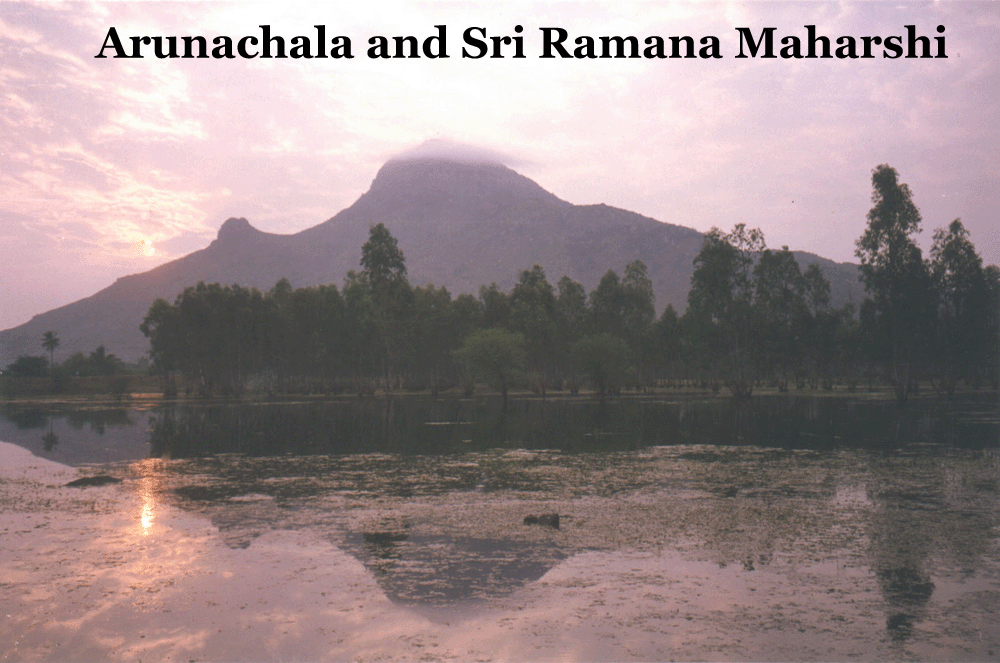
Over the last year or so I made a couple of stuttering and ultimately failed attempts to upgrade my site (www.davidgodman.org). The design and coding were done twelve years ago and are now in need of a major overhaul. I am about to begin another attempt but as a stop-gap measure I recently made a new site that contains extracts from all my books, along with information on where they can be obtained. It can be viewed here:
http://davidgodman.wix.com/ramanamaharshibooks
The site was made from a template provided by a company called Wix. It is simple and easy to use and I can recommend it to anyone who wants to put out a site, but who doesn't have any knowledge of coding.
Since there is a built-in feature on the Wix site that enables blogging and the posting of photo galleries, slide-shows and videos, I plan to use it to add photo and video presentations. To start the ball rolling I have uploaded a gallery of photos that were taken by Eliot Elisofon when he visited Tiruvannamalai in 1949:
http://davidgodman.wix.com/ramanamaharshibooks#!photo-2/cos9
Eliot Elisofon was the photographer who took the photos for the article on Bhagavan that appeared in the 1949 article in LIFE magazine. He took many additional photos that were not included in this article. I have collected all the ones I could find and put them together in this slide show. It runs automatically, but you can stop it with your mouse to see captions or expand the photos.
The 'Photo' section also contains a collection of old black-and-white pictures of Arunachala that I have collected in recent years.
http://davidgodman.wix.com/ramanamaharshibooks#!photos/c1i7j
I love old photos of Tiruvannamalai and Arunachala and have many more that I will post in future presentations.
A couple of days ago I was presented with one of the first copies of a translation of Guru Vachaka Kovai
in Telugu. It was the full text of the version prepared by T. V.
Venkatasubramanian, Robert Butler and myself, minus the introduction and
the end material. This is the cover:
I
have been assured by a devotee in Hyderabad, who has translated
Bhagavan's books into Telugu himself, that the translation is a good
one.
I was
gratified to discover that this edition, which has been brought out by
Ramana Bhakta Mandali, Bangalore, has been initially published as a free
offering to devotees. Only a hundred copies have been printed, and
these are being distributed, free of charge, to Telugu devotees and to
Ramana centres in Andhra Pradesh. If this initial offering is a success
and meets with the approval of Telugu devotees, it is hoped that a
second and more commercial printing can be made.
If any Telugu-speaking devotees want more information about this book, they should contact
C. L.Giridhar, General Secretary, Ramana Bhakta Mandali, Bangalore,
No 377, F- Block, 12th Cross, 16th Main,
Sahakara Nagar, Bangalore –560092
email: ramanabhaktamandali@gmail.com
Blog: http://www.ramana-bhakta.blogspot.in/
This is
latest in a long line of books by Muruganar that have been subsidised by
dedicated devotees. In the 1930s and 40s Ramanapadananda raised money
to publish Muruganar's works in Tamil. I wrote about his efforts a few
years ago on this blog: http://sri-ramana-maharshi.blogspot.in/2008/05/ramanapadananda.html.
In the
late 1970s Professor Swaminathan persuaded the New Delhi government to
bring out all Muruganar's unpublished verses, which were being edited
and compiled by Sadhu Om, in a subsidised series. The resulting nine
Tamil volumes of Sri Ramana Jnana Bodham went on sale at a remarkable Rs 10 per volume.
After
Ramanapadananda handed on the responsibility of publishing Muruganar's
Tamil books to Sri Ramanasramam, it reprinted several of Muruganar's
titles, knowing that they were unlikely to cover their costs. T. V.
Venkatasubramanian told me several years ago that he had edited one of
these books for the ashram. When he asked about a year later how many
copies had been sold, he was told 'About ten'. That wasn't the full
extent of the distribution: many copies were given away to Tamil
devotees who had the necessary literary skill and interest to go through
the text.
When we (Venkatasubramanian, Robert and myself) brought out our own English version of the Guru Vachaka Kovai,
two devotees heard about our project and offered to subsidise the book
for readers in India who might not have been able to buy the book if it
was sold at a commercially viable price. These large subsidies have
enabled me to sell copies to the Ramanasramam bookstore at a price that,
per copy, is less than the cost of printing the book.
Some of
my other books have also found unexpected sponsors. Many years ago a
Korean Zen monk, Daesung Sunim, came across a copy of Be As You Are
and decided to translate it into Korean. When he had finished, he
contacted Penguin in London and asked for the right to publish the book
in South Korea. Penguin had already given the rights to a Korean
publishing house, which was not interested in bringing out Daesung's
translation. He consulted a lawyer who informed him that if he printed
the book himself and gave it away free of charge, he would not be
violating the rights of the South Korean publishing company. In South
Korea monks are often sponsored by industrial companies. Daesung found a
business house that was willing to pay for the printing, and he
received a big enough donation to print 5,000 copies. Daesung then went
on a tour of Zen monasteries and gave away a free copy of Be As You Are
to every Zen monk in South Korea who wanted to read it. For several
years afterwards I would occasionally be accosted and greeted by Korean
Zen monks in Ramanasramam. They were immediately recognisable by their
grey tunics. Most of them didn't know a word of English, but that hadn't
stopped them from making a pilgrimage to Ramanasramam.
While I was finalising the first printing of Padamalai, I gave it to a devotee to proof read.
She didn't find many errors, but when she returned it, she asked, 'How much will this cost to print?'
When I told her, she wrote me a cheque for the full amount. Reading Muruganar seems to affect some people that way.
Not all
translation stories have such a happy ending. Most English books on
Bhagavan manage to cover their costs, but translations into other
languages often struggle to find customers and publishers. I have
several friends who are sitting on manuscripts of Ramana books, which
they have translated themselves, that no one wants to (or can afford to)
print. If reading these stories has inspired any potential patrons, let
me know, and I will put you in touch with devotees who need help with
their projects.
I have been in Colorado, USA, for the last few weeks, staying with my wife who is currently working near Denver. Here I am a couple of days ago, standing in front of a herd of elk who had come down to a picnic area just outside Rocky Mountain National Park.
The day before I went to this park I did an interview with Rick Archer for his site 'Buddha at the Gas Pump'. Rick interviews a different spiritual writer or teacher every week and posts the interview on his site. All the interviews he has done can be found here:
www.batgap.com
His interviews are also posted on Youtube. Here is our conversation, which covered a wide variety of topics:
A few weeks ago Michael James was also interviewed by Rick. This is his interview:
There are several more videos of Michael talking about Bhagavan on his Youtube channel:
http://www.youtube.com/user/SriRamanaTeachings?feature=watch
A few months ago I also started a Youtube channel and loaded up a few videos that were mostly made in my old house about ten years ago. I also added some extracts from a South African documentary on modern advaita teachers that I featured in a few years ago, and a clip of Annamalai Swami. The channel can be found here:
http://www.youtube.com/channel/UCBcqQGNwcSEwlv6gJXP-U9A/feed?view_as=public
Here is one of the videos I posted. It is a short talk I gave about Robert Adams' early life and his relationship with Bhagavan:
I hope to add several more videos in the coming weeks.
If you want to comment on any of these videos, there are three possible places. There is a forum on the www.batgap.com site where viewers can comment on the weekly video. There are separate forums for mine and Michael's interviews. It is also possible to make comments under the videos on the Youtube site. And, of course, you can also leave a comment on this blog.
I will be back in Tiruvannamalai soon.
Apologies
for the lack of contributions to the blog in recent times. I hope to
remedy that with some long posts later in the year. Meanwhile, I am
happy to announce that I have recently brought out an edition of Sorupa Saram
that contains the original Tamil verses, an English translation of
them, and an introduction that summarises the available information
about its author Sorupananda, his chief disciple, Tattuvaraya.
Information about the text and its author can be found in one of my earlier posts:
http://sri-ramana-maharshi.blogspot.in/2011/05/tattuvaraya-and-sorupananda.html
The text has been revised by T. V. Venkatasubramanian and myself since it was published in 2011 on this blog.
The
book is available in India from the Sri Ramanasramam Book Depot. Those
ordering from outside India can obtain it from my site:
http://www.davidgodman.org/books/buybooks.shtml