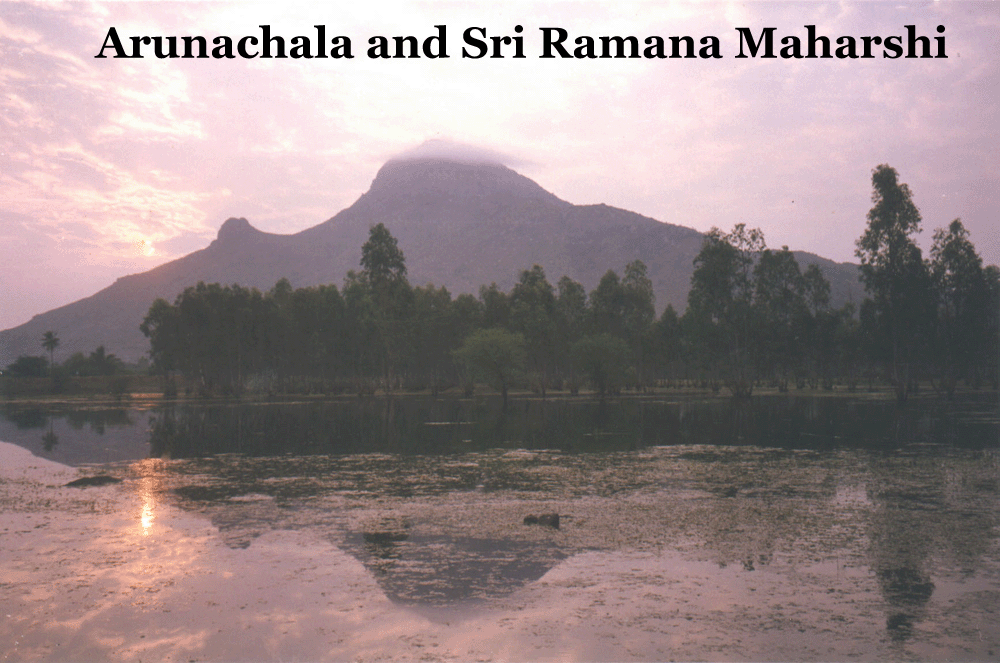
About a week ago I posted a Robert Adams dialogue in which he explained self-enquiry. Since it was very well received, here is another, with the added bonus of some extra stories about his experiences at Ramanasramam.
* * *
When I was eighteen years old, I arrived at Tiruvannamalai. In those days they didn’t have jet planes. It was a propeller plane. I purchased flowers and a bag of fruit to bring to Ramana. I took the rickshaw to the ashram. It was about 8:30 a.m. I entered the hall and there was Ramana on his couch reading his mail. It was after breakfast. I brought the fruit and the flowers over and laid them on his feet. There was a guardrail in front of him to prevent fanatics from attacking him with love. And then I sat down in front of him. He looked at me and smiled, and I smiled back.
I have been to many teachers, many saints, many sages. I was with Nisargadatta, Ananda Mayi Ma, Papa Ramdas, Neem Karoli Baba and many others, but never did I meet anyone who exuded such compassion, such love, such bliss as Ramana Maharshi. There were about thirty people in the room. He looked at me and asked me if I’d eaten breakfast. I said, ‘No’. He spoke some Tamil to the attendant and the attendant came back with two giant leaves, one with fruit and one with some porridge with pepper. After I had consumed the food, I just lay down on the floor. I was very tired.
It was time for his usual walk. He had arthritis in the legs and could hardly walk at that time. After his attendants had helped him to get up, he walked out the door. When he was outside he said something to his attendants, and his attendants motioned for me to come. He guided me to a little shack that I was going to use while I stayed there. He came inside with me, and I bet you think we spoke about profound subjects. On the contrary, he was a natural man. He was the Self of the universe. He asked me how my trip was, where I was from, what made me come here. Then he said I should rest, so I lay down on the cot and he left.
I was awakened about 5 o’clock. It was Ramana again. He came by himself and he brought me food. Can you imagine that? We spoke briefly; I ate and I slept. The next morning I went into the hall. After the morning chanting there was breakfast, and everybody sat around just watching Ramana as he went through his routine. He would go through the mail and read it out loud, talk to some of his devotees. I just observed everything. His composure never changed. Never did I see such compassion, such love.
Then people started to come over to him, asking him questions. His replies were very succinct. They weren’t like you read in a book. Apparently, what you read in a book is his reply to three or four people. They condense it all into one question and answer. But people usually asked a question or made a statement. If he agreed, he would nod or say, ‘Yes. That’s it’. If he didn’t, he would offer an explanation in maybe one or two sentences.
There were foreigners at the ashram when I was there, Muslims, Catholic priests, people from all races and all nationalities. The devotees would sit around and say nothing, but the seekers and disciples would ask questions. After I had been there a week or so, two of his disciples were sort of jokingly arguing with him about something in Tamil. I asked the interpreter what they were talking about.
He said, ‘Ramana’s couch is covered with lice, and he refuses to let us kill them. They climb over his body and his legs and he doesn’t care. He even feeds them. We want to exterminate all the bugs on the couch, but he won’t let us.’
So, the next day they tricked him. When he went outside for his morning walk, they sprayed his couch with DDT.
When he came back, he smelled the couch. He smiled and jokingly said, ‘Someone has tricked me’.
He never got angry, never got mad. I don’t think he knew what the words meant.
A couple of weeks later a German lady came to the ashram. Apparently, she had made a donation of some kind, but she wasn’t happy for some reason. She was complaining to Ramana, but he just kept silent.
I asked the interpreter, ‘What does she want?’
The interpreter said, ‘She wants her donation back. She wants to go home, back to Germany.’
So she started to argue. Everything was going on in front of Ramana. She started to argue with one of the managers of the ashram and Ramana just looked.
Then Ramana said in English, ‘Give her back her donation and add fifty rupees to it,’ which they did, and she left.
This was his nature. He never saw anything wrong. He never took anyone out of his love. No matter what they did, who they were, where their ego was, he understood. He loved everyone just the same.
Six months prior to his leaving his body, I went to Bangalore to see Papa Ramdas. While I was there, I was informed that he [Bhagavan] had left his body. I went back to Tiruvannamalai. The crowds had already started to come, thousands and thousands of people. So, I climbed the hill and went into one of the caves. I stayed there for five days. When I came down, the crowds had dispersed. Ramana had already been interred.
I enquired of the devotee who saw him last, ‘What were the last words he spoke?’
The devotee said, ‘While he was leaving his body a peacock flew on top of the hall and started screeching. Ramana remarked to his devotee, ‘Has anyone fed the peacock yet?’ Those were the last words he spoke.
Now, let’s talk about you. Think of the problems you believe you have. Think of the nonsense that you go on with everyday. Think how furious you become, how you always want to stick up for your rights, as if you had any. The problem is, you think. If you would only stop thinking.
You say, ‘How can I function if I stop thinking?’
Very well, thank you! As a matter of fact you will function much better than you do now, for you will always be taken care of. The universe loves you. It will always supply you with your needs. Forget about other people, what they do, what they don’t do. Do not listen to malicious gossip. Be yourself. Understand who you really are. You are the absolute reality, unconditioned consciousness. Work from that standpoint. Do not work from your problems. Do not get lost in meaningless gossip. Understand your true reality. Be yourself.
What Ramana taught was not new. Ramana simply taught the Upanishads. ‘Who am I?’ has been around since time immemorial. If a teacher always tells you he has something new to teach you, be careful, because there’s nothing new under the sun. Ramana simply revised the ‘Who am I’ philosophy and made it simple for people in the twentieth century. But what did he teach? He simply taught that you are not the body-mind principle. He simply taught that if you have a problem, do not feel sorry for yourself, do not go to psychiatrists, do not condemn yourself. Simply ask yourself, ‘To whom does this problem come?’ And of course the answer will be, ‘The problem comes to me’. Hold onto the ‘me’. Follow the ‘me’ to the source, the substratum of all existence.
How do you do that? How do you hold onto ‘me’? How do you hold onto ‘I’? By simply asking yourself, ‘Who am I? What am I?’ It’s the same thing. Ask yourself again and again, ‘Who am I?’
Forget about time. Forget about space. Forget everything. Keep yourself from thinking. When the thoughts come, ask yourself, ‘To whom comes the thoughts?’
Again, ‘They come to me.’ Hold onto the ‘me’. ‘I think these thoughts. Well then, Who am I? Who thinks these thoughts? Who am I?’
An easier way to do this I have found is to simply say to yourself, ‘I-I, I-I,’ and you will notice as you do this, the I-I goes deeper, deeper, deeper within you into your Heart centre, right to the source. For westerners I have found that saying ‘I-I’ seems to be more helpful than ‘Who am I?’ Again, do not look at time. Do not ask yourself, ‘When is something going to happen?’
A devotee went to Ramana and said, ‘I’ve been with you for twenty-five years, doing “Who am I?” and nothing has happened yet,’ so Ramana said, ‘Try it another twenty-five and see what happens’.
Forget about time. Forget about when something is going to happen. Even if nothing happens in this life, you are ahead of the game, for, if you’ve been sincere, and if you’ve really been working on yourself, you will come back to an environment that is conducive for your realisation, and at that time you may have realisation when you’re about twelve or thirteen years old, because you’ve earned it.
But if you’re like most people and go around minding everybody’s business and saying, ‘I have no time to do this. I’ve tried it for two hours and it doesn’t work,’ then you will keep coming back again, and again, and again, going through all kinds of experiences, until one day, maybe 10,000 years from now you may actually get it and start working on yourself diligently; what you should be doing now.
What do you do with yourself all day long? Think. From the moment you get out of bed, how does your day go? Do you think of God at all? Do you practise or do you think about your affairs and your body? Be honest with yourself. If you’re not making any headway in spiritual life, it’s because you’re not putting anything into it. You have to realise that whatever you see in the world is only a reflection of yourself. If people are mean to you, if they abuse you, it is because you’re seeing yourself as those people. In other words, you’ve got those qualities.
Remember the story of Ramana and the German lady, the one he returned the donation to, plus some extra money?
The following afternoon a devotee asked him, ‘Bhagavan, why did you do that?’ and Ramana explained, ‘When she gave us a donation, to whom do you think she gave it? She gave it to herself, for there’s only one Self. When she took it back, she took it away from herself. When she goes back to Germany, I’m sure she’ll have financial problems until she learns that anything you give is only giving to yourself, for there’s not two or three or four selves, there’s only one Self.’
This includes everything you do in your life, the way you look at another person. Whatever you see, you’re simply seeing yourself.
This is why the only thing I can do for you is to love you, because I love myself and you are myself. When I say ‘I love myself’, I am not referring to Robert. When I use the word ‘Self’ I am referring to infinity, to omnipresence. It includes everything in this universe. So when I love myself, I am obviously loving everyone and everything that exists. I also realise that everything that exists is a projection of my own mind, so I do not identify with the images. I identify with the source, with consciousness, with absolute reality, with ultimate oneness, with nirvana, with emptiness. While I’m talking to you, I realise I’m talking to myself because again there is only one Self. If you can only remember that in your dealings with others, whichever way you deal with anyone else, you’re doing it to yourself. Can you see now why a person like Ramana could never hate anyone or be angry? It wasn’t in his nature.
How do you react to life? When a person displeases you, what do you do? Curse him or her, become angry or violent? How do you handle it? How do you react? Be honest with yourself. It’s the only way. Start from where you are. No human being is perfect. We all make mistakes. Do not feel sorry for yourself, but start from where you are. Where are you? You are consciousness. This is your true nature. Learn to love everything. Learn to see only the good. Realise there’s a reason for everything. If a person displeases you, simply look the other way and forget it. Learn to stop your mind from thinking. You do this by immediately catching yourself when you react to a condition, and enquiring within yourself, ‘Who is becoming angry? Who feels out of sorts?’ ‘I do. “I”.’
Realise you’re dealing with the personal ‘I’, and that all the anger, all the frustration, all the karma, all the samskaras are all attached to that personal ‘I’. Consequently, when you get rid of the personal ‘I’, everything else will go with it. So, don’t try to solve your problems. Do not try to become a better person. Do not try to run away from your life. Simply see who it is who is running, who it is who needs to be a better person. Who has all these problems? ‘I’, ‘I’, always ‘I’. Hold onto that ‘I’ with all of your might, but do not concentrate on the ‘I’. You concentrate on the source of it, which is consciousness, God.
Everybody asks me, over and over again, ‘How do I hold onto the “I”?’
By asking, ‘Who am I?’ or just saying, ‘I-I, I-I, I-I.’ Automatically you will notice the ‘I’ going deeper, and deeper, and deeper and deeper within your Heart, and one day you will become free. But you’re already free. Why not wake up right now? Why go through anything? Everybody is different.
If this appears too difficult for you, if vichara appears hard, then your next best bet is to surrender completely to God. Surrender everything, your problems, your ego, your body, your mind, your work, your world.
Say, ‘Here, God, take it, I want no more of this. I am yours. Do with me as you will. Thy will be done.’
This means you no longer have anything to worry about. If you truly surrender, you will immediately become radiantly happy, for you have given your ego to God. And what’s left is God. You have no body. You have no mind. You have no work. You have no problems. It has been your ego all the time fooling you, making you believe that something is wrong, and you’ve been playing hide and seek, trying to find God here, there and everywhere, when all the time God was within yourself as yourself.
Begin to see the truth. Begin to stand up tall. Become fearless. Become strong. Leave the world alone. It’ll take care of itself. There is a mysterious power that guides the world to its right destiny. It doesn’t need any help from you. If you’re meant to do certain work in the world, it will be done, but you have nothing to do with that. It doesn’t mean that you have to leave your job, or go sit in a cave, or give up your life. Wherever you are, right now is where you’re supposed to be. Just feel, ‘I am not the doer’ and your work will go on. Do not be attached to your work. Do not react to any situation or any condition. Be yourself. Focus your attention on consciousness, and your body will go on doing whatever it came here to do. Everything is preordained. Even when I raise my finger like this, it is preordained. Do not be egotistical and believe that you have any power over everybody or anybody, or that you are the doer. It’s a privilege to have been born on this earth, and the reason you have been born is to find your real Self. Go for it, do it, and become free.
I don’t know why I talk so much. It doesn’t do you any good. I always want to sit in silence, but sometimes we have some new people and they do not understand the silence yet, so I keep on chatting. I wonder if I know what I’m talking about. It doesn’t matter anyway. Any questions?
Question: What is the relationship between effort and realisation, since only the ego is doing this effort. How can the ego doing this effort... ?
Robert: What you call ‘effort’ has been preordained.
Question: Self-enquiry is the ego doing effort?
Robert: Self-enquiry is the ego trying to find itself as the Self, so the effort is brought on through your karma so that you may become Self-realised. It is a privilege to have been able to find in this life the method of self-enquiry. Therefore, it’s been predestined that you should make the effort to find yourself.
Question: Since God or realisation is something that really is like an effortless presence, how could it be ... ?
Robert: When you get on the path correctly, after awhile it becomes effortless. In the beginning there seems to be a little effort you have to take, because you’re breaking away from your old patterns, and as you continue it becomes effortless, easier and easier. It becomes a pleasure. It becomes a joy and you’re always doing it, effortlessly, so the effort is only the beginning stages. It’s not really effort, but when you break into a new habit, the old wants to still stay there and take over. So you still have to push it out as you enquire, ‘To whom does it come? Who feels miserable?’
And as you keep practising and practising it becomes effortless, and pretty soon you do not have to do anything. It just happens by itself. You become happier and happier, more peaceful, and your life becomes a joy to others and to yourself.
Question: I’m confusing the false ‘I’ with the true ‘I’.
Robert: There is only one ‘I’, but for the sake of conversation we say there is a personal ‘I’ which is your ego. The only confusion is your identifying with the personal ‘I’ instead of the real ‘‘I. The real ‘I’ is absolute reality, pure intelligence, Parabrahman, sat-chit-ananda. That is the real ‘I’, and you have a choice.
That choice is: ‘With whom am “I” going to identify?’
Identify with yourself, with consciousness, and there will be no question of two ‘I’s. But again, when you begin, it is your ego ‘I’ that you’re working with. ‘Who am I?’ means the ego. Who is this ego? Where did it come from? Who gave it birth? Why does it exist?
Eventually you will realise, ‘Why, I gave it birth by believing in it. I created my ego myself. I did all this.’
Then it begins to change. The personal ‘I’ becomes weaker and consciousness becomes stronger until the personal ‘I’ disappears altogether and you become free. So, do not keep identifying with the personal ‘I’. Hold on to it. Follow it by asking, ‘What is “I”? Who am I?’
All levels and all teachings are an emanation of the mind, for there has to be someone to experience those levels. Vichara, or self-enquiry, goes right to the heart of the matter. It bypasses every system, negates every system, and awakens you immediately. The mind, as ‘I,’ gives you the problem. When the mind, as ‘I,’ goes, everything else goes with it: all of your past teachings, the world, the universe, God, reincarnation, karma. You become free of the whole mess, and you awaken.
So again, every system is a projection of the mind. In these systems you have to be present to do the work, whereas in this teaching we get rid of the ‘you’ that does the work. So, if the ‘you’ is gone, there’s no work to be done. In other words, who has to meditate? I do. There has to be somebody present for you to meditate. Instead of meditating, ask yourself, ‘Who meditates?’ and the answer will be, ‘I do.’ Then ‘Who am I?’
The lights will come on and you’ll be free. Once the ‘I’ goes there is nobody left to do any spiritual work, for you become consciousness. You become absolute reality, omnipresent, infinite.
Question: So you’re saying these are progressive systems?
Robert: These are progressive systems, and I suppose most people need these things. They’re good. There’s nothing wrong with these things, but the direct path is vichara. You bypass everything.
Question: In the case of the man who spent twenty-five years with Ramana, who isn’t understanding, is he not going through stages?
Robert: On the contrary, he is just there. He’s at peace with himself, and when the time is right for him, he’ll awaken. There are no stages to go through as long as he’s present.
Question: That brings up this question then. If someone comes in here and they never heard this teaching before and they start practising, the first thing they have to do is to recognise that they have a mind and to recognise the storm within. And when they recognise that, then they have a herd of horses within, a stampede. So for a while, for atma vichara and ‘Who am I?’ to work, they have to slow down that stampede by working through a system. So that’s a progressive stage in a way, because there are emotions involved and feelings and sensations that come up. And all of this, for a person to cut through this and to evolve, they must work on those levels.
Robert: How do you know?
Question: Because I’ve been through it.
Robert: Does that mean everybody goes through it?
Question: Well, looking at the average human being, I would say ‘Absolutely’.
Robert: There are some people who just awaken. There are some people who go through stages. There are some people who do a lot of work. There are some people who practise meditation and mantras all day long. There are some people who do nothing and they awaken.
Question: Yes, but the people like that are very few, like Ramana. Ramana was an exception.
Robert: Well, then learn how to do it and become like Ramana. Practise what Ramana practised, and you too can be an exception. Why should you identify with the other? Identify with Ramana’s practice. He said the same thing. Why go through the trouble to go through yoga practices? You’ll come back life after life after life and keep practicing yoga. Find out who’s practising and become free.
Doesn’t that sound reasonable? All you have to do is to find out who’s practising. Who needs to do all these things? I do. Well, ‘Who am I? Where did I come from?’ ‘I-I’. Get rid of that ‘I’ and you’re home free.
Question: What about the identification with the body? I’m confusing the body with thought.
Robert: What about it?
Question: Identification. When there’s pain in the body, you’re just involved in the pain, not the reality.
Robert: The reality is not the pain. The body is in pain, but you are not the body. So, if you stick to your true Self, you will hardly feel the pain. Let the body take care of itself. Do not concern yourself with the body. The body will still eat, it will still go to the bathroom, it will still take a shower, it will still take care of itself, but you have absolutely nothing to do with it. You are not the body, so why identify with the pain. Identify with consciousness, with the Self, and then see what happens.
This is why, when people like Ramana and Ramakrishna were dying, especially Ramakrishna, he literally wasted away, and they used to tell him the same thing they did Ramana: ‘Master, heal yourself. We have seen you heal others. Heal yourself.’
And the answer would always be the same, ‘You foolish people, what do you see? Who sees a sick body? There is nobody to be sick. What are you looking at? Change your identification. See the truth.’
That’s why Jesus was able to say, ‘I am with you always, even unto the end of the world,’ for he realised he was consciousness, not the body, not what appears to be real. Everything that most of you are looking at right now is an appearance. It is not the truth. There is another world of reality where there is only perfection, love, bliss, joy. With whom are you identifying? The choice is yours.
Question: The ‘I’ seems to be such a deeply ingrained habit. It seems like the primary addiction. It seems like all other addictions come out of the addiction of ‘I’. The ego addiction is the primary addiction. That’s the problem: it’s so addictive.
Robert: Indeed. Correct. As you keep referring back to yourself and saying, ‘Who am I?’ the ‘I’ becomes weaker and weaker and weaker. Eventually it has to disappear, and then you’re free.
Question: It’s funny that sometimes I feel a little loosened up, abiding, and at other times it’s all forgotten, and it’s back to the ego again.
Robert: That’s how it appears to work, but as you continue practising and practising and practising, the day will come when you’re home free. That’s why I said, do not look at time, even if it takes more than a lifetime. You’re still ahead of the person going bowling.
Question: Even when you see the thoughts moving and you see how identified you are, it’s almost like the ego enjoys this. It enjoys resisting the peace, silence and intelligence. It’s so used to this, it seems to like its own suffering.
Robert: Are you talking from the standpoint of the ego or the Self?
Question: From the ego.
Robert: So ask yourself, ‘Who’s going through all this? Who’s suffering? To whom does it come?’ Identify with the source, not with the ego. Do not go into all the details of what the ego does. Go into the details of what the Self is, pure intelligence, absolute awareness, sat-chit-ananda, Parabrahman. Speak of those things, and let the ego take care of itself.
Question: The ego doesn’t seem to want all that.
Robert: No, you don’t want all that because you refuse to identify with those higher things. You keep talking about the ego over and over again as if it were a power. It doesn’t even exist. It’s a non-entity.
Question: I guess I’m possessed.
Robert: You’re possessed by God, You can never get away from God, no matter how hard you try.
Question: I’ve been trying with all my might.
Robert: Maybe that’s the problem. Just observe and watch. Stop trying. Watch your mind in action. Observe your thoughts, become the witness, and then you’ll say, ‘Ah, look what’s happening to me. Am I that? Of course not.’ Then it will become easier for you.
Question: It’s really embarrassing to watch my mind, because you feel like you should be committed to a mental institution. It’s total nonsense, total craziness.
Robert: Again, to whom is it embarrassing? It’s embarrassing to the ego. The ego watches, the ego’s embarrassed, and the ego fights back, but you do not react to it. Do not react. Watch, observe and ask the question, ‘To whom does it come?’ That’s all you’ve got to do, and everything else will take care of itself.
Question: Watching it breaks the identification?
Robert: Observing.
Question: It’s funny, when you start to forget to observe, you melt into the identification of it so easily. You melt into the identification with the ego. That’s what is wonderful about enquiry, that it breaks it.
Robert: Don’t get caught up in too many details. Make it simple, very simple. The simpler the better.
Question: I think part of the problem is, speaking for myself of course, is that I don’t believe it will happen. I feel it happens just to a favored few, like Jesus, Buddha or yourself. What’s the sense of trying it if it’s not going to happen?
Robert: Well, if you don’t feel it’s going to happen, what can you do? Go see a movie. You’ve got to realise you are greater than you think, and you’ve got the same power within you as everybody else does. It may appear to be asleep, but as you work on yourself, work on yourself, work on yourself, you will awaken it, and one day it will become stronger than you are and take you over completely and you’ll be free. But you’ve got to keep on working on yourself, and stop putting yourself down. The worst thing you can do is put yourself down. That’s blasphemy because you’re putting God down. Think of yourself as a higher person, love yourself, worship yourself, bow to yourself. You are greater than you think.
Question: Robert, at first when you were speaking to Bob, you said to make things simple and follow self-enquiry of ‘Who am I?’, and at the same time you said, ‘Don’t make it like a mantra’. If you keep saying ‘I-I’ or ‘Who am I?, I am me,’ you get caught in a circular answer and question thing. You said not to make it like a mantra.
Robert: ‘Who am I?’ is never a mantra. You simply observe yourself, ask yourself the question, ‘To whom do these things come? To me,’ then say ‘Who am I?’ or ‘I-I’, ‘I-I.’ It’s not a mantra. As you keep doing it to yourself, you will awaken.
Question: Even if I do the question and answer, even though I come into a circle of three questions with three answers, and I kept going around and around, it’s not a mantra?
Robert: No it’s not. But you can ask yourself, ‘To whom do these things come? To whom do the three questions come?’ There has to be a person to experience the three questions. Get rid of that person and you’ll be free.
Question: Would I be breaking self-enquiry if I got rid of the me with, ‘To whom to these questions come? They come to me.’
Robert: Self-enquiry is only for the ego.
Question: I’m like Bob then. I’ve got a big ego.
Robert: Keep practising. Keep practising and you’ll break it down.
Question: Robert, you said, when you ask yourself the question, you don’t answer because when you answer, that just comes from the mind. When you ask, ‘Who am I?’ just rest, don’t question.
Is consciousness observing the self-enquiry?
Robert: Consciousness is self-contained. It has nothing to do with self-enquiry. Only the ego does.
Question: Then why do we have to do self-enquiry?
Robert: Because you have to use the ego to get rid of the ego.
Question: So consciousness is noticing all of the self-enquiry then?
Robert: It doesn’t notice anything. As you practice self-enquiry, your mind will disappear and your true Self will come forth all by itself.
Question: Isn’t our true Self here now?
Robert: Yes, you will awaken to it, but you don’t believe it is, so you must practice self-enquiry.
Question: How do you trace it to the heart, when you say that with self-enquiry you trace it to the heart?
Robert: Another term for the heart is consciousness, so the heart is really consciousness. You simply enquire, ‘Who am I?’ It takes care of itself. The ‘I’ becomes weaker and weaker and disappears.
Question: Your attention then should always be focused on the source. When you hold onto the ‘I’, that’s just a way of focusing attention on the source from whence the ‘I’ arises.
Robert: Yes, when I say hold onto the ‘I’, I mean you’re witnessing the ‘I’. You’re watching where it goes. From whence it came from and where it goes back to.
Question: When you say that consciousness or God dwells in you as you, that ‘as you’ is not referring then to the ego?
Robert: No, it’s referring to consciousness.
Question: It’s redundant really.
Robert: Yes. Consciousness is your true existence and nothing else. Everything else we talk about, everything else we do is to make you realise that your true nature is consciousness. Then everything becomes redundant, but we have to talk like this because you believe you’re human. You believe you’re the body. When will you stop believing that?
Question: Robert, if a person believes that they’re happy in this alleged consciousness that we all possibly share, I mean your students, is that the same thing? Being in love with nature as being in love with life. Is that about on the same level in your eyes as...
Robert: All of these things that you’re referring to are a projection of your mind. You create your universe, and you create your world, and you create the trees and the birds and everything else. So get rid of your mind and everything else will go.
Question: There won’t be any trees?
Robert: You’ll be the tree. You’ll be everything you like.
Question: So then it’s really the ego that has all the beauty.
Robert: You can say that, yes. You bring fresh flowers into your room and then they die in a couple of days. So how can that be real ultimately? Everything you fall in love with gets old and dies. So how can you say that’s real? Contact reality and you will always be happy.