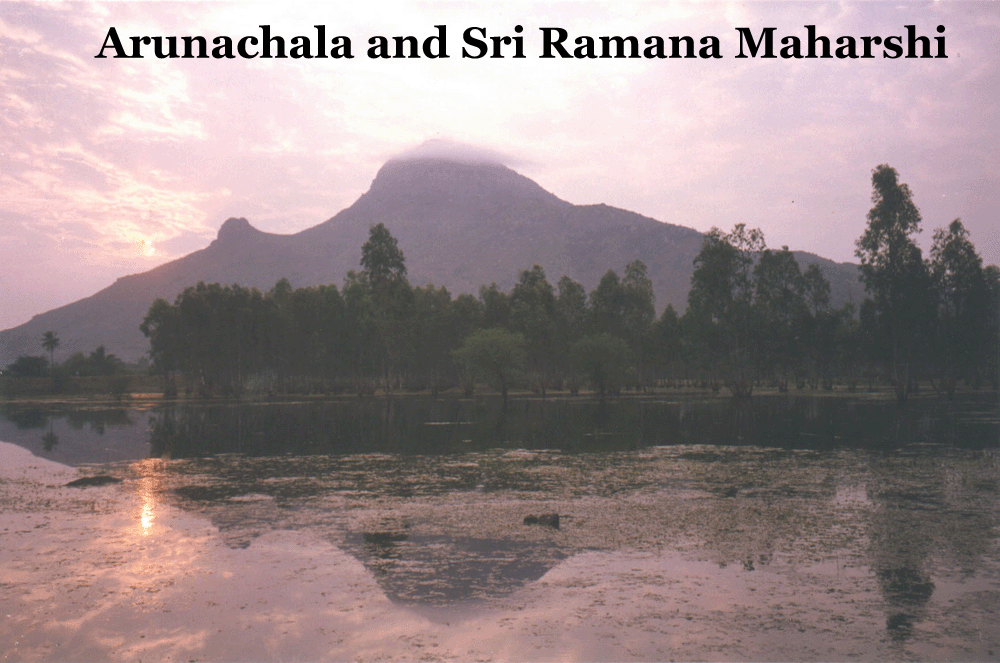
Swami Pranavananda was a Malayali devotee who first had Bhagavan’s darshan in 1910. Prior to that date he had spent twelve years in a traditional Gurukula environment learning Vedanta theory and practice, followed by two years as a wandering sannyasin. The information he had picked up in his school from his Guru had convinced him that the Atman was bliss, and his real nature, but his day-to-day experience could not validate this in any way. He fully believed that the Self was bliss, but was utterly despondent that he had failed to recognise or experience it in any way. He felt he was a beggar who was sitting on a pile of treasure that he couldn’t access. In 1910, still in a state of despair, he came to Virupaksha Cave and had the darshan of Bhagavan. This is how he describes what happened next:
Bhagavan was seated outside the cave on the pial that had been constructed under the tree. He looked like Dakshinamurti, the ancient Guru who taught his disciples in silence. Bhagavan’s gaze fell upon me, and lo!, instantly I felt I was drowned in the ocean of peace. I lost my body consciousness and experienced the bliss I had been hunting for so long. I spent some time in this state.
My Guru had spent twelve years teaching me about the bliss of the Self, but Bhagavan made me taste it for myself with just a single look. This is what I call God’s grace. Who else was Bhagavan but God himself?
I have no hesitation in proclaiming that the formless God took the form of Bhagavan Sri Ramana Maharshi. He came to planet earth only to make it holy.
Swami Pranavananda eventually settled down near Bhagavan and came to see him every day to sit in his presence and listen to his teachings. The following story he tells must have taken place many years later since he locates it in ‘the hall’ the building that was built in 1928 for Bhagavan to receive visitors in.
Bhagavan spoke only when he had to. And that too briefly. He explained that silence was continuous eloquence.
My intimacy with him had grown by this time. I had a desire to ask him questions whenever doubts arose, but I always resisted the temptation. Yet, somehow, my doubts had to be cleared, so I conceived a plan. When some new devotees of Bhagavan came to the ashram, I asked them to speak the very questions that I myself wanted to be answered.
They were happy to oblige. When they sat in the hall where Bhagavan gave darshan to everyone, they prayed to Bhagavan to clear their doubts, which, in fact were mine. Everyone in the hall – not just me – waited anxiously for Bhagavan to give his reply.
Bhagavan, however, didn’t utter a word. Instead, he looked at me at and summoned me to come closer. I went up to him, wondering what he would say.
Bhagavan said, ‘You have heard the questions they have put to me. Unfortunately, I am not the person to answer them since I am not very well educated. You are a learned person. As such, you should give them answers since you have the qualifications. Please give them an answer.’
Hearing him, I was dumbfounded. I guessed that Bhagavan knew that I was the author of these questions, and not the people who had asked them. But what was I to do when Bhagavan had himself expressed his opinion that he was not competent to give answers, whereas I was, since I was more qualified? I was captured in my own trap.
‘Go on! Answer their questions,’ said Bhagavan again.
I had no alternative except to obey his command. I had to think up replies to my own questions. I did it, but it took me about one and a half hours. But how could I clear my own doubts? It was Bhagavan himself who guided me from within. He smiled throughout my performance.
I felt a great empathy with Swami Pranavananda when I read these words because I was once in this trap myself.
In the 1990s, when I was working on Papaji’s biography in Lucknow, various journalists would come and ask Papaji if they could interview him. Papaji generally agreed, and the interviews would be held in public as part of the usual morning satsang. Papaji would ask them to write out their questions in advance and give him a copy so he could see what kind of topics they were interested in. Usually, he would ask them to give me the list so that I could type the questions up in a bigger-than-usual font. His eyesight was quite poor towards the end of his life, and it was much easier for him to read large-font printouts, rather than handwritten scrawls. He couldn’t just listen to the questions because his hearing ability had also been considerably reduced.
I would go through the questions with the visitors and occasionally suggest supplementary questions that I thought Papaji would be interested in answering. He had answered most questions many times already, and I knew from experience that he appreciated the occasional new topic. It was also an opportunity for me to get answers to questions that were coming up in the course of my own research.
Unlike Swami Pranavananda, I was not shy about submitting my own questions. The first questionnaire I gave him was about sixteen pages long, and Papaji spent most of one summer writing out replies to my various questions. I have about 150 pages of his handwritten replies in various files and notebooks. I added extra questions to the visitors’ lists, not just because I needed the information; I knew that Papaji liked to be challenged in public interviews, and I knew from experience that he could get very energised by a good set of questions.
There is one other point that I should mention. If you went up to Papaji during satsang with a question, there was no way of knowing whether he would answer it. He might tell a story; he might ask you to sing a song; or he might make fun of some of the things you had written to him. He would sometimes ignore everything you had written, but as you sat there in his presence and under his powerful gaze, you would get what you needed in that moment. It may not have been a verbal answer, but the power of the Self would make sure that you went away with a glimpse of what Papaji wanted you to experience, rather than a response to your question.
Public interviews by journalists, though, operated under entirely different rules. If you asked a straight question, you would get a straight answer. That is why they were so ideal, from my point of view, for slipping in extra questions on topics that most people were far too afraid to ask. Towards the end of his life, for example, I slipped one question into an interview because I felt that Papaji needed to make an unequivocal public statement that could not be challenged later.
I persuaded someone to ask him, ‘Have you appointed a successor, and if not, are you planning to?’ To which he replied, ‘No I haven’t, and I’m not going to’. As I said, during interviews with journalists, straight to-the-point questions received straight and direct answers.
My downfall came in 1996 when an Australian and a New Zealand woman both came to Lucknow and asked for interviews for their respective magazines. Papaji decided to amalgamate the interviews and asked them, as usual, to give me their questions so that I could type them up. I sat with them after satsang, looked at their questions, and decided they were mostly not the sort that Papaji would be interested in. There was a lot of what I would describe as ‘new age’ stuff that I knew he didn’t care much for. I started to suggest related topics which I knew he might be more interested in, and they both agreed to all my various insertions. They both seemed quite interested in working with dreams, so I suggested a couple of questions that had a more advaitic and Ramana-related twist.
One question I inserted asked: ‘Ramana Maharshi says that there is no difference between the waking state and the dream state except that one is short and the other is long. If this is so, how can you tell right now whether you are giving satsang in your dream or in your waking state?’
I put this particular question in because, in fun, I had asked the same question to Lakshmana Swamy in the early 1980s. It was a light-hearted question, and I expected a light-hearted answer, but Lakshmana Swamy took it very seriously.
After a long pause while he contemplated the topic, he replied, ‘Sometimes it’s very difficult to tell them apart. If I can’t decide whether I am awake or dreaming, I remember that the waking world is a gross one whereas the dream world is subtle. If I have any doubts, I hit something that looks solid. If that wakes me up, I know I was dreaming. If it doesn’t I know I am awake.’
I loved this answer because it gave me a rare and unexpected insight into the state of Self-abidance. If, instead of identifying with the body, one remains established in the Self, the waking and dream pictures that appear and disappear in that underlying state are essentially indistinguishable. Lacking the false anchor of 'I am the body', Lakshmana Swamy really didn't know some of the time whether he was awake or in a dream.
I added this question to the women’s interview list to see how Papaji would respond to it. I also added quite a few more since I thought the original questions were a bit on the bland side. When I was done, I think that about half the questions were mine. I took the list to his house and gave it to him.
He scanned the pages with a straight face, giving nothing away, but then he said, ‘All these people, they ask the same questions. I have been answering these questions every week for decades now. You know what my answers are to all these questions. Write them out for me, as if they are my answers, and I will read them out in satsang tomorrow morning.’
I was stumped. I had no idea how he would answer my own questions, which is why I had asked them in the first place. I now had to go off and formulate replies that would sound like Papaji giving his own answers on these topics. I sweated over them for several hours before I finally came up with responses that seemed philosophically correct, and which also sounded like the kind of replies Papaji normally gave. I handed in my ‘homework’ the next morning.
Papaji went through them and occasionally giggled as he read what I had written.
‘These are good answers,’ he said, ‘but it doesn’t sound like me because there are not enough stories. We need more stories.’
I said, ‘Satsang is in a couple of hours. I haven’t got time to type out stories. Anyway, you don’t need a script to tell stories. As you are reading, if a story pops up in your consciousness, just tell it.’
So that’s what he did. He read out my answers one by one, after telling the women that he had made notes on the questions at home the night before. Occasionally, he would branch out and tell a story or two. The women were sitting to his left. I was on his right, far enough away to be completely out of his line of sight.
However, when he came to the question, ‘How can you tell right now whether you are giving satsang in the waking state or in the dream state?’, he swivelled ninety degrees on his chair, looked at me and said, ‘That’s a very interesting question, isn’t it David? I wonder how I should answer it.’
I knew at that point that he knew what was going on. I knew he knew that I had been adding questions, and I knew he knew that this particular one was mine.
He turned back to the women and read out what I had written: ‘I am not in either the waking state or the dream state right now. Both of these states are in me.’
I thought it was a good answer, but I have no idea whether it would have been something that Papaji might have said himself if I had asked the question in more conventional circumstances.
That was the last time I overloaded an interview with my own questions. Papaji continued to send me lists of journalist’s questions to type out, but having learned my lesson with this particular story, I never added more than two extra queries to the subsequent questionnaires. I assumed he knew that I had been doing this before; and I assumed that he didn’t mind because he had always answered my interpolated questions before. He just drew the line when I tried to hijack an interview with far too many questions of my own.