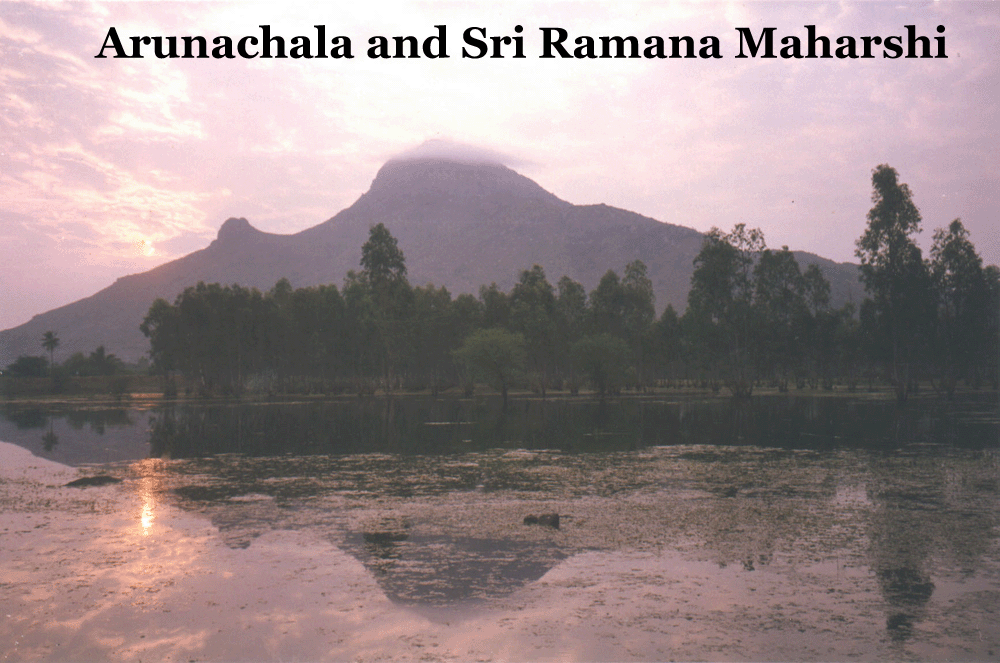
I started to reply to Broken Yogi’s description of an experience he had had, and then decided to make a separate post of it. This is what he said:
First of all, I must say that this sounds like a wonderful experience. I suspect a few readers were thinking to themselves, ‘I wish something like that would happen to me’.
I think quite a few people on the spiritual path have a brief epiphany in which they suddenly become aware, directly, of what is ‘real’ and what is not. The ‘what is not’ turns out to be everything they formerly regarded as ‘real’. As Broken Yogi remarked, Papaji used to say that if an experience comes and goes, it is not an experience of the Self because the Self never comes and goes. However, you could turn that around and say, ‘Since it is mind that comes and goes, when mind is temporarily absent, one gets a glimpse of the underlying Self’. Such experiences may be mediated through a still-existing latent ‘I’-thought, but even so, they are always impressive when they happen.
There is an interesting account by Kunju Swami that sheds some light on this phenomenon. Like Broken Yogi, he had had a wonderful experience in the presence of his Guru, but subsequently lost it. This is his description of what happened:
Because the plague had driven away most of the inhabitants of the town [of Tiruvannamalai], visitors to Sri Bhagavan were very few. I was therefore left alone with Sri Bhagavan for much of the time. While we were together he often used to look at me, and as he did so, I became aware that his eyes had a strange brilliance and fascination in them. Whenever I looked into his eyes for any length of time I saw a bright effulgence. I could not say from where it came but it had the effect of making me forget everything. It was not like sleep for I was fully aware. I was also filled with a strange peace and bliss. After each experience I would come back to my normal physical state with a shudder. This occurred again and again on each of the eighteen days that I stayed with Sri Bhagavan. I was like someone intoxicated. I was absolutely indifferent to everything, had no curiosity to see anything, no desires whatsoever. Whatever activities I did, I did them all in a very mechanical way. So long as I stayed in the presence of Sri Bhagavan, I continued to have these experiences of peace and bliss. Because of the greatness of the presence of Sri Bhagavan I was able to experience the tranquil state of abiding firmly in the Heart.
After experiencing this state for some days the thought occurred to me, ‘Here, in order to join in all the daily routines, I have to interrupt my meditative state. Now that I have this firm experience I could remain uninterruptedly in continuous meditation for days if I stayed at home.’ Furthermore, I felt that it was a sin to eat food from the Guru without doing any service to him in return.
When I conveyed my thoughts to Ramakrishna Swami, I found that he was in complete agreement with me. We informed Sri Bhagavan of our decision and went back to our homes in Kerala. We had decided in advance that when we reached home we would meditate in seclusion, observe silence and be immersed in samadhi. We also decided neither to speak to anyone nor to meet each other.
When I reached home I found that my parents, who had been in a very agitated state because they had no idea where I had gone, were extremely happy to see me. Ramakrishna and I stuck to our resolution by staying in our respective homes and observing silence. My parents did not mind the silence, or anything else that I did. They were quite content merely to have me at home.
As the days passed the meditative state experienced in Sri Bhagavan’s presence steadily declined. I slowly became my old restless self. I did not have any new experiences, nor could I get into samadhi. Only then did I realise how ignorant I had been. I was greatly shaken by this disappointment, but I could not reveal to anyone what had happened. Then, one night, while I was dwelling on my disappointment, Ramakrishna Swami came to my place and revealed that his experience had been the same as mine. We both felt ashamed of our foolishness that led us to believe that we had achieved in a few days the state that aspirants of ancient days attained only after many years of striving in the immediate presence of great sages. By losing the state we had formerly experienced, we also realised fully the greatness of Sri Bhagavan’s presence. Feeling that it would be pointless for us to stay any longer at home, we decided that our only hope was to take refuge in Sri Bhagavan at Tiruvannamalai…
One day, [some time after my return,] while I was doing some work for Sri Bhagavan, I asked him why the experiences I had felt in his presence during my first visit had not continued after my return to Kerala but instead had steadily declined and finally ceased. By way of a reply Sri Bhagavan asked me to read verses eighty-three to ninety-three of Kaivalya Navaneeta, part one, telling me that the answer to my question could be found in those verses. The verses are as follows:
On hearing this [instruction from the Master] the disciple, loyal to the instructions of the Master, discarded the five sheaths and the blank [mind], realised the Self as ‘I am Brahman’, went beyond that and remained as perfect being.
At the glance of the Master, who was grace incarnate, the worthy disciple sank into the ocean of bliss and merged as the undivided whole, as pure consciousness, free from the body, the organs and all else, with mind made perfect so that he became the true Self, unaware while awake.
After the blessed disciple had remained in that state for a long time, his mind gently turned outwards. Then he saw his glorious Master before him. His eyes were filled with tears of joy. He was full of love and fell at the feet of the Master. He rose up, went round the Master with folded hands and spoke to him:
‘Lord, you are the reality remaining as my inmost Self, ruling me during all my countless incarnations! Glory to you who have put on an external form in order to instruct me! I do not see how I can repay your grace for having liberated me. Glory! Glory to your holy feet!’
The Master beamed on him as he spoke, drew him near and said very lovingly, ‘To stay fixed in the Self, without the three kinds of obstacles obstructing your experience, is the highest return you can render me.’
‘My Lord! Can such realisation as has transcended the dual perception of “You” and “I”, and found the Self to be entire and all pervading, fail me at any time?’ The Master replied, ‘The truth that “I am Brahman” is realised from the scriptures or by the grace of the Master, but it cannot be firm in the face of obstruction.
‘Ignorance, uncertainty and wrong knowledge are obstacles resulting from long-standing habits in the innumerable incarnations of the past which cause trouble [and make] the fruits of realisation slip away. Therefore root them out by hearing the truth, reasoning and meditation [sravana, manana, nididhyasana].
‘Defective realisation will not put an end to bondage. Therefore, devote yourself to hearing the truth, reasoning and meditation and root out ignorance, uncertainty and wrong knowledge.
‘Ignorance veils the truth that the Self is Brahman and shows forth multiplicity instead. Uncertainty is the confusion resulting from lack of firm faith in the words of the Master. The illusion that the evanescent world is a reality and that the body is the self is wrong knowledge. So say the sages.
‘Hearing the truth is to revert the mind repeatedly to the teaching: “That thou art”. Reasoning is rational investigation of the meaning of the text, as already heard. Meditation is one-pointedness of mind.
‘If every day you do these, you will surely gain liberation. The practice must be kept up so long as the sense of knower and knowledge persists. No effort is necessary thereafter. Remaining as pure, eternal consciousness, untainted like the ether and thus liberated while alive, one will live forever as That, after being disembodied also.’
Sri Bhagavan then summarised the verses and explained their meaning to me. During the course of his explanation he remarked, ‘The experience [of the Self] can occur in the presence of the Guru, but it may not last. Doubts will rise again and again and in order to clear them, the disciple should continue to study, think and practise. Sravana, manana and nididhyasana should be done until the distinction between knower, known and knowing no longer arises.’
After Sri Bhagavan had explained all this to me I decided to stay always in his presence and to carry out the practices he prescribed. (The Power of the Presence, part two, pp. 8-13)
Sravana, manana and nididhyasana comprise the traditional vedantic route to knowledge. Sravana is listening to the Guru’s words, manana is contemplating them and convincing oneself that they are true, and nididhyasana is the practice that results in the direct experience of what they indicate. The implication of Bhagavan’s response to Kunju Swami is that while the presence or power of the Guru may bring about temporary abidance in the Heart, such an experience may not remain firm unless it is followed by contemplating the truth of the Guru’s words and ultimately experiencing them as one’s own reality.
While I was in Lucknow I was surprised to hear Papaji, who generally did not advocate these traditional forms of practice, give this same advice to a visitor. However, when I questioned him about his remarks later, he began his reply by saying that if one has a direct but temporary experience of the Self, it is more useful and effective to find a true teacher who can help one establish oneself firmly in that state:
Although Papaji began his reply by appearing to disparage the traditional practices of manana, sravana and nididhyasana, in the second half of his reply he is clearly advocating them since he says that one should go to a true Guru, listen to him proclaim ‘You are That’, and then abide in that state which is being pointed out by the words.
I showed the Kaivalya Navaneeta verses that Bhagavan recommended to Kunju Swami to Papaji and asked him what he thought of the advice they contained. He replied:
Papaji then read out all the verses, commenting on a few of them. At the end of verse 89 he remarked:
When Papaji had reached the end of the Kaivalya Navaneeta verses, I posed the following questions:
By claiming the experience – ‘I’ am enlightened – and by holding onto it as something that one ‘has’, one allows the individual ‘I’ to rise again. When this happens, the experience fades and becomes nothing more than a pleasant memory.
While I was in Lucknow I met many people who had had waking up experiences or brief glimpses of the Self while they were attending satsang with Papaji, but in almost all cases they seemed to wear off in the days and weeks that followed. While the Guru’s presence was the key catalyst in making the experience happen, what caused it to go away were the vasanas that had not been destroyed by the experience. This is what Papaji told me when I spoke to him in 1992:
The Lucknow satsangs were characterised by large numbers of people claiming ‘enlightenment’. What is far less well known is that Papaji distinguished between ‘enlightenment’, which he seemed to regard as an experience of the Self that could be lost if it was not guarded properly, and the sahaja state, which was permanent and irreversible. I tried to get to grips with this distinction in the following dialogue that I had with Papaji, but, like many other people who tried to talk to him about this, the results were not entirely satisfactory. I have included a few explanatory comments of my own in italics and in brackets after some of the replies.
David: Three days ago I received a copy of a letter which you wrote to a couple in 1991. You were congratulating them on having waking-up experiences. In your letter you wrote: ‘You have won enlightenment. Now you have to go beyond on the raft of this enlightenment to the unmanifest supreme, turiyatita sahaja samadhi. This can be vaguely translated into English as “spontaneous natural state”.’
Papaji: Turiyatita sahaja samadhi actually cannot be translated into any other language. This is a Sanskrit term which has no equivalent in English. Waking, dreaming and sleeping are the first three states that we all know and experience. ‘Turiya’ means ‘the fourth’. It is the state which underlies and supports the three states of waking, dreaming and sleeping. Beyond this is turiyatita, which means ‘beyond the fourth’. It has no name because it cannot be named. We can call it the transcendent state, or we can loosely translate it as the ‘spontaneous, natural state’. Very few people discover this state. Kabir, Ravidas and Sukdev found it, but very few others know this state directly. Kabir was a weaver, Ravidas was a shoemaker, and Janaka was a king. They had different roles in life, but their state was the same.
What are the indications of this state? In the sahaja state there is no planning. There is no feeling, ‘I have got to do this,’ or ‘I have not got to do that’. Whatever comes is finished and then forgotten. It is not stored in the memory.
David: I would like to ask you some questions about the two states. What is the difference between enlightenment and the state beyond it, which you call sahaja sthiti?
Papaji: Enlightenment is connected with the word ‘light’, which is the opposite of dark. It is seen as the light which banishes darkness. If a man thinks that he is in spiritual darkness, he strives for the light that will banish that darkness. He meditates, he chants the name of God and does tapas until finally this state of enlightenment is revealed to him. Before, he was in darkness; now, through his efforts, he has found the light that banishes the darkness. Before he attained the state of enlightenment, he was in a state of ignorance. This means that enlightenment came at some later time and was not there before. If it was not present before and only appeared later, it is in time, and whatever exists in time is not permanent. At some later time it will disappear. This state which is won by effort will sooner or later disappear. It is not the natural or sahaja state, which is there all the time, and which needs no effort to reveal itself. This is the difference between them. One is attained in time by effort, and is not permanent; the other is there all the time, naturally and effortlessly.
Everyone is in this natural state whether one is aware of it or not. It is only arrogance that prevents one from being aware of it. Everyone thinks, ‘I have done this’, ‘I must do that’. ‘This is mine; that is his.’ Claiming ownership of things that are not yours is arrogance; taking responsibility for things you have not done is arrogance. The man who lives in sahaja sthiti does not live and behave like this. He knows that everything is going on naturally by itself. He claims nothing as his own, not even his thoughts.
When I speak and read, the eyes help me to read and the tongue helps me to speak. The words I speak come out of the mouth, but the tongue itself is not speaking. Where do these words ultimately come from? Nobody thinks about the answer to this question. If the eyes of a dead person are open, that body can’t read, and it can’t speak. So who or what is responsible for sending the light to the eyes to see, and for sending the sound which ends up as talking? Go back and see the source from which everything comes. If you know that source, you will know what this sahaja sthiti is. Everything else is ego. When there is the feeling ‘I am looking’ or ‘I am feeling,’ or ‘I am behaving,’ there is mind, there is ego, and the natural state is covered up. Everything, including this whole world, arises from that source. When you know that source by being that source, then and only then can you say that you are in sahaja sthiti.
[Papaji’s claim here that everything except sahaja sthiti is a state of the ego is an interesting one. This would necessarily include enlightenment experiences or direct experiences of the Self that come and go. Bhagavan endorsed this to some extent when he discussed the sahaja state with S. S. Cohen:
The context of Bhagavan’s discussion with S. S. Cohen was the distinctions between kevala nirvikalpa samadhi, the ‘I-I’ consciousness and the sahaja state. When he said that all states and experiences prior to the sahaja state were intellectual, Bhagavan seemed to include kevala nirvikalpa samadhi and the ‘I-I’ consciousness in this ‘intellectual’ category.
In the responses to the ‘Ajata’ posting there was some discussion about whether temporary experiences of the Self could be classed as ‘ajata’, whether an experience of the Self is necessarily an experience of ajata, and so on. If these temporary experiences are, as Bhagavan seems to be saying here, just very subtle states of mind, then I would say that these experiences are not ‘ajata’. For me (and you are all welcome to disagree on this) the experience of ajata cannot be a mediated one. There cannot be a valid ajata experience if it is mediated through a ‘created’ and imaginary entity.
Now back to my discussion with Papaji:]
David: You advised the couple to go from the state of enlightenment to the sahaja state. How is it possible to progress from the former to the latter? Does it happen automatically? Does it happen in all cases, most cases, or only a few? If it only happens in some cases, what prevents the rest from moving on to this final state? If it cannot be done by effort or practice, can it be done merely by attending satsang?
Papaji: It cannot be attained by any effort or practice, nor can it be attained merely by attending satsang. Many people attend this satsang, some for years at a time. But who among then can stand up and honestly proclaim, ‘I am in sahaja sthiti’?
The sahaja state can never come through effort or practice. It cannot be attained because it is there all the time. It neither comes, nor does it go. If you simply keep quiet and let things happen by themselves, you will find that it is that which is present all the time. You are never away from it or apart from it. Whatever is done is done by the supreme power which moves all things. Without that supreme power I could not even lift my hand. The problems start when you think, ‘I am lifting my hand’. Don’t bring in this egotistic idea at all. Let this supreme power take charge of all your activities, and be aware that it is this supreme power alone that is doing them. Don’t ever have the idea that nothing can happen unless you decide to make it happen. This is the kind of relationship that you have to have with this supreme power which is always there. Bow down before that power because she is supreme. Without her the sun could not rise in the morning, nor the moon at night. Nothing can function without this power, but no one is aware of this.
David: You sometimes say that the state of enlightenment is a diamond which must be guarded, protected, and not thrown away. It seems that the diamond of enlightenment can be thrown away, but the sahaja sthiti can never be lost or discarded. Is this correct? If the mind and the individual self have ceased to function in the state of enlightenment, who is there left to guard the experience or throw it away?
Papaji: You can neither retain nor reject the sahaja sthiti because it does not belong to you. It is not yours to lose or dispose of. Nothing belongs to you. When nothing is yours, you have nothing to lose or throw away. If something comes to you, you can keep it, but don’t have the idea that it belongs to you. And when it goes, don’t cry over it. A beautiful thing may come and go, but if the idea of ownership or attachment is not there, neither its coming nor its going will matter to you. In the sahaja sthiti nothing is claimed or rejected. Because these notions are not there, there is never any feeling of gain or loss. It is the ego that keeps accounts of what is gained and what is lost.
Have no thought of gaining or losing; have no thought of ownership; have no notions about time. When all these have gone, there is sahaja sthiti.
David: The following words come from a verse in Tripura Rahasya. Do you have any comments on it?
Papaji: The mind of a busy man will be crowded with thoughts. Occasionally, though, he may experience a small gap between the end of one thought and the beginning of the next. If that glimpse comes, it will attract him; it will show him happiness. But it will only be a fleeting glimpse because the vasanas will soon find another way to grab his attention and interest…
[The verse says] ‘Such a one is obliged to practise samadhi in successive births for effective and final realisation’. That is what all the scriptures say: if a man has not completed his work in this life, he has to be reborn in better circumstances in his next life so that he can finish his work or fulfil his desires. I don’t believe this any more. I don’t accept it. Birth, death and rebirth are just ideas created by the mind. Bondage and liberation are just ideas you create to keep yourself busy. Get rid of the idea that birth, death, rebirth, bondage and liberation are real. They are not. They are nothing more than ideas. There are no gods, no demons and no heavens. No one exists; nothing exists. That is the truth. The mind can think about so many things. Why can’t it think about this fundamental truth instead? Nothing ever existed. This, ultimately, is the only truth. Whatever else you read in the scriptures comes from a different perspective, a relative perspective which assumes the reality of ideas such as birth, death, bondage, and so on. I will tell you the bare truth: there is no birth and there is no death, there is no creator and there is no creation. This is now my conviction, my experience.
David: What about your own case? In your last life you went into samadhi many times, but you didn’t attain liberation because your pending vasanas were too strong for you. You still had an unfulfilled desire, so you had to be born again. This is exactly what this verse in Tripura Rahasya is describing.
[On a few occasions Papaji narrated stories of his last life as a yogi who had an ashram on the Tungabadra River, near Sringeri in southern Karnataka. Guided by a dream or a vision, he found his old ashram on one of his South India trips. He said that his samadhi shrine had been washed away by the river, but a temple containing a black Krishna statue that he had installed himself was still there.
During this life he went into samadhi many times, once so deeply that his devotees thought he was dead. One ‘devotee’ decided to check by chipping a hole in the top of his head with a machete. This blow was the actual cause of his death. During that life he had an unfulfilled sexual desire for one of the girls who picked coconuts in his ashram. In his next and final life this girl became his wife.]
Papaji: Yes, this all happened because I listened to the people who talked like this. I listened to the saints, I listened to the elders, I read the books. All these sources told me that I would be reborn if I didn’t attain enlightenment. Because I believed all this, that belief manifested. In that dream world I made for myself out of all my ideas and beliefs, I took another birth. Nowadays I don’t listen to anyone or believe anything anyone tells me. Because I know the truth that nothing has ever happened, I don’t need to listen to or believe in stories like this any more.
David: It seems that the enlightenment state can, by the Guru’s grace, come to anyone at any time, but the final sahaja state only comes to those in whom there are no more pending desires. Do you agree or disagree?
Papaji: ‘The final sahaja state only comes to those in whom there are no more pending desires.’ Do I agree or disagree? [long pause]
[Laughing] I absolutely one hundred percent agree with you. Whenever there is a desire, you are bound. The desire will manifest in front of you, or you yourself will be manifested as that desire…. When there are desires, desires manifest and there is no liberation. Everything and everyone you see around you are manifestations of your desires. When you have no desires, you don’t see anything at all. Try it now and see for yourself. Stop the mind and its desires and see if there is anything left to see.
When there is a desire, the eyes start working and they start seeing things, which become objects of desire. The seer and the seer are maintained by the desire of one for the other. When the desires are not there, there is no seer and nothing to be seen. If there is no desire, you can’t see, you can’t hear, you can’t smell, you can’t taste. Try it, just for a fraction of a second. Let your mind be absolutely absent just for a second and see what happens to all the objects of desire that you used to think were real. This one second will give you happiness and love. It is bliss, perfection, happiness, enlightenment, wisdom. Call it by any name that appeals to you.
Actually, this love, this bliss, has no name at all. It is just emptiness of mind. Nothing is there any more. We arose from emptiness and sooner or later we will return to that emptiness. In the interval between them we think, have desires and suffer the consequences of them. But don’t think, ‘I came from emptiness and sooner or later I will return to that emptiness and be happy’. That will not solve the problem of your present suffering. Instead, have the conviction, ‘I am in emptiness right now. Emptiness is my nature.’ This conviction will be enough to give you bliss, love and freedom. (Nothing Ever Happened, vol. 3, pp. 406-414)
To complete this post on ‘Glimpses of the Self’ I will give the descriptions of the Self that Saradamma gave prior to her realisation, along with Lakshmana Swamy’s comments on them. The exchanges are from No Mind – I am the Self, pp. 170-72:
She [Saradamma] was still able to talk and Swamy, thinking that her realisation was near, placed a small tape-recorder near her to record her words. Sarada spoke in short, quiet sentences, with frequent pauses as she was overwhelmed by the bliss of the Self.
Swamy then asked her how she was feeling.
Swamy remarked, “It is like an elephant entering a weak hut. The hut cannot stand the strain. Is it beyond time and death?”
Swamy then told her that her ‘I’ was not yet dead and that she had not yet reached the final state. Sarada replied:
“Have you no mother or father?” asked Swamy.
“Then who is talking?” asked Swamy. Sarada remained silent and so Swamy answered his own question. “The Self is talking.” Sarada continued:
Three months before Swamy had told Sarada, “Even though I sleep I am not sleeping”. Sarada remembered this, repeated Swamy’s words and said that she was finally able to understand what he had meant. Sarada continued to talk:
Swamy asked her to stay but Sarada answered:
Swamy then stopped the tape we were listening to and talked a little about the state that Sarada was experiencing when she spoke these words.
“Anyone whose mind completely subsides into the Heart for a short time can talk like an enlightened person. Their experience of the Self is the same as that of a realised person. However, their ‘I’-thought is not dead and it is likely to re-emerge at any time. Such an experience is not the final state because it is not permanent.”
He then played the final portion of Sarada’s comments on her experience.
The final realisation, the definitive extinction of the ‘I’-thought, happened a few minutes after this final comment when Saradamma put her head on Lakshmana Swamy’s feet. Her comments, and Lakshmana Swamy’s remarks on them, are highly interesting in that they indicate it is possible to have what appears to be a full experience of the Self, even though the ‘I’-thought has not been fully extinguished. Saradamma herself was convinced that she had realised the Self, and her description of its characteristics are definitely from the standpoint of the jnani, but Lakshmana Swamy could see that the experience was a temporary one. A few years later Lakshmana Swamy spoke about this phenomenon during one of his morning darshans:
We didn’t have computers in those days, but the hidden ‘I’-thought in the Heart sounds a bit like having a dangerous virus quarantined somewhere on the hard drive. It can still cause trouble if it gets out, but if it is properly contained, it will not be able to make its presence felt in any way.
That concludes today’s offering. I will address another point that Broken Yogi made in my next post.
I have had exactly one such experience in my life, back when I was a teenager. It occurred during my first meeting with the teacher who was to be my Guru for many years thereafter. I came into a small room with him, very nervous, waiting I thought for the “big moment”. I kept chastising myself for being so crassly craving of having “something happen”, but before I could control myself he was looking me right in the eye, and it was as if he could see everything I was doing. I felt caught red-handed, and I could hear his inner voice speaking to me, saying, “Well, here we are. I’m looking at you, and you’re looking at me, and nothing is happening.” I felt crushed, but then all of a sudden he repeated the words “Nothing is happening!” and it was as if I was suddenly slapped in the face. I saw instantly that nothing was happening, that the universe wasn’t happening, that there was nothing happening anywhere, at any time, in any place. The only thing that was real was the Guru, and I was in eternal relationship with the Guru.
Now, the reason I ask the question is that of course that moment of insight didn’t amount to permanent realization in my case - far from it. I remained the same idiot afterward that I was beforehand. So I was wondering what is different about such experiences of “nothing happening” from the real thing. Is it merely a matter of it being permanent, or is it altogether different. I know Papaji has said that there is no genuine experience of realisation prior to realization, so I was wondering what is different, experientially.
I think quite a few people on the spiritual path have a brief epiphany in which they suddenly become aware, directly, of what is ‘real’ and what is not. The ‘what is not’ turns out to be everything they formerly regarded as ‘real’. As Broken Yogi remarked, Papaji used to say that if an experience comes and goes, it is not an experience of the Self because the Self never comes and goes. However, you could turn that around and say, ‘Since it is mind that comes and goes, when mind is temporarily absent, one gets a glimpse of the underlying Self’. Such experiences may be mediated through a still-existing latent ‘I’-thought, but even so, they are always impressive when they happen.
There is an interesting account by Kunju Swami that sheds some light on this phenomenon. Like Broken Yogi, he had had a wonderful experience in the presence of his Guru, but subsequently lost it. This is his description of what happened:
Because the plague had driven away most of the inhabitants of the town [of Tiruvannamalai], visitors to Sri Bhagavan were very few. I was therefore left alone with Sri Bhagavan for much of the time. While we were together he often used to look at me, and as he did so, I became aware that his eyes had a strange brilliance and fascination in them. Whenever I looked into his eyes for any length of time I saw a bright effulgence. I could not say from where it came but it had the effect of making me forget everything. It was not like sleep for I was fully aware. I was also filled with a strange peace and bliss. After each experience I would come back to my normal physical state with a shudder. This occurred again and again on each of the eighteen days that I stayed with Sri Bhagavan. I was like someone intoxicated. I was absolutely indifferent to everything, had no curiosity to see anything, no desires whatsoever. Whatever activities I did, I did them all in a very mechanical way. So long as I stayed in the presence of Sri Bhagavan, I continued to have these experiences of peace and bliss. Because of the greatness of the presence of Sri Bhagavan I was able to experience the tranquil state of abiding firmly in the Heart.
After experiencing this state for some days the thought occurred to me, ‘Here, in order to join in all the daily routines, I have to interrupt my meditative state. Now that I have this firm experience I could remain uninterruptedly in continuous meditation for days if I stayed at home.’ Furthermore, I felt that it was a sin to eat food from the Guru without doing any service to him in return.
When I conveyed my thoughts to Ramakrishna Swami, I found that he was in complete agreement with me. We informed Sri Bhagavan of our decision and went back to our homes in Kerala. We had decided in advance that when we reached home we would meditate in seclusion, observe silence and be immersed in samadhi. We also decided neither to speak to anyone nor to meet each other.
When I reached home I found that my parents, who had been in a very agitated state because they had no idea where I had gone, were extremely happy to see me. Ramakrishna and I stuck to our resolution by staying in our respective homes and observing silence. My parents did not mind the silence, or anything else that I did. They were quite content merely to have me at home.
As the days passed the meditative state experienced in Sri Bhagavan’s presence steadily declined. I slowly became my old restless self. I did not have any new experiences, nor could I get into samadhi. Only then did I realise how ignorant I had been. I was greatly shaken by this disappointment, but I could not reveal to anyone what had happened. Then, one night, while I was dwelling on my disappointment, Ramakrishna Swami came to my place and revealed that his experience had been the same as mine. We both felt ashamed of our foolishness that led us to believe that we had achieved in a few days the state that aspirants of ancient days attained only after many years of striving in the immediate presence of great sages. By losing the state we had formerly experienced, we also realised fully the greatness of Sri Bhagavan’s presence. Feeling that it would be pointless for us to stay any longer at home, we decided that our only hope was to take refuge in Sri Bhagavan at Tiruvannamalai…
One day, [some time after my return,] while I was doing some work for Sri Bhagavan, I asked him why the experiences I had felt in his presence during my first visit had not continued after my return to Kerala but instead had steadily declined and finally ceased. By way of a reply Sri Bhagavan asked me to read verses eighty-three to ninety-three of Kaivalya Navaneeta, part one, telling me that the answer to my question could be found in those verses. The verses are as follows:
83
On hearing this [instruction from the Master] the disciple, loyal to the instructions of the Master, discarded the five sheaths and the blank [mind], realised the Self as ‘I am Brahman’, went beyond that and remained as perfect being.
84
At the glance of the Master, who was grace incarnate, the worthy disciple sank into the ocean of bliss and merged as the undivided whole, as pure consciousness, free from the body, the organs and all else, with mind made perfect so that he became the true Self, unaware while awake.
85
After the blessed disciple had remained in that state for a long time, his mind gently turned outwards. Then he saw his glorious Master before him. His eyes were filled with tears of joy. He was full of love and fell at the feet of the Master. He rose up, went round the Master with folded hands and spoke to him:
86
‘Lord, you are the reality remaining as my inmost Self, ruling me during all my countless incarnations! Glory to you who have put on an external form in order to instruct me! I do not see how I can repay your grace for having liberated me. Glory! Glory to your holy feet!’
87
The Master beamed on him as he spoke, drew him near and said very lovingly, ‘To stay fixed in the Self, without the three kinds of obstacles obstructing your experience, is the highest return you can render me.’
88
‘My Lord! Can such realisation as has transcended the dual perception of “You” and “I”, and found the Self to be entire and all pervading, fail me at any time?’ The Master replied, ‘The truth that “I am Brahman” is realised from the scriptures or by the grace of the Master, but it cannot be firm in the face of obstruction.
89
‘Ignorance, uncertainty and wrong knowledge are obstacles resulting from long-standing habits in the innumerable incarnations of the past which cause trouble [and make] the fruits of realisation slip away. Therefore root them out by hearing the truth, reasoning and meditation [sravana, manana, nididhyasana].
90
‘Defective realisation will not put an end to bondage. Therefore, devote yourself to hearing the truth, reasoning and meditation and root out ignorance, uncertainty and wrong knowledge.
91
‘Ignorance veils the truth that the Self is Brahman and shows forth multiplicity instead. Uncertainty is the confusion resulting from lack of firm faith in the words of the Master. The illusion that the evanescent world is a reality and that the body is the self is wrong knowledge. So say the sages.
92
‘Hearing the truth is to revert the mind repeatedly to the teaching: “That thou art”. Reasoning is rational investigation of the meaning of the text, as already heard. Meditation is one-pointedness of mind.
93
‘If every day you do these, you will surely gain liberation. The practice must be kept up so long as the sense of knower and knowledge persists. No effort is necessary thereafter. Remaining as pure, eternal consciousness, untainted like the ether and thus liberated while alive, one will live forever as That, after being disembodied also.’
Sri Bhagavan then summarised the verses and explained their meaning to me. During the course of his explanation he remarked, ‘The experience [of the Self] can occur in the presence of the Guru, but it may not last. Doubts will rise again and again and in order to clear them, the disciple should continue to study, think and practise. Sravana, manana and nididhyasana should be done until the distinction between knower, known and knowing no longer arises.’
After Sri Bhagavan had explained all this to me I decided to stay always in his presence and to carry out the practices he prescribed. (The Power of the Presence, part two, pp. 8-13)
* * *
Sravana, manana and nididhyasana comprise the traditional vedantic route to knowledge. Sravana is listening to the Guru’s words, manana is contemplating them and convincing oneself that they are true, and nididhyasana is the practice that results in the direct experience of what they indicate. The implication of Bhagavan’s response to Kunju Swami is that while the presence or power of the Guru may bring about temporary abidance in the Heart, such an experience may not remain firm unless it is followed by contemplating the truth of the Guru’s words and ultimately experiencing them as one’s own reality.
Question: … it is said that Guru kataksham [the glance of the Guru] is like [an elephant] seeing a lion in its dream.
Bhagavan: That is true. If an elephant sees a lion in its dream, it wakes up startled and will not sleep again that day for fear that the lion might appear again in a dream. In the same way in a man’s life, which is also akin to a dream, it is not Guru kataksham alone, but also sravana, manana, nididhyasana etc. that are akin to the sight of a lion in a dream. As they go on getting these dreams they wake up, and again go to bed and by efflux of time they may some day get a lion’s dream called Guru kataksham in an intense manner. They get startled and obtain jnana. Then there will be no more dreams and they will not only be wakeful at all times but will not give room for any dreams of life but will remain alert until that true and real knowledge is obtained. These lion’s dreams are unavoidable and must be experienced. (Letters from Sri Ramanasramam, 18th May, 1947)
David: A couple of months ago a boy came up to you in satsang to tell you about an experience of emptiness he had had when he was ten years old. The experience later wore off. Later that morning, as you were reading the Panchadasi, you read out a verse that stated that one should do sravana, manana and nididhyasana if one wanted to become stabilised in the truth. You stopped and said to the boy, ‘You should have done this when you were ten. If you had done this, the experience would not have left you.’
Papaji: When you get this kind of experience, you should not reactivate the mind by thinking about the truth. If you want it to stick, you should go to a true teacher who has established himself in the truth. Such a teacher will not tell you to do anything else. He will tell you, ‘You don’t have to hear anything from anyone else. There is nothing more you need to do. Stay where you are and be as you are.’
This boy didn’t know what the experience was, nor did he have a competent teacher who could evaluate it for him.
The same thing happened to me when I was six years old. I had a direct experience, but no one was there to tell me, ‘This is the truth. You don’t need anything else.’
Instead, everyone told me, ‘The peace you enjoyed in that state came because of Krishna. If you start worshipping him, he will appear before you and make you happy.
I was already happy but somehow these uninformed people made me do sadhana because they thought that I needed new experiences. Because I had no one who could say with authority, ‘You need nothing else. Stay as you are,’ I ended up spending years looking for external gods.
There has been no change in my understanding, my experience and my conviction since I was six years old. From the age of six till now, when I am over eighty years old, there has been no change, but this truth, this understanding, was not fully revealed to me until I met the Maharshi. This is the role of the true teacher: to show you and tell you that you are already That, and to do it in such an authoritative way that you never doubt his words. Over the last few months I have been reading out books by some of the great teachers of the past. Again and again they say, ‘You are That. You are Brahman. This alone is the truth.’
All the teachers are saying this because they want their students to have the firm conviction that this is the truth, that this is who they truly are. This is the function of the true teacher: to remove your doubt that you are not Brahman and by doing so to allow you to see who you really are. (Nothing Ever Happened, vol. 3, pp. 388-89)
I showed the Kaivalya Navaneeta verses that Bhagavan recommended to Kunju Swami to Papaji and asked him what he thought of the advice they contained. He replied:
Papaji: The disciple should come to the Guru with an open heart. If he does, one word will be enough. But if he doesn’t, you have to give out instructions like these. Somehow the student has to generate a conviction that the Guru’s words are true. (Nothing Ever Happened, vol. 3, p. 391)
Papaji: This is the advice one has to give to those who do not yet have the conviction that they are Brahman. They are advised to stay on with the Guru till the end of their life. There should be no problem with this. What else can you do with this life? You have already gone through millions of incarnations. In those lives you have already done everything that it is possible to do in a body, but you haven’t found out the cause of all these births, and you haven’t found out how to end them. This is something very new for you. Why don’t you stay and get this liberating knowledge? (Nothing Ever Happened, vol. 3, p. 394)
The phenomenon of gaining and losing experiences of the Self also came up in an interview that Papaji had with Rama Crowell, a Canadian devotee. It includes some interesting advice on how to maintain such experiences:David: After showing these verses to Kunju Swami, the Maharshi said that the practice of sravana, manana and nididhyasana in the Guru’s presence was the most effective way to stabilise in the experience of the Self and eradicate the ignorance, uncertainty and wrong knowledge which might rise to cover it up. Do you approve of this prescription?
Papaji: Yes, I do agree. What he says is what I am also saying here. So I do approve of his prescription.
David: Can an experience of this kind be stabilised by any kind of effort, or does effort cause it to go?
Papaji: It should happen by itself if you listen intently to the teacher, but if it doesn’t happen, then you need absolute effort. Not 50% but 101%. Whatever the teacher says, you have to abide by it. You must not forget anything he says.
He will tell you, ‘You are Atman, you are Brahman, you are Truth Itself’. You must believe him. You must have an unshakeable conviction that his words are true. Until you have that conviction, stay on. Don’t leave till you have it.
This intense determination to succeed is the effort. Don’t give it up. If it doesn’t happen in this life, keep it up in the next life, and the next and the next. One day you have to get it. (Nothing Ever Happened, vol. 3, pp. 396-7)
Rama: Many people come to you, receive this teaching and get a glimpse of it through a direct experience. But the glimpse disappears, maybe because they are not fit to hold on to that teaching. These people then get disappointed.
Papaji: Yes, yes, they get a glimpse of it here, and then they go away fully satisfied to the West. But they come back saying they have lost it on the way.
There was one girl from Vancouver who told me a story like this. There is also a boy here now who said the same thing.
I told the girl, ‘You lost it because you always tried to maintain it. You tried to keep it, therefore you lost it. It is not your father’s property. It is not something that you can keep. Now you have come for a second time.
‘You have had a glimpse. Don’t try to hold on to it. Don’t try to maintain it. It came. Now let it go. It’s not your possession. It’s not an object to be possessed. A glimpse is a glimpse.’
Rama: Would it not be more helpful to equip such a person with the means of holding on to the experience?
Papaji: The best way of equipping oneself is to give up the intention of holding. (Nothing Ever Happened, vol. 3, pp. 389-90)
While I was in Lucknow I met many people who had had waking up experiences or brief glimpses of the Self while they were attending satsang with Papaji, but in almost all cases they seemed to wear off in the days and weeks that followed. While the Guru’s presence was the key catalyst in making the experience happen, what caused it to go away were the vasanas that had not been destroyed by the experience. This is what Papaji told me when I spoke to him in 1992:
Many people have had temporary glimpses of the Self. Sometimes it happens spontaneously, and it is not uncommon for it to happen in the presence of a realised Master. After these temporary glimpses, the experience goes away because there are still thoughts and latent desires which have not been extinguished. The Self will only accept, consume and totally destroy a mind that is totally free from vasanas. (Nothing Ever Happened, vol. 3, p. 405)
David: Three days ago I received a copy of a letter which you wrote to a couple in 1991. You were congratulating them on having waking-up experiences. In your letter you wrote: ‘You have won enlightenment. Now you have to go beyond on the raft of this enlightenment to the unmanifest supreme, turiyatita sahaja samadhi. This can be vaguely translated into English as “spontaneous natural state”.’
Papaji: Turiyatita sahaja samadhi actually cannot be translated into any other language. This is a Sanskrit term which has no equivalent in English. Waking, dreaming and sleeping are the first three states that we all know and experience. ‘Turiya’ means ‘the fourth’. It is the state which underlies and supports the three states of waking, dreaming and sleeping. Beyond this is turiyatita, which means ‘beyond the fourth’. It has no name because it cannot be named. We can call it the transcendent state, or we can loosely translate it as the ‘spontaneous, natural state’. Very few people discover this state. Kabir, Ravidas and Sukdev found it, but very few others know this state directly. Kabir was a weaver, Ravidas was a shoemaker, and Janaka was a king. They had different roles in life, but their state was the same.
What are the indications of this state? In the sahaja state there is no planning. There is no feeling, ‘I have got to do this,’ or ‘I have not got to do that’. Whatever comes is finished and then forgotten. It is not stored in the memory.
David: I would like to ask you some questions about the two states. What is the difference between enlightenment and the state beyond it, which you call sahaja sthiti?
Papaji: Enlightenment is connected with the word ‘light’, which is the opposite of dark. It is seen as the light which banishes darkness. If a man thinks that he is in spiritual darkness, he strives for the light that will banish that darkness. He meditates, he chants the name of God and does tapas until finally this state of enlightenment is revealed to him. Before, he was in darkness; now, through his efforts, he has found the light that banishes the darkness. Before he attained the state of enlightenment, he was in a state of ignorance. This means that enlightenment came at some later time and was not there before. If it was not present before and only appeared later, it is in time, and whatever exists in time is not permanent. At some later time it will disappear. This state which is won by effort will sooner or later disappear. It is not the natural or sahaja state, which is there all the time, and which needs no effort to reveal itself. This is the difference between them. One is attained in time by effort, and is not permanent; the other is there all the time, naturally and effortlessly.
Everyone is in this natural state whether one is aware of it or not. It is only arrogance that prevents one from being aware of it. Everyone thinks, ‘I have done this’, ‘I must do that’. ‘This is mine; that is his.’ Claiming ownership of things that are not yours is arrogance; taking responsibility for things you have not done is arrogance. The man who lives in sahaja sthiti does not live and behave like this. He knows that everything is going on naturally by itself. He claims nothing as his own, not even his thoughts.
When I speak and read, the eyes help me to read and the tongue helps me to speak. The words I speak come out of the mouth, but the tongue itself is not speaking. Where do these words ultimately come from? Nobody thinks about the answer to this question. If the eyes of a dead person are open, that body can’t read, and it can’t speak. So who or what is responsible for sending the light to the eyes to see, and for sending the sound which ends up as talking? Go back and see the source from which everything comes. If you know that source, you will know what this sahaja sthiti is. Everything else is ego. When there is the feeling ‘I am looking’ or ‘I am feeling,’ or ‘I am behaving,’ there is mind, there is ego, and the natural state is covered up. Everything, including this whole world, arises from that source. When you know that source by being that source, then and only then can you say that you are in sahaja sthiti.
[Papaji’s claim here that everything except sahaja sthiti is a state of the ego is an interesting one. This would necessarily include enlightenment experiences or direct experiences of the Self that come and go. Bhagavan endorsed this to some extent when he discussed the sahaja state with S. S. Cohen:
S. S. Cohen: In the ‘Talks’ section of Sat Darshana Bhashya, the ‘I-I’ is referred to as the Absolute Consciousness, yet Bhagavan once told me that any realisation before sahaja nirvikalpa is intellectual… Is the ‘I-I’ consciousness Self-realisation?
Bhagavan: It is a prelude to it: when it becomes permanent, sahaja, it is Self-realisation, liberation. (Guru Ramana, 1974 ed. pp. 81-3)
In the responses to the ‘Ajata’ posting there was some discussion about whether temporary experiences of the Self could be classed as ‘ajata’, whether an experience of the Self is necessarily an experience of ajata, and so on. If these temporary experiences are, as Bhagavan seems to be saying here, just very subtle states of mind, then I would say that these experiences are not ‘ajata’. For me (and you are all welcome to disagree on this) the experience of ajata cannot be a mediated one. There cannot be a valid ajata experience if it is mediated through a ‘created’ and imaginary entity.
Now back to my discussion with Papaji:]
David: You advised the couple to go from the state of enlightenment to the sahaja state. How is it possible to progress from the former to the latter? Does it happen automatically? Does it happen in all cases, most cases, or only a few? If it only happens in some cases, what prevents the rest from moving on to this final state? If it cannot be done by effort or practice, can it be done merely by attending satsang?
Papaji: It cannot be attained by any effort or practice, nor can it be attained merely by attending satsang. Many people attend this satsang, some for years at a time. But who among then can stand up and honestly proclaim, ‘I am in sahaja sthiti’?
The sahaja state can never come through effort or practice. It cannot be attained because it is there all the time. It neither comes, nor does it go. If you simply keep quiet and let things happen by themselves, you will find that it is that which is present all the time. You are never away from it or apart from it. Whatever is done is done by the supreme power which moves all things. Without that supreme power I could not even lift my hand. The problems start when you think, ‘I am lifting my hand’. Don’t bring in this egotistic idea at all. Let this supreme power take charge of all your activities, and be aware that it is this supreme power alone that is doing them. Don’t ever have the idea that nothing can happen unless you decide to make it happen. This is the kind of relationship that you have to have with this supreme power which is always there. Bow down before that power because she is supreme. Without her the sun could not rise in the morning, nor the moon at night. Nothing can function without this power, but no one is aware of this.
David: You sometimes say that the state of enlightenment is a diamond which must be guarded, protected, and not thrown away. It seems that the diamond of enlightenment can be thrown away, but the sahaja sthiti can never be lost or discarded. Is this correct? If the mind and the individual self have ceased to function in the state of enlightenment, who is there left to guard the experience or throw it away?
Papaji: You can neither retain nor reject the sahaja sthiti because it does not belong to you. It is not yours to lose or dispose of. Nothing belongs to you. When nothing is yours, you have nothing to lose or throw away. If something comes to you, you can keep it, but don’t have the idea that it belongs to you. And when it goes, don’t cry over it. A beautiful thing may come and go, but if the idea of ownership or attachment is not there, neither its coming nor its going will matter to you. In the sahaja sthiti nothing is claimed or rejected. Because these notions are not there, there is never any feeling of gain or loss. It is the ego that keeps accounts of what is gained and what is lost.
Have no thought of gaining or losing; have no thought of ownership; have no notions about time. When all these have gone, there is sahaja sthiti.
David: The following words come from a verse in Tripura Rahasya. Do you have any comments on it?
The glimpse of jnana gained by one whose mind is crowded with dense vasanas accumulated in the past incarnations does not suffice to override one’s deep-rooted ignorance. Such a one is obliged to practise samadhi in successive births for effective and final realisation.
[The verse says] ‘Such a one is obliged to practise samadhi in successive births for effective and final realisation’. That is what all the scriptures say: if a man has not completed his work in this life, he has to be reborn in better circumstances in his next life so that he can finish his work or fulfil his desires. I don’t believe this any more. I don’t accept it. Birth, death and rebirth are just ideas created by the mind. Bondage and liberation are just ideas you create to keep yourself busy. Get rid of the idea that birth, death, rebirth, bondage and liberation are real. They are not. They are nothing more than ideas. There are no gods, no demons and no heavens. No one exists; nothing exists. That is the truth. The mind can think about so many things. Why can’t it think about this fundamental truth instead? Nothing ever existed. This, ultimately, is the only truth. Whatever else you read in the scriptures comes from a different perspective, a relative perspective which assumes the reality of ideas such as birth, death, bondage, and so on. I will tell you the bare truth: there is no birth and there is no death, there is no creator and there is no creation. This is now my conviction, my experience.
David: What about your own case? In your last life you went into samadhi many times, but you didn’t attain liberation because your pending vasanas were too strong for you. You still had an unfulfilled desire, so you had to be born again. This is exactly what this verse in Tripura Rahasya is describing.
[On a few occasions Papaji narrated stories of his last life as a yogi who had an ashram on the Tungabadra River, near Sringeri in southern Karnataka. Guided by a dream or a vision, he found his old ashram on one of his South India trips. He said that his samadhi shrine had been washed away by the river, but a temple containing a black Krishna statue that he had installed himself was still there.
During this life he went into samadhi many times, once so deeply that his devotees thought he was dead. One ‘devotee’ decided to check by chipping a hole in the top of his head with a machete. This blow was the actual cause of his death. During that life he had an unfulfilled sexual desire for one of the girls who picked coconuts in his ashram. In his next and final life this girl became his wife.]
Papaji: Yes, this all happened because I listened to the people who talked like this. I listened to the saints, I listened to the elders, I read the books. All these sources told me that I would be reborn if I didn’t attain enlightenment. Because I believed all this, that belief manifested. In that dream world I made for myself out of all my ideas and beliefs, I took another birth. Nowadays I don’t listen to anyone or believe anything anyone tells me. Because I know the truth that nothing has ever happened, I don’t need to listen to or believe in stories like this any more.
David: It seems that the enlightenment state can, by the Guru’s grace, come to anyone at any time, but the final sahaja state only comes to those in whom there are no more pending desires. Do you agree or disagree?
Papaji: ‘The final sahaja state only comes to those in whom there are no more pending desires.’ Do I agree or disagree? [long pause]
[Laughing] I absolutely one hundred percent agree with you. Whenever there is a desire, you are bound. The desire will manifest in front of you, or you yourself will be manifested as that desire…. When there are desires, desires manifest and there is no liberation. Everything and everyone you see around you are manifestations of your desires. When you have no desires, you don’t see anything at all. Try it now and see for yourself. Stop the mind and its desires and see if there is anything left to see.
When there is a desire, the eyes start working and they start seeing things, which become objects of desire. The seer and the seer are maintained by the desire of one for the other. When the desires are not there, there is no seer and nothing to be seen. If there is no desire, you can’t see, you can’t hear, you can’t smell, you can’t taste. Try it, just for a fraction of a second. Let your mind be absolutely absent just for a second and see what happens to all the objects of desire that you used to think were real. This one second will give you happiness and love. It is bliss, perfection, happiness, enlightenment, wisdom. Call it by any name that appeals to you.
Actually, this love, this bliss, has no name at all. It is just emptiness of mind. Nothing is there any more. We arose from emptiness and sooner or later we will return to that emptiness. In the interval between them we think, have desires and suffer the consequences of them. But don’t think, ‘I came from emptiness and sooner or later I will return to that emptiness and be happy’. That will not solve the problem of your present suffering. Instead, have the conviction, ‘I am in emptiness right now. Emptiness is my nature.’ This conviction will be enough to give you bliss, love and freedom. (Nothing Ever Happened, vol. 3, pp. 406-414)
* * *
To complete this post on ‘Glimpses of the Self’ I will give the descriptions of the Self that Saradamma gave prior to her realisation, along with Lakshmana Swamy’s comments on them. The exchanges are from No Mind – I am the Self, pp. 170-72:
She [Saradamma] was still able to talk and Swamy, thinking that her realisation was near, placed a small tape-recorder near her to record her words. Sarada spoke in short, quiet sentences, with frequent pauses as she was overwhelmed by the bliss of the Self.
Swamy asked her if she was looking and she replied:I have no body. I have no ‘I’. I am not the body. How I am talking I do not know. Some power is talking through me.
Even though I am looking, I am not looking. Where is the ‘I’ to look. When the mind enters the Heart there is no ‘I’ to tell that there is no ‘I’. My ‘I’ is dead.
My whole body is filled with peace and bliss. I cannot describe it. Everything is filled with peace. The Self is pulling me towards it and I am not able to open my eyes. The whole body is weak.
It is beyond time and death as there is no mind. As the ‘I’ is dead I don’t wish to eat anymore. I am not able to eat. However tasty the food, I cannot eat. I have no desire to eat. Everything is filled with peace and bliss. I am content with my realisation. I have recognised my own Self, so I am content.
As the ‘I’ is dead there is no you.
No father, no mother, no world. Everything is peace and bliss. Why do I have to eat when there is no ‘I’? The body is inert, it cannot eat. A corpse will not eat. It is like that because the ‘I’ is dead. As I cannot eat, I cannot talk. Who is talking I do not know.
Even though I am seeing, I am not seeing. Even though I am talking I am not talking. Whatever I do I am not doing it because the ‘I’ is dead. I have no body. All the nerves are filled with peace and bliss. All is Brahman. All is bliss. In the veins instead of blood, love and bliss are flowing. A great power has entered into me.
I have no thought of doing anything. I have no fear of death. Before, I feared death, but not anymore. I don’t care about death. I have nothing more to do. I shall give up the body.
What is death to die now? The body is inert, how can it die? My ‘I’ is dead, what is there left to die? Why then fear death? Swamy then reminded her again that her ‘I’ was not dead and that she was not yet in the final sahaja state.
“Anyone whose mind completely subsides into the Heart for a short time can talk like an enlightened person. Their experience of the Self is the same as that of a realised person. However, their ‘I’-thought is not dead and it is likely to re-emerge at any time. Such an experience is not the final state because it is not permanent.”
He then played the final portion of Sarada’s comments on her experience.
I am everywhere. I am not the body. I have no body so I have no fear. I am immobile. Whatever I may do I am immobile. I am shining as the Self. Everything is a great void [maha-sunya]. How can I describe the Self in words? It is neither light nor dark. No one can describe what it is. In the past, present and future no one can describe what it is. It is difficult to describe. Self is Self, that is all.
* * *
The final realisation, the definitive extinction of the ‘I’-thought, happened a few minutes after this final comment when Saradamma put her head on Lakshmana Swamy’s feet. Her comments, and Lakshmana Swamy’s remarks on them, are highly interesting in that they indicate it is possible to have what appears to be a full experience of the Self, even though the ‘I’-thought has not been fully extinguished. Saradamma herself was convinced that she had realised the Self, and her description of its characteristics are definitely from the standpoint of the jnani, but Lakshmana Swamy could see that the experience was a temporary one. A few years later Lakshmana Swamy spoke about this phenomenon during one of his morning darshans:
The ‘I’-thought can hide in the Heart for long periods without being destroyed. People in whom this happens are experiencing the Self, but they are not fully realised. They can talk about the Self from their own direct experience of it, and they can even sometimes be a conduit for the power of the Self. If you look at the eyes of such a person, there is no ‘I’ or mind functioning there. The jnani can easily see the ‘I’ or the mind of ordinary people by looking at their eyes, but with these people there is no ‘I’ visible there. However, if you look into the Heart, you can see their ‘I’-thought hiding there, latent and waiting to re-emerge. This state is not liberation because when the body dies, the undestroyed ‘I’-thought will take a new form and identify with a new body.
It is the job of the Guru to find the latent ‘I’ hiding in the Heart and destroy it there through the power of the Self. For Self-realisation to occur, the ‘I’ must die, rather than lie hidden out of sight. When this happens the Self shines in the Heart. This is the true and final state of Self-realisation.
That concludes today’s offering. I will address another point that Broken Yogi made in my next post.


